With a focus on actionable insights and strategic value, The Business Research Company’s 2026 market reports include market attractiveness scoring, total addressable market sizing, company benchmarking matrices, interactive Excel dashboards, deeper supply chain intelligence, emerging startup tracking, and granular product-level insights.
How Large Could The Automotive Glass Market Become By 2030 At A 6.5% CAGR?
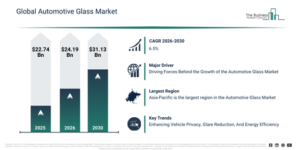
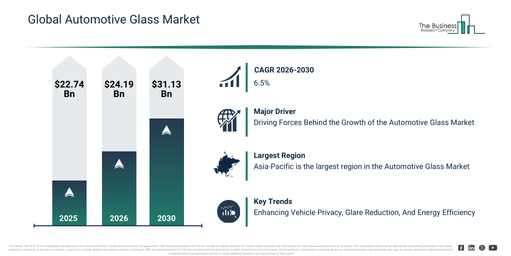
The automotive glass market has experienced significant expansion recently. It will grow from $22.74 billion in 2025 to $24.19 billion in 2026 at a compound annual growth rate (CAGR) of 6.4%. This historical expansion is primarily due to increased production of passenger and commercial vehicles, heightened replacement demand in the aftermarket, a greater embrace of laminated and tempered glass, improvements in automotive safety standards, and the proliferation of luxury and electric vehicle sectors.
The automotive glass market is anticipated to experience significant expansion over the upcoming years. By 2030, its size is projected to reach $31.13 billion, demonstrating a compound annual growth rate (CAGR) of 6.5%. This projected growth during the forecast period can be attributed to several factors, including the increasing adoption of electric and autonomous vehicles, a surge in demand for smart and electrochromic glass, a heightened emphasis on acoustic and UV-protective laminated glass, the integration of lightweight and durable glass solutions, and the expansion of automotive manufacturing in the Asia-Pacific region. Key trends expected during this period involve the increasing use of laminated and tempered glass in automobiles, a growing appetite for panoramic roof and sunroof glass, a greater application of smart and electrochromic glass, the broadening of bulletproof and privacy glass functionalities, and an elevated focus on UV-protective and heated laminated glass.
Get A Free Automotive Glass Market Sample With 2030 Forecast Insights:
Automotive Glass Market Outlook: Key Driver Supporting Long-Term Growth
The increasing demand for passenger and commercial vehicles is anticipated to drive the expansion of the automotive glass market. Passenger vehicles are defined as cars and other forms of transport primarily for conveying people, while commercial vehicles encompass vans, trucks, and buses utilized for business and logistical purposes. The surge in demand for both passenger and commercial vehicles is attributed to economic growth, growing urbanization, and enhanced consumer confidence, which in turn boosts transportation requirements. Automotive glass serves key roles in these vehicles, including providing visibility, safeguarding against external elements, and offering structural reinforcement. Therefore, this escalating demand for passenger and commercial vehicles will propel the automotive glass market.
Segmentation Of The Automotive Glass Market: Key Categories Explained
The automotive glass market covered in this report is segmented –
1) By Product: Tempered Glass, Laminated Glass, Other Products
2) By Vehicles Type: Passenger Vehicles, Light Commercial Vehicles, Heavy Commercial Vehicles, Electric Vehicles
3) By Application: Windshield, Sidelite, Sunroof, Backlite
4) By End-Use: Original Equipment Manufacturer (OEM), Aftermarket
Subsegments:
1) By Tempered Glass: Side Windows Glass, Rear Windows Glass, Door Glass, Sunroofs And Roof Panels, Quarter Windows Glass
2) By Laminated Glass: Windshields (Front And Rear), Acoustic Laminated Glass, UV-Protective Laminated Glass, Heated Laminated Glass
3) By Other Products: Plastic Automotive Glazing (Polycarbonate, Acrylic), Smart Glass (Electrochromic Glass), Head-Up Display (HUD) Glass
Automotive Glass Market Evolving Trends: What Businesses Should Know
Major companies operating in the automotive glass market are concentrating on technological advancements, such as smart glass technologies, to gain a competitive edge. Smart glass technologies are materials designed to adjust transparency, tint, or opacity on demand through methods like electrochromic and photochromic processes, and are utilized in windows and automotive glass to improve privacy, lessen glare, and boost energy efficiency.
Who Competes In The Automotive Glass Market? Major Companies Listed
Major companies operating in the automotive glass market report are Saint-Gobain S.A., Asahi Glass Co Ltd, Nippon Sheet Glass Co. Ltd, Fuyao Glass Industry Group Co. Ltd., Xinyi Glass Holdings Limited, Guardian Industries Corp, Vitro S.A.B. de C.V., Türkiye Şişe ve Cam Fabrikaları, Taiwan Glass Ind Corp., Central Glass Co. Ltd., AGC Automotive, Corning Incorporated, Shenzhen Benson Automobile Glass Co. Ltd., CSG Holding Co. Ltd., SYP Glass Group, Cardinal Glass Industries, PGW Auto Glass, Trakya Cam Sanayii A.S., Sunglass Industry Co. Ltd., Kibing Group
Read The Complete Automotive Glass Market Forecast Report Through 2030:
Automotive Glass Market Regional Ranking: Which Geography Comes First?
Asia-Pacific was the largest region in the automotive glass market in 2025. The regions covered in the automotive glass market are Asia-Pacific, South East Asia, Western Europe, Eastern Europe, North America, South America, Middle East, Africa.
Reach Out To Our Team:
The Business Research Company: https://www.thebusinessresearchcompany.com/
Americas: +1 310-496-7795
Asia: +44 7882 955267 & +91 8897263534
Europe: +44 7882 955267
Email us at: marketing@tbrc.info
Follow us on:
LinkedIn: https://in.linkedin.com/company/the-business-research-company
YouTube: https://www.youtube.com/channel/UC24_fI0rV8cR5DxlCpgmyFQ
Global Market Model: https://www.thebusinessresearchcompany.com/global-market-model

Wasay has over a decade of experience in market research, data modelling, and analytics, with prior experience at GlobalData and Decision Tree Consulting Services. At The Business Research Company , he leads research operations across syndicated studies, customized consulting engagements, and the Global Market Model platform. His professional experience includes supporting organizations such as Boston Consulting Group, KPMG, and Ernst & Young. Wasay holds a degree in Electronics and Communications Engineering, postgraduate management qualifications from International Management Institute Belgium and Indian School of Business and Entrepreneurship, and completed the Integrated Program in Business Analytics from Indian Institute of Management Indore.