With a focus on actionable insights and strategic value, The Business Research Company’s 2026 market reports include market attractiveness scoring, total addressable market sizing, company benchmarking matrices, interactive Excel dashboards, deeper supply chain intelligence, emerging startup tracking, and granular product-level insights.
How Large Could The Metal Working Market Become By 2030 At A 4.6% CAGR?
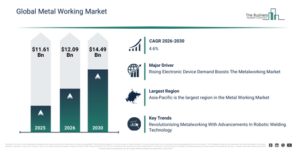
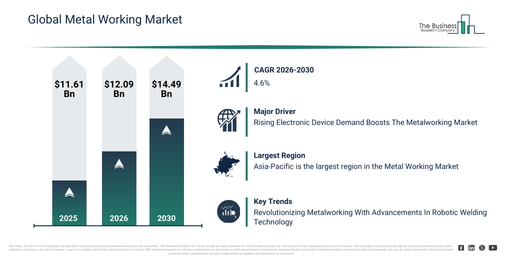
The metal working market has experienced consistent expansion over the last few years. Projected figures indicate its value will increase from $11.61 billion in 2025 to $12.09 billion in 2026, demonstrating a compound annual growth rate (CAGR) of 4.1%. Key factors contributing to this historic growth include the development of oil and gas infrastructure, expanded mining activities, an uptick in industrial and logistics facilities, a surge in building construction projects, and the increased uptake of structural steel fabrication.
The metal working market size is anticipated to experience consistent expansion in the coming years. It is projected to reach $14.49 billion by 2030, exhibiting a compound annual growth rate (CAGR) of 4.6%. This expansion during the forecast period is driven by several factors, including the development of renewable energy infrastructure, a surge in demand for water and utility metalworks, an increase in energy-efficient construction projects, the spread of industrial automation, and the uptake of sophisticated welding and stamping technologies. Key trends foreseen for this period encompass the growing adoption of advanced cutting and forming technologies, greater reliance on automation and robotic systems in metalworking, an increase in custom metal fabrication offerings, the broader application of metalworking in pre-engineered and prefabricated structures, and an emphasis on producing high-precision and intricate metal components.
Get A Free Metal Working Market Sample With 2030 Forecast Insights:
Metal Working Market Outlook: Key Driver Supporting Long-Term Growth
The escalating need for electronic devices is projected to boost the expansion of the metalworking market in the future. Electronic devices encompass a diverse array of gadgets that depend on electronic components for their functionality. Metalworking services are essential in producing consumer electronics, ensuring the manufacture of precise metal parts for items like smartphones and laptops.
Segmentation Of The Metal Working Market: Key Categories Explained
The metal working market covered in this report is segmented –
1) By Type: Cutting, Forming, Welding, Stamping, Punching, Rolling, Other Types
2) By Fabrication: Structural Steel Fabrication, Architectural Aluminum Fabrication, Architectural Steel Fabrication, Pre-Fabricated Buildings, Pre-Engineered Buildings, Other Segments
3) By Application: Oil And Gas, Mining, Energy And Utilities, Water, Industrial And Logistics, Building Construction, Other Applications
Subsegments:
1) By Cutting: Laser Cutting, Plasma Cutting, Waterjet Cutting, Flame Cutting
2) By Forming: Forging, Extrusion, Bending, Drawing
3) By Welding: MIG Welding, TIG Welding, Arc Welding, Spot Welding
4) By Stamping: Progressive Die Stamping, Transfer Die Stamping, Four-Slide Stamping
5) By Punching: CNC Punching, Turret Punching, Mechanical Punching
6) By Rolling: Hot Rolling, Cold Rolling, Thread Rolling
7) By Other Types: Drilling, Grinding, Machining
Metal Working Market Evolving Trends: What Businesses Should Know
Leading companies within the metalworking market are concentrating on the development of robotic welding products, such as robotic welders, to enhance their market position and broaden their product range. Robotic welders automate the welding process in manufacturing environments, thereby boosting precision and efficiency through the use of robotic arms programmed to execute welds on metal components, ultimately resulting in increased productivity and uniform weld quality.
Who Competes In The Metal Working Market? Major Companies Listed
Major companies operating in the metal working market report are BTD Manufacturing Inc., Mayville Engineering Company Inc., O’Neal Manufacturing Services, Ironform Corporation, United Steel Inc., Tenere Inc., Robinson Metal Inc., Morton Industries LLC, Metalcraft of Mayville Inc., Standard Iron & Wire Works Inc., Monti Inc., PMF Industries Inc., Valmont Industries Inc., Komaspect Pte Ltd., Gulf Steel & Engineering, Matcor Matsu Group Inc., BTD Manufacturing Inc., Mayville Engineering Company Inc., United States Steel Fabrication, The Bradbury Co. Inc.
Read The Complete Metal Working Market Forecast Report Through 2030:
Metal Working Market Regional Ranking: Which Geography Comes First?
Asia-Pacific was the largest region in the metal working market in 2025. The regions covered in the metal working market are Asia-Pacific, South East Asia, Western Europe, Eastern Europe, North America, South America, Middle East, Africa.
Reach Out To Our Team:
The Business Research Company: https://www.thebusinessresearchcompany.com/
Americas: +1 310-496-7795
Asia: +44 7882 955267 & +91 8897263534
Europe: +44 7882 955267
Email us at: marketing@tbrc.info
Follow us on:
LinkedIn: https://in.linkedin.com/company/the-business-research-company
YouTube: https://www.youtube.com/channel/UC24_fI0rV8cR5DxlCpgmyFQ
Global Market Model: https://www.thebusinessresearchcompany.com/global-market-model

Wasay has over a decade of experience in market research, data modelling, and analytics, with prior experience at GlobalData and Decision Tree Consulting Services. At The Business Research Company , he leads research operations across syndicated studies, customized consulting engagements, and the Global Market Model platform. His professional experience includes supporting organizations such as Boston Consulting Group, KPMG, and Ernst & Young. Wasay holds a degree in Electronics and Communications Engineering, postgraduate management qualifications from International Management Institute Belgium and Indian School of Business and Entrepreneurship, and completed the Integrated Program in Business Analytics from Indian Institute of Management Indore.