Enhanced with market attractiveness analysis, total addressable market evaluation, company benchmarking matrices, interactive Excel dashboards, expanded supply chain intelligence, emerging startup coverage, and detailed product insights, The Business Research Company’s 2026 market reports deliver more actionable and strategically valuable research.
Non-Dispersive Infrared (NDIR) Market Revenue Outlook: What CAGR Is Expected Through 2030?
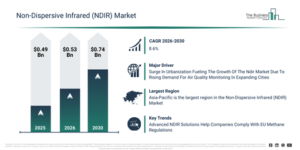
The non-dispersive infrared (ndir) market has seen significant expansion in its size recently. This market is projected to expand from $0.49 billion in 2025 to $0.53 billion in 2026, demonstrating a compound annual growth rate (CAGR) of 8.7%. The historical growth of this market was driven by several factors, including its initial deployment in automotive monitoring, early adoption within the chemical industry, the previous reliance on manual detection methods, an uptick in environmental monitoring, and the broadening of HVAC applications.
The non-dispersive infrared (ndir) market is anticipated to experience robust expansion in the upcoming years, with its size projected to reach $0.74 billion by 2030, demonstrating a compound annual growth rate (CAGR) of 8.6%. This forecasted growth can be attributed to factors such as the increasing utilization of multi-gas sensors, the integration of AI-based analytics, broader application in industrial and manufacturing monitoring, growing adoption within the medical and healthcare sectors, and the ongoing development of portable high-precision detectors. Prominent trends for this period encompass the integration of advanced gas detection modules, the advancement of portable ndir sensors, the implementation of IoT-enabled gas monitoring solutions, the uptake of high-sensitivity infrared sensors, and the expansion of multi-gas detection systems.
Download A Free Sample Report For Comprehensive Market Insights:
Non-Dispersive Infrared (NDIR) Market Growth Drivers: What Factors Are Accelerating Expansion?
The future expansion of the Non-Dispersive Infrared (NDIR) market is anticipated to be propelled by rising urbanization. Urbanization defines the shift of a growing portion of people from rural settings to cities, which fosters the development of urban hubs and infrastructure. This surge in urbanization is fueled by economic prospects, as individuals relocate to urban environments seeking enhanced employment, greater earnings, and superior living conditions, thereby contributing to the enlargement of urban regions. Non-Dispersive Infrared (NDIR) sensors facilitate urbanization by providing precise air quality monitoring in developing cities, assisting in pollution control, and establishing healthier habitats for increasing urban populations. As an illustration, the United Nations Organization, an international entity based in the US, reported in February 2024 that in 2024, roughly 58% of the world’s population lived in urban locales, with forecasts suggesting this figure will climb to 60% by 2030 and potentially exceed 68% by 2050. Consequently, the expanding urbanization actively contributes to the Non-Dispersive Infrared (NDIR) market’s growth.
Non-Dispersive Infrared (NDIR) Market Segment Outlook: Which Categories Are Expanding The Fastest?
The non-dispersive infrared (ndir) market covered in this report is segmented –
1) By Gas Type: Carbon Dioxide, Hydrocarbons, Carbon Monoxide, Other Gas Type
2) By Application: HVAC, Monitoring, Detection And Analysis
3) By End User: Automotive And Transportation, Chemicals, Oil And Gas, Medical, Industrial And Manufacturing, Environmental, Food Processing And Storage, Other End-Users
Subsegments:
1) By Carbon Dioxide (CO2): Low-Concentration CO2 Sensors, High-Concentration CO2 Sensors
2) By Hydrocarbons: Methane (CH4) Sensors, Propane (C3H8) Sensors, Benzene (C6H6) Sensors
3) By Carbon Monoxide (CO): Portable CO Sensors, Fixed CO Sensors
4) By Other Gas Types: Nitrous Oxide (N2O) Sensors, Ammonia (NH3) Sensors, Hydrogen Sulfide (H2S) Sensors
Non-Dispersive Infrared (NDIR) Market Strategic Trends: What Is Defining The Next Phase Of Growth?
Leading companies operating in the non-dispersive infrared (NDIR) market are dedicating their efforts to advanced solutions, such as high-sensitivity detection, to assist industrial firms in meeting new EU regulations on methane emissions, consequently contributing to environmental sustainability and the reduction of greenhouse gases. The heightened sensitivity in detection arises from the capacity of NDIR sensors to accurately measure low concentrations of target gases by identifying specific infrared absorption wavelengths without requiring dispersive elements, thus allowing for precise gas concentration analysis. For instance, in May 2024, ABB Ltd., a Switzerland-based engineering company, introduced OA-ICOS technology, specifically designed to help industrial companies comply with the forthcoming EU Methane Regulation. This technology offers sensitivity more than 1,000 times greater than conventional technologies and identifies leaks 10 times faster than traditional equipment, enabling the precise location, attribution, and quantification of gas leak sources. This innovation is crucial as it empowers industrial companies to identify and prioritize necessary repairs, ensuring compliance with stringent EU regulations on methane emissions and supporting global efforts to reduce greenhouse gases.
Non-Dispersive Infrared (NDIR) Market Key Companies And Competitive Benchmarking
Major companies operating in the non-dispersive infrared (ndir) market are Emerson Electric Co., ABB Group, Honeywell International Inc., Senseair AB, Dynament Ltd., Mipex Technology AB, Gas Sensing Solutions Ltd., S+S Regeltechnik GmbH, Nano Environmental Technology S.r.l., Sensirion AG, Vaisala Corporation, Teledyne API, ELT SENSOR Corp., Axetris AG, Edinburgh Sensors Ltd., Alphasense Ltd., Figaro Engineering Inc., AMETEK Inc., E+E Elektronik GmbH, Winsen Electronics Technology Co. Ltd., Hanwei Electronics Group Corporation, SGX Sensortech (IS) Ltd., Cubic Sensor and Instrument Co. Ltd.
Access The Complete Non-Dispersive Infrared (NDIR) Market Report:
Non-Dispersive Infrared (NDIR) Market Regional Outlook: Where Are The Largest Opportunities Located?
Asia-Pacific was the largest region in the non-dispersive infrared (NDIR) market in 2025. North America was the second-largest region in the non-dispersive infrared (NDIR) market. The regions covered in the non-dispersive infrared (ndir) market report are Asia-Pacific, South East Asia, Western Europe, Eastern Europe, North America, South America, Middle East, Africa.
Get in touch with us:
The Business Research Company: https://www.thebusinessresearchcompany.com/
Americas: +1 310-496-7795
Asia: +44 7882 955267 & +91 8897263534
Europe: +44 7882 955267
Email us at: marketing@tbrc.info
Follow us on:
LinkedIn: https://in.linkedin.com/company/the-business-research-company
YouTube: https://www.youtube.com/channel/UC24_fI0rV8cR5DxlCpgmyFQ
Global Market Model: https://www.thebusinessresearchcompany.com/global-market-model

Wasay has over a decade of experience in market research, data modelling, and analytics, with prior experience at GlobalData and Decision Tree Consulting Services. At The Business Research Company , he leads research operations across syndicated studies, customized consulting engagements, and the Global Market Model platform. His professional experience includes supporting organizations such as Boston Consulting Group, KPMG, and Ernst & Young. Wasay holds a degree in Electronics and Communications Engineering, postgraduate management qualifications from International Management Institute Belgium and Indian School of Business and Entrepreneurship, and completed the Integrated Program in Business Analytics from Indian Institute of Management Indore.