Delivering more actionable and strategically valuable research, The Business Research Company’s 2026 market reports feature market attractiveness analysis, total addressable market evaluation, company benchmarking matrices, interactive Excel dashboards, expanded supply chain intelligence, emerging startup coverage, and detailed product insights.
Indoor Architectural Lighting Market Size, Value And Growth Trends Through 2030
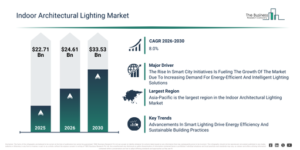
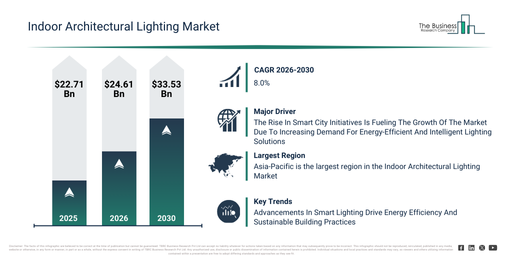
The indoor architectural lighting market has experienced substantial growth in recent years. This market is projected to expand from $22.71 billion in 2025 to $24.61 billion in 2026, at a compound annual growth rate (CAGR) of 8.4%. Historically, this expansion can be ascribed to several factors, including the increasing adoption of LED technology, the growth in residential and commercial construction, heightened awareness of energy-efficient lighting, advancements in lighting design software, and government incentives promoting sustainable buildings.
The indoor architectural lighting market size is anticipated to undergo significant growth in the coming years. It is projected to reach $33.53 billion by 2030, demonstrating a compound annual growth rate (CAGR) of 8.0%. The expansion during this forecast period can be attributed to factors such as the integration of AI into lighting controls, an increase in smart building projects, the adoption of connected lighting solutions, a rising demand for customizable lighting experiences, and the expansion of commercial and hospitality infrastructure. Key trends expected in the forecast period include smart adaptive lighting systems, energy-efficient architectural lighting, connected lighting & iot integration, AI-driven lighting design, and intelligent building lighting management.
Download A Free Sample Report For Comprehensive Market Insights:
Indoor Architectural Lighting Market Opportunity Drivers: What Is Creating New Revenue Potential?
The indoor architectural lighting market is anticipated to expand due to the increasing number of smart city initiatives. These initiatives encompass integrating digital technologies and intelligent infrastructure, aiming to improve urban living in terms of efficiency, sustainability, and quality. The growth of smart cities stems from a global drive for urban modernization, prompting cities to adopt advanced technologies for better resource management and public services. Indoor architectural lighting contributes to smart city objectives through the deployment of energy-efficient LEDs and intelligent sensors, which reduce power consumption. This lighting seamlessly integrates with intelligent systems, allowing adjustments based on occupancy and natural light, thereby fostering sustainable urban environments. As an illustration, in March 2024, AXA Investment Managers, a France-based investment management firm, reported that the global smart cities sector is forecast to achieve a valuation of US$3.7 trillion by 2030. This projection highlights substantial growth potential and robust investment prospects. Consequently, the increasing prevalence of smart city initiatives is a key factor propelling the expansion of the indoor architectural lighting market.
Indoor Architectural Lighting Market Segment Landscape: Which Areas Lead Market Development?
The indoor architectural lighting market covered in this report is segmented –
1) By Product Type: Recessed Lighting, Surface-Mounted Lighting, Suspended Lighting, Track Lighting, Other Product Types
2) By Light Source: Light Emitting Diode (LED), Fluorescent, Incandescent, Other Light Sources
3) By Distribution Channel: Online Stores, Specialty Stores, Supermarkets Or Hypermarkets, Other Distribution Channels
4) By Application: Residential, Commercial, Industrial, Other Applications
Subsegments:
1) By Recessed Lighting: Light Emitting Diode (LED) Downlights, Adjustable Recessed Fixtures, Wall Washers, Fixed Recessed Lights, Shower Trim Lights
2) By Surface-Mounted Lighting: Ceiling-Mounted Fixtures, Wall-Mounted Fixtures, Light Emitting Diode (LED) Downlights Panels, Bulkhead Lights, Cove Lights
3) By Suspended Lighting: Linear Suspended Lights, Pendant Lights, Chandeliers, Ring Lights, Cluster Pendant Systems
4) By Track Lighting: Fixed Track Lights, Flexible Track Lights, Monorail Track Systems, Two-Circuit Track Systems, Track Pendant Lights
5) By Other Types: Spotlights, Accent Lighting, Under-Cabinet Lighting, Picture Lights, Step Lights
Indoor Architectural Lighting Market Transformation Trends: Which Innovations Are Driving Change?
Leading firms within the indoor architectural lighting market are concentrating on creating sophisticated products, notably smart lighting, to boost energy efficiency and aid sustainable construction methods. These smart lighting systems leverage sensors, applications, or voice commands for automated and distant lighting management. They intelligently adjust brightness, color, and operational schedules in response to the environment or user requirements, thereby enhancing both energy conservation and comfort for users. A relevant illustration is Signify, an Indonesia-based supplier of connected LED lighting systems, introducing WiZ in Indonesia during September 2024. This offering includes products that readily integrate with smart home setups and can be controlled through smartphones, voice commands, or dedicated remotes. With this introduction, Signify aims to propel Indonesia’s digital transformation forward and solidify its prominent position in connected lighting solutions. WiZ features smart lighting options providing a wide array of 16 million color selections, encompassing various white tones up to a comprehensive color spectrum. The system highlights its plug-and-play simplicity and intuitive controls, rendering it easily usable for individuals who wish to customize their home environments and atmospheres with ease.
Indoor Architectural Lighting Market Industry Leaders And Market Competition
Major companies operating in the indoor architectural lighting market are Panasonic Corporation, Toshiba Corporation, Eaton Corporation plc, Legrand, Signify N.V., OSRAM Licht AG, Hubbell Incorporated, Acuity Brands Inc., Havells India Ltd., Zumtobel Group AG, Opple Lighting Co. Ltd., Fagerhult, Lutron Electronics Co. Inc., Cree Inc., RAB Lighting Inc., Delta Light, NVC Lighting Technology Corporation, XAL, Current Lighting, ERCO Lighting
Access The Complete Indoor Architectural Lighting Market Report:
Indoor Architectural Lighting Market Leading Geography: Which Region Generates The Most Revenue?
Asia-Pacific was the largest region in the indoor architectural lighting market in 2025. The regions covered in the indoor architectural lighting market report are Asia-Pacific, South East Asia, Western Europe, Eastern Europe, North America, South America, Middle East, Africa.
Get in touch with us:
The Business Research Company: https://www.thebusinessresearchcompany.com/
Americas: +1 310-496-7795
Asia: +44 7882 955267 & +91 8897263534
Europe: +44 7882 955267
Email us at: marketing@tbrc.info
Follow us on:
LinkedIn: https://in.linkedin.com/company/the-business-research-company
YouTube: https://www.youtube.com/channel/UC24_fI0rV8cR5DxlCpgmyFQ
Global Market Model: https://www.thebusinessresearchcompany.com/global-market-model

Wasay has over a decade of experience in market research, data modelling, and analytics, with prior experience at GlobalData and Decision Tree Consulting Services. At The Business Research Company , he leads research operations across syndicated studies, customized consulting engagements, and the Global Market Model platform. His professional experience includes supporting organizations such as Boston Consulting Group, KPMG, and Ernst & Young. Wasay holds a degree in Electronics and Communications Engineering, postgraduate management qualifications from International Management Institute Belgium and Indian School of Business and Entrepreneurship, and completed the Integrated Program in Business Analytics from Indian Institute of Management Indore.