Delivering more actionable and strategically valuable research, The Business Research Company’s 2026 market reports feature market attractiveness analysis, total addressable market evaluation, company benchmarking matrices, interactive Excel dashboards, expanded supply chain intelligence, emerging startup coverage, and detailed product insights.
Solar Shading Systems Market Expected To Reach $19.28 Billion By 2030 At 4.1% CAGR
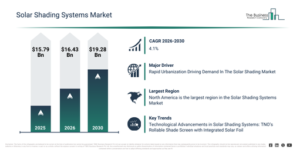
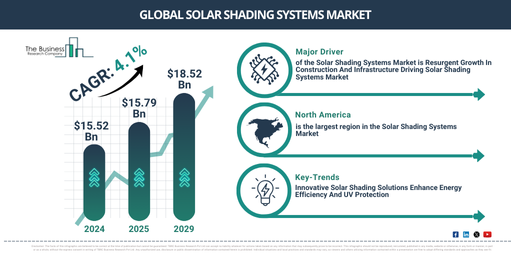
The solar shading systems market has experienced steady expansion in recent years. It is projected to grow from $15.79 billion in 2025 to $16.43 billion in 2026, achieving a compound annual growth rate (CAGR) of 4.0%. The expansion observed in the historic period is attributable to an increase in traditional shading installations, the growth of commercial building construction, the widespread reliance on manual shading mechanisms, the early adoption of architectural louvers, and the development of textile-based shading materials.
The solar shading systems market size is anticipated to experience steady expansion in the coming years. It is forecast to grow to $19.28 billion by 2030, exhibiting a compound annual growth rate (CAGR) of 4.1%. This growth during the forecast period is attributable to the increasing embrace of automated shading systems, a rising demand for sustainable building solutions, the broadening of smart home and commercial automation, the advancement of high-performance shading materials, and a heightened focus on indoor energy efficiency. Prominent trends expected in this period include the adoption of energy-efficient solar shading solutions, the integration of IoT-connected automated shading systems, the expansion of smart building optimization platforms, the development of advanced digital shading controls, and the enhancement of AI-based thermal and lighting regulation systems.
Download A Free Sample Report For Comprehensive Market Insights:
Solar Shading Systems Market Growth Drivers: What Factors Are Accelerating Expansion?
Rapid urbanization is anticipated to fuel the expansion of the solar shading market. Urbanization denotes the process of increasing human concentration in urban locales, specifically cities and towns. These urban environments frequently exhibit higher building density, featuring taller and more closely situated structures. This often leads to elevated solar exposure and heat gain in buildings, making solar shading systems crucial for controlling sunlight and maintaining comfortable internal temperatures. For instance, in April 2023, according to the World Bank, a US-based international financial institution, around 4.4 billion people, or 56% of the world’s population, currently reside in cities. By 2050, roughly 7 out of 10 individuals will inhabit cities, with the urban population projected to more than double its current level. Furthermore, by 2030, the world is expected to have an additional 1.2 million km² of urban built-up area as urban land consumption is forecast to continue growing at a rate up to 50% faster than population growth. This rapid increase in urbanization is consequently expected to generate significant demand for the solar shading market.
Solar Shading Systems Market Segment Performance And Strategic Opportunities
The solar shading systems market covered in this report is segmented –
1) By Product Type: Blinds, Shades, Louvers, Textiles
2) By Material: Metal, Glass, Wood, Other Materials
3) By Technology: Battery Powered, Manual, Smart Power Source
4) By Mechanism: Fixed, Manual, Motorized
5) By Application: Residential, Commercial, Industrial
Subsegments:
1) By Blinds: Horizontal Blinds, Vertical Blinds, Cellular Or Honeycomb Blinds
2) By Shades: Roller Shades, Roman Shades, Pleated Shades
3) By Louvers: Fixed Louvers, Adjustable Louvers, Operable Louvers
4) By Textiles: Sheer Fabrics, Blackout Fabrics, Technical Textiles
Solar Shading Systems Market Trends Driving Strategic Industry Expansion
Key companies operating within the solar shading systems sector are concentrating on technological enhancements, such as radiant heat barrier technology, to sustain their market standing. Radiant heat barrier technology refers to the methodologies and materials designed to diminish the transfer of radiant heat. For instance, in March 2025, TNO, the Netherlands-based research institute, unveiled a rollable shade screen featuring integrated solar foil. This system provides adjustable shading ranging from 0 % to 100 %, incorporates flexible solar-foil panels embedded within the screen for energy generation, and utilizes a ventilated design that facilitates air circulation while simultaneously reducing solar heat gain.
Solar Shading Systems Market Key Players: Which Companies Shape Industry Competition?
Major companies operating in the solar shading systems market are Hunter Douglas, Lutron Electronics, QMotion, Insolroll, Mecho, Draper Inc., Levolor, Gable Screens, Solar Screen, Phifer, Rollac Shutters, ODL, The Shade Store, IKEA, Sunesta, Coolaroo, Sun Control Products, Zebra Blinds, Blinds.com, Graber, Soltis, Eclipse Shading Systems, A. H. Harris, TerraShade, SolarGuard, Aluvision, Awnings by Munch, Screen Innovations
Access The Complete Solar Shading Systems Market Report:
Solar Shading Systems Market Leading Geography: Which Region Generates The Most Revenue?
North America was the largest region in the solar shading systems market share in 2025. The regions covered in the solar shading systems market report are Asia-Pacific, South East Asia, Western Europe, Eastern Europe, North America, South America, Middle East, Africa.
Get in touch with us:
The Business Research Company: https://www.thebusinessresearchcompany.com/
Americas: +1 310-496-7795
Asia: +44 7882 955267 & +91 8897263534
Europe: +44 7882 955267
Email us at: marketing@tbrc.info
Follow us on:
LinkedIn: https://in.linkedin.com/company/the-business-research-company
YouTube: https://www.youtube.com/channel/UC24_fI0rV8cR5DxlCpgmyFQ
Global Market Model: https://www.thebusinessresearchcompany.com/global-market-model

Wasay has over a decade of experience in market research, data modelling, and analytics, with prior experience at GlobalData and Decision Tree Consulting Services. At The Business Research Company , he leads research operations across syndicated studies, customized consulting engagements, and the Global Market Model platform. His professional experience includes supporting organizations such as Boston Consulting Group, KPMG, and Ernst & Young. Wasay holds a degree in Electronics and Communications Engineering, postgraduate management qualifications from International Management Institute Belgium and Indian School of Business and Entrepreneurship, and completed the Integrated Program in Business Analytics from Indian Institute of Management Indore.