Backed by market attractiveness analysis, total addressable market sizing, company benchmarking matrices, interactive Excel dashboards, wider supply chain intelligence, emerging startup coverage, and detailed product-level insights, The Business Research Company’s 2026 market reports are designed to offer research that is more actionable and strategically valuable than ever.
Smart Thermostat Market Revenue Growth On Track For A 20.1% CAGR Through 2030
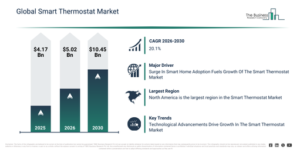
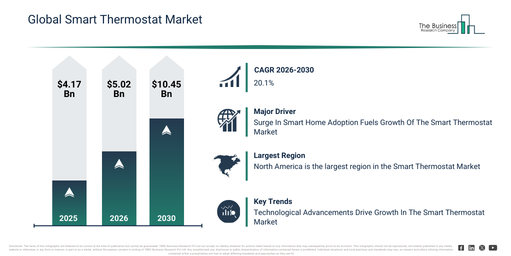
The smart thermostat market has witnessed substantial expansion in recent years. This market is expected to increase from $4.17 billion in 2025 to $5.02 billion in 2026, demonstrating a compound annual growth rate (CAGR) of 20.3%. Historically, this growth was influenced by heightened awareness regarding energy efficiency, the integration of programmable thermostats, a surge in smart home adoption, an increase in residential construction, and the demand for heating solutions that offer cost savings.
The smart thermostat market is projected to experience rapid expansion over the coming years. It will grow to $10.45 billion in 2030 at a compound annual growth rate (CAGR) of 20.1%. This anticipated growth during the forecast period is primarily driven by stringent energy efficiency regulations, the proliferation of connected home ecosystems, an increasing focus on carbon footprint reduction, the adoption of AI-powered learning thermostats, and the expansion of commercial smart buildings. Key trends anticipated during this period encompass adaptive temperature control, occupancy-based climate automation, remote HVAC management, energy usage optimization, and smart scheduling algorithms.
Get A Free Sample Report With In-Depth Market Insights:
Smart Thermostat Market Growth Backed By Core Demand Fundamentals
The smart thermostat market is projected to expand due to the rising embrace of smart homes. Smart home adoption signifies homeowners’ increasing acceptance and integration of smart home technologies and devices, illustrating a readiness among individuals and households to leverage the advantages and ease provided by automated and connected living environments. Smart thermostats, which enable remote management of heating, ventilation, and air conditioning (HVAC) systems through connected and programmable units, are among the most frequently utilized smart home devices. For example, data from Samsung Electronics Co., Ltd., a South Korea-based electronics company, revealed in June 2024 that in 2024, 79% of individuals intending to relocate by renting or buying within the next five years favor smart homes. This trend is further supported by demographic insights, showing 48% of Gen Z actively seeking smart homes, alongside a consistent rise in interest from those aged 65 and above, which points to a growing demand for connected living spaces across different generations. Consequently, the increasing prevalence of smart homes is fueling the expansion of the smart thermostat market.
Smart Thermostat Market Segmentation And Category Overview
The smart thermostat market covered in this report is segmented –
1) By Product: Connected Smart Thermostat, Learning Smart Thermostat, Standalone Smart Thermostat
2) By Technology: Wi-Fi, Bluetooth, Zigbee, Other Technologies
3) By Application: Air Conditioning, Heating, Ventilation
4) By End-User: Residential, Commercial, Industrial, Other End-Users
Subsegments:
1) By Connected Smart Thermostat: Wi-Fi Enabled Thermostats, Zigbee Or Z-Wave Enabled Thermostats
2) By Learning Smart Thermostat: AI-Powered Learning Thermostats, Adaptive Learning Thermostats
3) By Standalone Smart Thermostat: Basic Programmable Thermostats, Digital Non-Programmable Thermostats
Smart Thermostat Market Growth Trends Reshaping The Competitive Landscape
Major companies operating in the smart thermostat market are developing advanced technologies, such as radar sensor technology, to attract larger customer bases, boost sales, and increase revenue. Radar sensor technology is an impressive tool utilized for detecting, locating, and tracking objects through radio waves. For instance, in August 2024, Google, a US-based technology company, introduced the Nest Learning Thermostat 4th Generation. This smart thermostat incorporates Soli radar sensor technology, representing the company’s most sophisticated sensor innovation to date. This technology enhances occupancy detection, motion sensing, and energy optimization by identifying when someone is present in the home. Notably, the 4th-Generation variant is distinguished by its Dynamic Farsight display, which activates when a person approaches, providing simple access to temperature and home status information. The integrated radar sensor functions alongside phone-based geolocation to support the Home and Away feature, automatically adjusting heating or cooling based on occupancy. Additionally, the device is compatible with a wide array of HVAC systems through a redesigned 12-wire backplate, ensuring accurate control and enhanced comfort throughout the living space.
Smart Thermostat Market Competitive Analysis Of Leading Industry Participants
Major companies operating in the smart thermostat market are Bosch Thermotechnology; Siemens AG; Honeywell International Inc.; Schnieder Electric SE; Johnson Controls International plc; Emerson Electric Co.; Trane Technologies plc; Legrand Group; Ingersoll Rand plc; Resideo Technologies Inc.; Lennox International Inc.; Nortek Inc.; Tado GmbH; Centrica Hive Limited; Netatmo SA; Lux Products Corporation; Salus Controls GmbH; Eve Systems GmbH; Nest Labs Inc.; Vine Connected Corporation; Climote Ltd.
View The Full Smart Thermostat Market Report:
Smart Thermostat Market Geographic Landscape: Which Region Leads Industry Growth?
North America was the largest region in the smart thermostat market in 2025. Asia-Pacific is expected to be the fastest-growing region in the smart thermostat market report during the forecast period. The regions covered in the smart thermostat market report are Asia-Pacific, South East Asia, Western Europe, Eastern Europe, North America, South America, Middle East, Africa.
Reach Out To Our Team:
The Business Research Company: https://www.thebusinessresearchcompany.com/
Americas: +1 310-496-7795
Asia: +44 7882 955267 & +91 8897263534
Europe: +44 7882 955267
Email us at: marketing@tbrc.info
Follow us on:
LinkedIn: https://in.linkedin.com/company/the-business-research-company
YouTube: https://www.youtube.com/channel/UC24_fI0rV8cR5DxlCpgmyFQ
Global Market Model: https://www.thebusinessresearchcompany.com/global-market-model

Wasay has over a decade of experience in market research, data modelling, and analytics, with prior experience at GlobalData and Decision Tree Consulting Services. At The Business Research Company , he leads research operations across syndicated studies, customized consulting engagements, and the Global Market Model platform. His professional experience includes supporting organizations such as Boston Consulting Group, KPMG, and Ernst & Young. Wasay holds a degree in Electronics and Communications Engineering, postgraduate management qualifications from International Management Institute Belgium and Indian School of Business and Entrepreneurship, and completed the Integrated Program in Business Analytics from Indian Institute of Management Indore.