
Through market attractiveness analysis, total addressable market evaluation, company benchmarking matrices, interactive Excel dashboards, expanded supply chain intelligence, emerging startup coverage, and detailed product insights, The Business Research Company’s 2026 market reports provide more actionable and strategically valuable research.
Smart Labelling In Logistics Market Revenue Outlook: What CAGR Is Expected Through 2030?
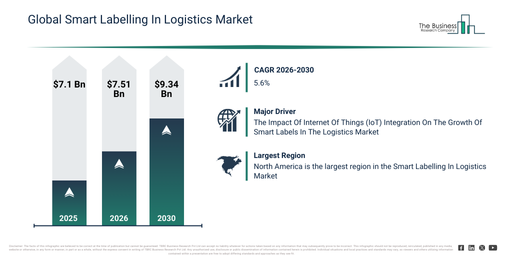
The smart labelling in logistics market has seen significant expansion in recent years. It is anticipated to expand from a value of $7.1 billion in 2025 to $7.51 billion by 2026, achieving a compound annual growth rate (CAGR) of 5.7%. This historical growth can be attributed to factors such as the broadening of global logistics operations, a greater reliance on barcode-based identification, an escalating need for accurate inventory tracking, the increase in cross-border trade, and the implementation of digital logistics solutions.
The smart labelling in logistics market is projected for significant expansion over the coming years. Its valuation is anticipated to reach $9.34 billion by 2030, exhibiting a compound annual growth rate (CAGR) of 5.6%. Key factors driving this growth during the forecast period include greater investments in intelligent supply chain infrastructure, an escalating need for complete shipment visibility, the broadening scope of cold chain monitoring applications, increasing use of NFC-enabled consumer engagement, and a heightened emphasis on traceability and regulatory adherence. Notable trends expected within this period encompass the increased uptake of RFID-based tracking solutions, the expanding implementation of NFC and smart QR labels, the growing incorporation of real-time inventory visibility systems, the wider availability of cloud-based label management platforms, and a stronger commitment to supply chain transparency.
Download A Free Sample Report For Comprehensive Market Insights:
Smart Labelling In Logistics Market Opportunity Drivers: What Is Creating New Revenue Potential?
The escalating adoption of Internet of Things (IoT) integration is anticipated to fuel the expansion of the smart labelling in logistics market in the coming years. IoT integration involves the process of linking and synchronizing Internet of Things (IoT) devices and systems to facilitate uninterrupted data flow and automation. This surge in IoT integration stems from various elements, including technological progress, enhanced connectivity, decreased expenses of IoT devices, and a rising need for intelligent solutions across diverse sectors. Smart labels within logistics bolster IoT integration by delivering real-time information and unbroken connectivity for monitoring, tracing, and overseeing products across the entire supply chain. An illustrative example is from August 2025, where Eurostat, the statistical office of the European Union located in Luxembourg, reported that 70.9% of individuals in the EU utilized internet-connected devices or internet of things (IoT) in 2024, with the Netherlands recording the peak usage at 94.8%. Consequently, the growing prevalence of Internet of Things (IoT) integration will significantly propel the growth of the smart labelling in logistics market.
Smart Labelling In Logistics Market Segmentation And Category Breakdown
The smart labelling in logistics market covered in this report is segmented –
1) By Product: Radio Frequency Identification (RFID) Labels, Near Field Communication (NFC) Labels, Electronic Shelf Labels (ESL), Other Products
2) By Component: Hardware, Software, Services
3) By Deployment Type: Cloud-Based, On-Premises
4) By Company Size: Small And Medium-Sized Enterprises (SMEs), Large Enterprises
5) By Application: Inventory Management, Asset Tracking, Parcel Tracking And Delivery, Cold Chain Monitoring, Other Applications
Subsegments:
1) By Radio Frequency Identification (RFID) Labels: Passive RFID Labels, Active RFID Labels, Semi-Passive RFID Labels, High-Frequency RFID Labels (HF), Ultra-High Frequency RFID Labels (UHF)
2) By Near Field Communication (NFC) Labels: NFC Stickers, NFC Tags, NFC-Enabled Smart Labels, NFC Interactive Labels
3) By Electronic Shelf Labels (ESL): E-Paper ESL, LED-based ESL, Full-Color ESL, Bluetooth Low Energy (BLE)-Enabled ESL
4) By Other Products: Smart QR Code Labels, Smart Barcode Labels, Augmented Reality (AR) Labels, Wireless Temperature Monitoring Labels, Digital Price Tags
Smart Labelling In Logistics Market Innovation Trends Driving Future Development
Leading companies in the smart labels in logistics market are concentrating on developing sophisticated solutions, such as unified visibility platform-based labeling, to enhance supply chain efficiency and accuracy. This type of labeling refers to a system that consolidates and provides comprehensive, real-time tracking and management of goods throughout the supply chain via a single, cohesive interface. For example, in May 2024, Roambee Corporation, a US-based provider of supply chain visibility and intelligence, introduced a 5G global positioning system (GPS) smart label with a peel-and-ship design, measuring 4 inches by 6 inches. This advanced label utilizes 5G technology, GPS, and sensors calibrated by the National Institute of Standards and Technology (NIST) to monitor environmental factors including temperature, humidity, shock, and light, offering exceptional real-time visibility for shipments. It operates much like a barcode, allowing users to effortlessly scan the label for shipment information without requiring complex infrastructure such as printers. The smart label integrates smoothly with Roambee’s unified visibility platform, delivering precise insights into the estimated time of arrival (ETA), shipment quality, and security across the entire supply chain.
Smart Labelling In Logistics Market Competitive Analysis Of Major Industry Participants
Major companies operating in the smart labelling in logistics market are Oracle Corporation, Honeywell International Inc., 3M Company, NXP Semiconductors N.V., Avery Dennison Corporation, Zebra Technologies Corporation, CCL Industries Inc., Toshiba Tec Corporation, Cognex Corporation, Sato Holdings Corporation, Checkpoint Systems Inc., Mimaki Engineering Co. Ltd., Impinj Inc., Identiv Inc., Barcodes Inc., Alien Technology LLC., Roambee Services Private Limited, William Frick & Company, Scanbuy Inc., Thin Film Electronics ASA, SMARTRAC TECHNOLOGY GmbH, KSW Microtec AG, Invengo Information Technology Co. Ltd, TSC Auto ID Technology Co. Ltd.
Access The Complete Smart Labelling In Logistics Market Report:
Smart Labelling In Logistics Market Largest Region By Revenue And Market Share
North America was the largest region in the smart labelling in logistics market in 2025. The regions covered in the smart labelling in logistics market report are Asia-Pacific, South East Asia, Western Europe, Eastern Europe, North America, South America, Middle East, Africa.
Get in touch with us:
The Business Research Company: https://www.thebusinessresearchcompany.com/
Americas: +1 310-496-7795
Asia: +44 7882 955267 & +91 8897263534
Europe: +44 7882 955267
Email us at: marketing@tbrc.info
Follow us on:
LinkedIn: https://in.linkedin.com/company/the-business-research-company
YouTube: https://www.youtube.com/channel/UC24_fI0rV8cR5DxlCpgmyFQ
Global Market Model: https://www.thebusinessresearchcompany.com/global-market-model

Wasay has over a decade of experience in market research, data modelling, and analytics, with prior experience at GlobalData and Decision Tree Consulting Services. At The Business Research Company , he leads research operations across syndicated studies, customized consulting engagements, and the Global Market Model platform. His professional experience includes supporting organizations such as Boston Consulting Group, KPMG, and Ernst & Young. Wasay holds a degree in Electronics and Communications Engineering, postgraduate management qualifications from International Management Institute Belgium and Indian School of Business and Entrepreneurship, and completed the Integrated Program in Business Analytics from Indian Institute of Management Indore.