
Enhanced with market attractiveness analysis, total addressable market evaluation, company benchmarking matrices, interactive Excel dashboards, expanded supply chain intelligence, emerging startup coverage, and detailed product insights, The Business Research Company’s 2026 market reports deliver more actionable and strategically valuable research.
Smart Transportation Market Size Forecast: How Large Could The Market Become By 2030?
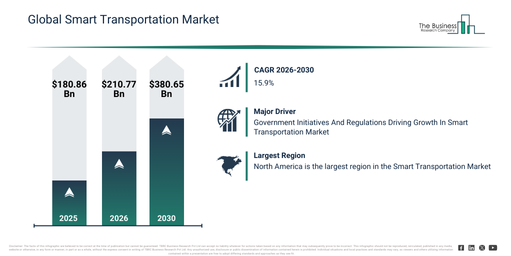
The smart transportation market size has witnessed rapid growth in recent years. It is anticipated to expand from $180.86 billion in 2025 to $210.77 billion in 2026, with a compound annual growth rate (CAGR) of 16.5%. In the past, this expansion was primarily driven by the proliferation of urban infrastructure initiatives, an increase in intelligent transport system deployments, a surge in vehicle ownership rates, the implementation of traffic signal control systems, and the enhanced usage of navigation applications.
The size of the smart transportation market is anticipated to experience substantial expansion over the coming years. This market is projected to reach $380.65 billion by 2030, showing a compound annual growth rate (CAGR) of 15.9%. This projected increase during the forecast period stems from factors such as greater investments in smart city initiatives, a rise in the use of connected and self-driving vehicles, the broadening of integrated mobility platforms, an escalating need for sustainable transport options, and the wider implementation of IoT-enabled transport systems. Key developments anticipated during this timeframe involve the heightened utilization of real-time traffic management solutions, the increased rollout of connected vehicle technologies, the expanding integration of intelligent parking solutions, the broadening of on-demand public transportation, and a stronger emphasis on mobility planning guided by data.
Download A Free Sample Report For Comprehensive Market Insights:
Smart Transportation Market Growth Drivers And Industry Catalysts
The smart transportation market is being driven by a surge in government initiatives and regulations. Governments across both emerging and developing economies are committing to investments in innovative transportation technologies, aiming to mitigate roadway congestion, uphold safe transportation practices, and decrease road accidents. For instance, in October 2023, The UK Government launched its latest round of the Transport Research and Innovation Grant (TRIG) innovation competition, allocating £1.8 million ($2.18 million) in funding. This funding targets companies developing projects focused on airport decarbonization and leveraging AI to enhance transportation affordability and efficiency. As a result, increasing government initiatives and regulations are expected to fuel demand for smart transportation throughout the forecast period.
Smart Transportation Market Segment Analysis And Revenue Opportunities
The smart transportation market covered in this report is segmented –
1) By Product Type: Advanced Traveler Information Systems (ATIC), Advanced Transportation Management Systems (ATMS), Advanced Transportation Pricing Systems (ATPS), Advanced Public Transportation Systems (APTS), Cooperative Vehicle Systems
2) By Transportation Mode: Roadways, Railways, Airways, Maritime
3) By Application: Traffic Management, Road Safety And Security, Parking Management, Public Transport, Automotive Telematics, Freight
Subsegments:
1) By Advanced Traveler Information Systems (ATIS): Real-Time Traffic Information Systems, Route Planning Applications, Mobile Travel Apps, Dynamic Message Signs
2) By Advanced Transportation Management Systems (ATMS): Traffic Signal Control Systems, Incident Management Systems, Traffic Monitoring Systems, Fleet Management Solutions
3) By Advanced Transportation Pricing Systems (ATPS): Congestion Pricing Solutions, Toll Collection Systems, Parking Management Systems, Dynamic Pricing Applications
4) By Advanced Public Transportation Systems (APTS): Smart Bus Systems, Automated Fare Collection Systems, Real-Time Passenger Information Systems, Demand-Responsive Transport Solutions
5) By Cooperative Vehicle Systems: Vehicle-To-Vehicle (V2V) Communication Systems, Vehicle-To-Infrastructure (V2I) Systems, Connected Vehicle Technologies, Automated Driving Systems
Smart Transportation Market Trends Influencing Long-Term Demand
Leading firms within the smart transportation market are concentrating on utilizing connected vehicle and infrastructure technologies, notably vehicle-to-everything (V2X) platforms, to improve traffic flow, increase road safety, and advance connected mobility. These V2X platforms represent connectivity frameworks, allowing vehicles to share data with other vehicles, roadway infrastructure, pedestrians, and various traffic systems through cellular networks and edge computing, which facilitates functionalities like real-time alerts, awareness of infrastructure, and intelligence regarding traffic conditions. As an illustration, in June 2025, Verizon Business, a telecommunications and technology provider based in the US, introduced the Edge Transportation Exchange. This V2X connected-driving platform aims to forge an integrated smart transportation ecosystem by connecting vehicles, infrastructure, pedestrians, and other road users, incorporating 5G and LTE connectivity, low-latency edge computing, and data sharing enabled by geolocation. The Edge Transportation Exchange contributes to better traffic efficiency, enhanced roadway safety, and the scalable implementation of intelligent transportation applications by fostering collaborative innovation among automakers, technology developers, and public agencies.
Smart Transportation Market Leading Players Shaping Industry Direction
Major companies operating in the smart transportation market are Cisco Systems Inc., Toshiba Corporation, Siemens Corporation, SAP SE, Thales Group, Alphabet Inc., Tesla Inc., Uber Technologies Inc., Mobileye, NVIDIA Corporation, Siemens Mobility, TomTom N.V., IBM Corporation, Qualcomm Inc., Intel Corporation, General Motors Company, Ford Smart Mobility, Daimler AG, Bosch Group, Continental AG, Cubic Corporation, Aptiv PLC, Trimble Inc., HERE Technologies, Velodyne Lidar Inc., ChargePoint Inc., NXP Semiconductors, TransCore Holdings Inc., WSP Global Inc.
Access The Complete Smart Transportation Market Report:
Smart Transportation Market Geographic Distribution And Regional Opportunities
North America was the largest region in the smart transportation market in 2025. Asia-Pacific is expected to be the fastest growing region in the forecast period. The regions covered in the smart transportation market report are Asia-Pacific, South East Asia, Western Europe, Eastern Europe, North America, South America, Middle East, Africa.
Get in touch with us:
The Business Research Company: https://www.thebusinessresearchcompany.com/
Americas: +1 310-496-7795
Asia: +44 7882 955267 & +91 8897263534
Europe: +44 7882 955267
Email us at: marketing@tbrc.info
Follow us on:
LinkedIn: https://in.linkedin.com/company/the-business-research-company
YouTube: https://www.youtube.com/channel/UC24_fI0rV8cR5DxlCpgmyFQ
Global Market Model: https://www.thebusinessresearchcompany.com/global-market-model

Wasay has over a decade of experience in market research, data modelling, and analytics, with prior experience at GlobalData and Decision Tree Consulting Services. At The Business Research Company , he leads research operations across syndicated studies, customized consulting engagements, and the Global Market Model platform. His professional experience includes supporting organizations such as Boston Consulting Group, KPMG, and Ernst & Young. Wasay holds a degree in Electronics and Communications Engineering, postgraduate management qualifications from International Management Institute Belgium and Indian School of Business and Entrepreneurship, and completed the Integrated Program in Business Analytics from Indian Institute of Management Indore.