Backed by market attractiveness analysis, total addressable market sizing, company benchmarking matrices, interactive Excel dashboards, wider supply chain intelligence, emerging startup coverage, and detailed product-level insights, The Business Research Company’s 2026 market reports are designed to offer research that is more actionable and strategically valuable than ever.
Radio Telescope Market Forecast: What Value Will The Market Reach By 2030?
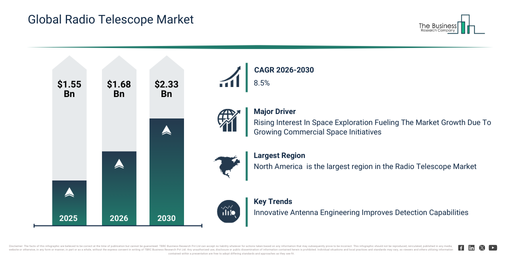
The radio telescope market has experienced robust expansion in recent years. It is projected to increase from $1.55 billion in 2025 to $1.68 billion in 2026, registering a compound annual growth rate (CAGR) of 8.4%. Historically, this growth has been driven by the expansion of astronomical observation programs, the development of single-dish and array telescopes, the adoption of advanced signal processing equipment, government and defense funding for space research, and the growth of satellite tracking and communication support.
The radio telescope market is projected to experience substantial expansion over the upcoming years. By 2030, its value is anticipated to reach $2.33 billion, demonstrating a compound annual growth rate (CAGR) of 8.5%. This growth during the forecast period can be ascribed to several factors, including the implementation of advanced high-sensitivity telescopes, the incorporation of AI-driven data analysis, the proliferation of multi-frequency and interferometric telescope arrays, an increase in educational and research initiatives, and the uptake of cloud-native data handling and processing solutions. Key trends emerging over the forecast horizon encompass sophisticated radio frequency signal processing, the development of highly sensitive low-noise receivers, the increasing use of multi-band and wideband telescopes, the merging of remote observation with automation, and the broadening of astronomy programs focused on education and research.
Get A Free Sample Report With In-Depth Market Insights:
Radio Telescope Market Growth Momentum: What Factors Are Shaping Demand?
An increasing fascination with exploring space is anticipated to drive the expansion of the radio telescope market. This involves examining and researching celestial objects and the cosmos with sophisticated technology and scientific approaches. A key motivator for this rising interest is the quest for extraterrestrial resources like valuable minerals, water, and power sources, vital for sustaining technology, industry, and human habitation in space. Radio telescopes support space exploration by identifying and analyzing radio signals from far-off cosmic entities, enabling researchers to observe phenomena undetectable by optical instruments, chart galaxies, comprehend astrophysical events like pulsars and black holes, and reveal the universe’s fundamental composition and development. As an illustration, in March 2024, the European Space Agency, based in France, reported that Europe’s combined public space budget reached $12.85 billion (€11.9 billion) in 2023, showing a 1% rise compared to 2022, while global institutional space budgets climbed to $113.4 billion (€106 billion) in 2023, an 11% increase. Consequently, the increased focus on space exploration is fueling the expansion of the radio telescope market.
Radio Telescope Market Segments: Where Is Growth Concentrated?
The radio telescope market covered in this report is segmented –
1) By Type: Single Dish Telescopes, Interferometric Telescopes, Radio Holographic Telescopes, Phased Array Telescopes
2) By Component: Antenna Systems, Receivers, Signal Processing Units, Control Systems, Data Storage Solutions
3) By Frequency Range: Low Frequency (30 Mhz – 300 Mhz), Medium Frequency (300 Mhz – 3 Ghz), High Frequency (3 Ghz – 30 Ghz), Very High Frequency (30 Ghz – 300 Ghz)
4) By Application: Astrophysics, Space Exploration, Satellite Communication, Radio Astronomy, Education And Research
5) By End-User: Government Research Organizations, Academic And Research Institutes, Military And Defense Agencies, Private Sector And Commercial Enterprises
Subsegments:
1) By Single Dish Telescopes: Large Single Dish Telescopes, Small Single Dish Telescopes
2) By Interferometric Telescopes: Very Long Baseline Interferometry (VLBI), Connected Element Interferometry, Aperture Synthesis Interferometry
3) By Radio Holographic Telescopes: Near Field Radio Holography, Far Field Radio Holography, Synthetic Aperture Holography
4) By Phased Array Telescopes: Active Phased Array Telescopes, Passive Phased Array Telescopes, Electronically Steered Phased Arrays
Radio Telescope Market Trends Redefining Industry Growth
Leading companies in the radio telescope market are focusing on implementing advanced solutions like sophisticated antenna design to improve sensitivity, precision, and observational range. This advanced antenna design involves creating antennas with cutting-edge technologies and materials to enhance signal reception, accuracy, and efficiency, thereby enabling a radio telescope to achieve higher sensitivity, better accuracy, and the ability to detect faint or distant cosmic signals. For example, in September 2024, the Xinjiang Astronomical Observatory (XAO), a research institution based in China, finalized the antenna track foundation for the QiTai Radio Telescope (QTT), marking a crucial step towards mounting its 110-meter main reflector. This accomplishment demonstrates the observatory’s commitment to employing advanced engineering and antenna design techniques to ensure superior pointing accuracy, sensitivity, and multi-disciplinary observational capabilities across a wide frequency spectrum from 270 MHz to 115 GHz, which will allow astronomers to detect dim and remote cosmic signals, perform precise measurements of celestial events, and support pioneering research in areas such as galaxy formation, star evolution, and molecular cloud investigations.
Radio Telescope Market Key Participants And Competitive Landscape
Major companies operating in the radio telescope market are General Dynamics Corporation, Mitsubishi Electric Corporation, CPI Satcom & Antenna Technologies Inc., MDA Space Ltd., Calian Ltd., SRI International Inc., National Radio Astronomy Observatory, Bushnell Corporation, Celestron LLC, Bresser GmbH, Vixen Co. Ltd., Ranor Inc., Barska, Bosma Machine & Tool Corporation, Takahashi, Sky Watcher, RFOptic Ltd., Lunar Resources Inc., Blue Skies Space Ltd., Telescope Engineering Company
View The Full Radio Telescope Market Report:
Radio Telescope Market Regional Split: Which Areas Are Fueling Growth?
North America was the largest region in the radio telescope market in 2025. Asia-Pacific is expected to be the fastest-growing region in the forecast period. The regions covered in the radio telescope market report are Asia-Pacific, South East Asia, Western Europe, Eastern Europe, North America, South America, Middle East, Africa.
Reach Out To Our Team:
The Business Research Company: https://www.thebusinessresearchcompany.com/
Americas: +1 310-496-7795
Asia: +44 7882 955267 & +91 8897263534
Europe: +44 7882 955267
Email us at: marketing@tbrc.info
Follow us on:
LinkedIn: https://in.linkedin.com/company/the-business-research-company
YouTube: https://www.youtube.com/channel/UC24_fI0rV8cR5DxlCpgmyFQ
Global Market Model: https://www.thebusinessresearchcompany.com/global-market-model

Wasay has over a decade of experience in market research, data modelling, and analytics, with prior experience at GlobalData and Decision Tree Consulting Services. At The Business Research Company , he leads research operations across syndicated studies, customized consulting engagements, and the Global Market Model platform. His professional experience includes supporting organizations such as Boston Consulting Group, KPMG, and Ernst & Young. Wasay holds a degree in Electronics and Communications Engineering, postgraduate management qualifications from International Management Institute Belgium and Indian School of Business and Entrepreneurship, and completed the Integrated Program in Business Analytics from Indian Institute of Management Indore.