Featuring market attractiveness scoring, total addressable market sizing, company benchmarking matrices, interactive Excel dashboards, deeper supply chain intelligence, emerging startup tracking, and granular product-level insights, The Business Research Company’s 2026 market reports are built to deliver research that is both more actionable and more strategically valuable.
Radio Frequency Energy Weapon Market Size Outlook: How Quickly Will Revenue Expand Through 2030?
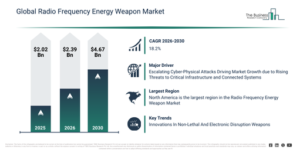
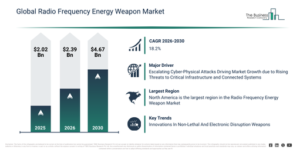
The radio frequency energy weapon market has experienced swift expansion in recent years. This market is projected to increase from $2.02 billion in 2025 to $2.39 billion in 2026, demonstrating a compound annual growth rate (CAGR) of 18.5%. Historically, this growth was fueled by factors such as the creation of directed energy weapon prototypes, military funding for non-lethal disabling technologies, progress in RF amplifier and antenna technology, rising defense R&D spending for electronic warfare, and the initial deployment of counter-drone systems.
The radio frequency energy weapon market is projected for significant expansion in the coming years, reaching $4.67 billion by 2030 with a compound annual growth rate (CAGR) of 18.2%. This growth is primarily driven by the increasing demand for anti-drone and cyber-physical attack solutions, their integration into autonomous and unmanned defense systems, expanded application for vehicle immobilization, advancements in targeting sensors and pulse modulators, and deployment in border and maritime security. Major trends expected include the growing adoption of high-power microwave systems for counter-drone and counter-swarm defense, miniaturization and SWaP (size, weight, and power) optimization of RF energy weapon platforms, greater integration into layered air-defense and electronic warfare architectures, rising demand for non-lethal RF-based crowd-control and area-denial solutions, and a transition from prototype demonstrators to fielded, export-ready RF energy weapon systems.
Get A Free Sample Report With In-Depth Market Insights:
Radio Frequency Energy Weapon Market Expansion Drivers: What’s Shaping Future Growth?
The radio frequency energy weapon market is anticipated to expand due to the growing complexity of cyber-physical attacks (CPA). Cyber-physical attacks (CPA) are defined as malevolent acts where digital assaults target physical systems, leading to interference with or harm to real-world equipment, infrastructure, or operational processes. The proliferation of cyber-physical attacks (CPA) stems from the heightened internet connectivity of physical systems. This connectivity broadens the potential attack surface and renders vital infrastructure vulnerable to distant cyber threats, thereby simplifying the process for adversaries to exploit weaknesses, interrupt operations, or inflict material damage. Radio frequency energy weapons facilitate cyber-physical attacks (CPA) through the emission of electromagnetic interference, which subsequently interferes with or harms electronic systems, thus making physical infrastructure susceptible to cyber weaknesses. An illustrative example, as reported by the US-based government agency, the Cyber Threat Intelligence Integration Center (CTIIC), in February 2024, indicates that globally, the healthcare sector recorded 214 ransomware attack victims in 2022. Furthermore, within the United States, these attacks escalated more considerably, showing a 128% increase from 113 victims in 2022 to 258 in 2023. This pattern highlights the intensifying cyber threats directed at healthcare systems across the globe. Consequently, the escalating complexity of cyber-physical attacks (CPA) is propelling the expansion of the radio frequency energy weapon market.
Radio Frequency Energy Weapon Market Segment Analysis: What Are The Core Market Categories?
The radio frequency energy weapon market covered in this report is segmented –
1) By Product Type: Directed Energy Weapons, Non-Lethal Weapons, Counter-Drone Systems, Other Product Types
2) By Technology: High Power Microwave, Ultra-Wideband, Other Technologies
3) By Platform: Land-Based, Airborne, Naval, Portable
4) By Application: Military, Homeland Security, Law Enforcement, Other Applications
5) By End-User: Defense, Commercial, Other End-Users
Subsegments:
1) By Directed Energy Weapons (DEWs): High-Power Microwave (HPM) Weapons, Electromagnetic Weapons (EMW)
2) By Non-Lethal Weapons (NLWs): Active Denial Systems (ADS), Stun Devices (SD), Radio Frequency Crowd Control Systems (RFCCS), Incapacitating Devices (ID)
3) By Counter-Drone Systems (CDS): Radio Frequency Jammers (RFJ), Global Positioning System Spoofers (GPS Spoofers), Laser-Based Anti-Drone Systems (LBADS), Drone Detection Systems (DDS)
4) By Other Products (OP): Radio Frequency Sensors (RFS), Communication Disruption Devices (CDD), Electronic Warfare Tools (EWT), Miscellaneous Radio Frequency Equipment (MRFE)
Radio Frequency Energy Weapon Market Strategic Trends: What Defines The Next Growth Phase?
Leading companies within the radio frequency energy weapon market are concentrating on leveraging advanced technologies, such as active electronically scanned arrays (AESA), to improve precision, range, and overall targeting effectiveness. Active electronically scanned arrays (AESA) are sophisticated radar systems that employ electronically controlled antennas to direct radio waves without any moving parts, thereby contributing to enhanced speed, accuracy, the ability to track multiple targets, and resistance to jamming. For instance, in February 2025, Tonbo Imaging India Private Limited, an India-based defense technology firm, unveiled a high-power microwave (HPM) directed energy weapon (DEW) system. This system aims to disable or disrupt hostile electronic systems, bolster perimeter security, and provide non-kinetic defensive capabilities for military and critical infrastructure applications. Tonbo Imaging’s microwave-based directed energy weapon (DEW) offers precise, non-kinetic targeting to neutralize electronic threats without causing permanent damage. It delivers high-power microwave pulses capable of disrupting several devices simultaneously, thereby enhancing area denial and perimeter security.
Radio Frequency Energy Weapon Market Top Companies Driving Competitive Growth
Major companies operating in the radio frequency energy weapon market are RTX Corporation, Lockheed Martin Corporation, BAE Systems plc, Thales S.A., L3Harris Technologies Inc., Leonardo S.p.A., Elbit Systems Ltd., Israel Aerospace Industries Ltd., Rafael Advanced Defense Systems Ltd., MBDA Limited, Bharat Electronics Limited, QinetiQ Group plc, Kratos Defense & Security Solutions Inc., Anduril Industries Inc., Teledyne e2v Ltd., Radiance Technologies Inc., HORIBA MIRA Ltd., Tonbo Imaging India Private Limited, Epirus Inc., Paras Defence and Space Technologies Private Limited
View The Full Radio Frequency Energy Weapon Market Report:
Radio Frequency Energy Weapon Market Top Region: Where Does Most Revenue Come From?
North America was the largest region in the radio frequency energy weapon market in 2025. Asia-Pacific is expected to be the fastest-growing region in the forecast period. The regions covered in the radio frequency energy weapon market report are Asia-Pacific, South East Asia, Western Europe, Eastern Europe, North America, South America, Middle East, Africa.
Reach Out To Our Team:
The Business Research Company: https://www.thebusinessresearchcompany.com/
Americas: +1 310-496-7795
Asia: +44 7882 955267 & +91 8897263534
Europe: +44 7882 955267
Email us at: marketing@tbrc.info
Follow us on:
LinkedIn: https://in.linkedin.com/company/the-business-research-company
YouTube: https://www.youtube.com/channel/UC24_fI0rV8cR5DxlCpgmyFQ
Global Market Model: https://www.thebusinessresearchcompany.com/global-market-model

Wasay has over a decade of experience in market research, data modelling, and analytics, with prior experience at GlobalData and Decision Tree Consulting Services. At The Business Research Company , he leads research operations across syndicated studies, customized consulting engagements, and the Global Market Model platform. His professional experience includes supporting organizations such as Boston Consulting Group, KPMG, and Ernst & Young. Wasay holds a degree in Electronics and Communications Engineering, postgraduate management qualifications from International Management Institute Belgium and Indian School of Business and Entrepreneurship, and completed the Integrated Program in Business Analytics from Indian Institute of Management Indore.