Backed by market attractiveness analysis, total addressable market sizing, company benchmarking matrices, interactive Excel dashboards, wider supply chain intelligence, emerging startup coverage, and detailed product-level insights, The Business Research Company’s 2026 market reports are designed to offer research that is more actionable and strategically valuable than ever.
Rocket Propulsion Market Value Analysis: What Growth Lies Ahead Over The Forecast Period?
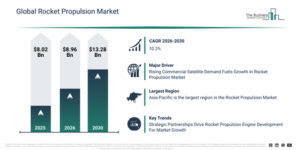
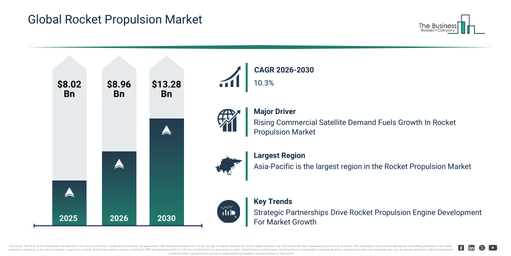
Significant expansion has been observed in the rocket propulsion market size over the past few years. It is projected to increase from $8.02 billion in 2025 to $8.96 billion in 2026, demonstrating a compound annual growth rate (CAGR) of 11.8%. The historic growth can be ascribed to the increasing deployment of cryogenic propulsion systems for heavy-lift launch missions, improvements in solid and liquid propellant formulations that boost thrust performance, the widening scope of commercial and government satellite launch programs, the initial development and testing of electric propulsion technologies for spacecraft, and greater investment in nuclear propulsion research for deep-space exploration.
The rocket propulsion market size is anticipated to undergo significant expansion in the next few years, projected to reach $13.28 billion in 2030 with a compound annual growth rate (CAGR) of 10.3%. This growth during the forecast period is fueled by an increasing need for high-efficiency propulsion solutions to support extended space missions, the expanding commercialization of low-earth-orbit operations which necessitates frequent launches, ongoing advancements in electric propulsion scalability for larger spacecraft platforms, the development of next-generation cryogenic engines designed for improved fuel efficiency, and the broadening initiatives from both government and private sectors to hasten the maturation of nuclear thermal and nuclear electric propulsion. Major trends expected in this period include sophisticated cryogenic propulsion technologies, the advancement of nuclear thermal propulsion, highly efficient electric propulsion systems, optimization of multi-stage hybrid propellants, and innovations in thrust vectoring and propulsion control.
Get A Free Sample Report With In-Depth Market Insights:
Rocket Propulsion Market Growth Momentum: What Factors Are Shaping Demand?
The anticipated rise in commercial satellites is set to boost the rocket propulsion market’s expansion. Commercial satellites are space-bound devices orbiting Earth, primarily for data gathering or radio communication purposes. These satellites rely on rocket propulsion systems for their launch into space, as these systems supply the necessary thrust to achieve orbit and maintain their designated position. For instance, in June 2024, SpaceNews, a US-based non-governmental organization, reported that in 2023, approximately 85% of commercially procured satellites were attributed to U.S. manufacturers. Satellite manufacturing revenue saw a 9% increase, reaching $17.2 billion, fueled by innovations like flexible software-defined payloads and advanced small satellites. A record 190 commercially procured launches occurred, an 18% rise from 2022. These deployments involved 2,781 commercial satellites, marking a 20% year-over-year increase, predominantly driven by SpaceX. Consequently, the increasing number of commercial satellites is a key factor in the growth of the rocket propulsion market.
Rocket Propulsion Market Segment Performance And Emerging Opportunities
The rocket propulsion market covered in this report is segmented –
1) By Propulsion Type: Solid, Liquid, Hybrid
2) By Orbit Type: LEO, MEO, GEO, Beyond GEO
3) By Launch Vehicle Type: Manned, Unmanned
4) By End User Type: Civil and Commercial, Military
Subsegments:
1) By Solid: Single-Stage Solid Propellant, Multi-Stage Solid Propellant
2) By Liquid: Bipropellant, Monopropellant
3) By Hybrid: Solid Fuel with Liquid Oxidizer, Liquid Fuel with Solid Oxidizer
Rocket Propulsion Market Trends Redefining Industry Growth
Leading companies in the rocket propulsion market are increasingly concentrating on forming strategic partnerships to develop rocket propulsion engines, aiming to maximize their revenue within the market. These collaborations seek to utilize the specialized knowledge and resources of various organizations to accelerate the development of rocket propulsion engines and reduce overall costs. For instance, in May 2023, Ursa Major, a US-based rocket propulsion company, announced a contract with the Air Force Research Laboratory (AFRL), a US-based aerospace and defense company, to advance U.S. hypersonics defense programs and space launch capabilities. According to the agreement, Ursa Major will proceed with developing its 200,000-pound thrust Arroway engine for space launch and constructing and testing a prototype of its new Draper engine for hypersonic travel. The Draper engine is a closed-cycle hydrogen peroxide engine with 4,000 pounds of thrust designed for hypersonic applications. Arroway is a reusable liquid oxygen and methane-staged combustion engine intended for medium and heavy launch vehicles. Ursa Major remains a critical partner as AFRL enhances its hypersonic capabilities and reduces America’s reliance on foreign propulsion systems for launch.
Rocket Propulsion Market Key Players: Which Companies Lead Industry Competition?
Major companies operating in the rocket propulsion market are Aerojet Rocketdyne Holdings Inc., Mitsubishi Heavy Industries Ltd., Space Exploration Technologies Corp., Safran S.A., Blue Origin LLC, Northrop Grumman Innovation Systems Inc., Virgin Galactic Holdings Inc., Rocket Lab USA Inc., United Launch Alliance LLC, Boeing Space Launch System, Lockheed Martin Space Systems Company, Reaction Engines Ltd., Firefly Aerospace Inc., Sierra Nevada Corporation, ExPace Technology Co. Ltd., Relativity Space Inc., Arianespace SA, IHI Corporation, Skyrora Ltd., Masten Space Systems Inc., Gilmour Space Technologies Pty Ltd., ArianeGroup GmbH, Terran Orbital Corporation, PLD Space S.L., Dauria Aerospace, Raptor Aerospace Inc., Axiom Space Inc., CubeCab Services Private Limited, Stratolaunch Systems Corporation
View The Full Rocket Propulsion Market Report:
Rocket Propulsion Market Regional Analysis: Which Geography Leads On Revenue?
Asia-Pacific was the largest region in the rocket propulsion market in 2025, and it is also expected to be the fastest-growing region in the forecast period. The regions covered in the rocket propulsion market report are Asia-Pacific, South East Asia, Western Europe, Eastern Europe, North America, South America, Middle East, Africa.
Reach Out To Our Team:
The Business Research Company: https://www.thebusinessresearchcompany.com/
Americas: +1 310-496-7795
Asia: +44 7882 955267 & +91 8897263534
Europe: +44 7882 955267
Email us at: marketing@tbrc.info
Follow us on:
LinkedIn: https://in.linkedin.com/company/the-business-research-company
YouTube: https://www.youtube.com/channel/UC24_fI0rV8cR5DxlCpgmyFQ
Global Market Model: https://www.thebusinessresearchcompany.com/global-market-model

Wasay has over a decade of experience in market research, data modelling, and analytics, with prior experience at GlobalData and Decision Tree Consulting Services. At The Business Research Company , he leads research operations across syndicated studies, customized consulting engagements, and the Global Market Model platform. His professional experience includes supporting organizations such as Boston Consulting Group, KPMG, and Ernst & Young. Wasay holds a degree in Electronics and Communications Engineering, postgraduate management qualifications from International Management Institute Belgium and Indian School of Business and Entrepreneurship, and completed the Integrated Program in Business Analytics from Indian Institute of Management Indore.