Built to provide research that’s more actionable and strategically valuable, The Business Research Company’s 2026 market reports include market attractiveness analysis, total addressable market sizing, company benchmarking matrices, interactive Excel dashboards, broader supply chain intelligence, emerging startup tracking, and in-depth product insights.
High-Speed Rocket Systems Market Expansion Outlook: What Revenue Opportunities Are Ahead?
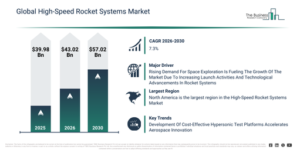
The high-speed rocket systems market has experienced robust expansion recently. Projections indicate it will increase from $39.98 billion in 2025 to $43.02 billion by 2026, demonstrating a compound annual growth rate (CAGR) of 7.6%. This historical growth is attributable to several factors, including the escalating development of ballistic and cruise missile programs aimed at improving long-range strike capabilities, the increased deployment of interceptor missiles supporting initial missile-defense frameworks, the augmented production of tactical rockets for swift military responses, innovations in propulsion and heat-resistant materials that facilitate prolonged high-speed flight, and the expansion of space launch vehicle initiatives which fuel demand for high-performance rocket systems.
The high-speed rocket systems market is projected to witness significant growth in the upcoming years, expanding to $57.02 billion by 2030, demonstrating a compound annual growth rate (CAGR) of 7.3%. This anticipated growth is driven by increasing investment in hypersonic weapons fostering next-generation rocket system development, a rising demand for sophisticated interceptor missiles to counteract high-speed and agile threats, the expansion of military modernization programs leading to greater procurement of high-velocity tactical rockets, the increasing utilization of reusable and cost-efficient launch vehicles boosting space-access applications, and the advancement of integrated guidance and control technologies enhancing precision at extreme speeds. Major developments anticipated during this forecast period include innovations in advanced hypersonic propulsion, increased adoption of thermal protection and heat-resistant composite materials, the integration of multi-domain launch capabilities for defense and space, a rise in reusable high-speed launch vehicle development, and the expansion of rapid-response missile and space deployment programs.
Get A Free Sample Report With In-Depth Market Insights:
High-Speed Rocket Systems Market Development Factors: What’s Supporting Demand?
The increasing need for space exploration is projected to boost the expansion of the high-speed rocket systems market in the future. This field encompasses both human-crewed and automated missions aimed at researching outer space, thereby fostering scientific knowledge and technological progress. Space exploration activity is on the upswing, fueled by expanding private sector investments that spark innovation and reduce expenses, particularly in areas like space tourism and satellite services. High-speed rocket systems are crucial as they enable rapid and effective payload deployment into space, which is vital for both launching satellites and conducting crewed missions. Their robust propulsion significantly cuts down travel durations and enhances the dependability of endeavors in space exploration. As an illustration, in March 2024, data from the Global Change Data Lab, a UK-based non-profit research organization, revealed that 2,664 objects were sent into space, surpassing the total from the preceding year. Consequently, the growing demand for space exploration is a significant factor driving the growth of the high-speed rocket systems market.
High-Speed Rocket Systems Market Segment Performance And Emerging Opportunities
The high-speed rocket systems market covered in this report is segmented –
1) By Type: Surface-To-Surface, Surface-To-Air, Air-To-Surface, Air-To-Air
2) By Component: Propulsion System, Guidance System, Control System, Warhead
3) By Range: Short Range, Medium Range, Long Range
4) By Application: Military, Space Exploration, Commercial
Subsegments:
1) By Surface-To-Surface: Tactical Ballistic Missiles, Cruise Missiles, Intercontinental Ballistic Missiles (ICBMs), Short-Range Ballistic Missiles (SRBMs)
2) By Surface-To-Air: Short-Range Surface-To-Air Missiles (SAMs), Medium-Range Surface-To-Air Missiles, Long-Range Surface-To-Air Missiles, Mobile Air Defense Systems
3) By Air-To-Surface: Air-Launched Cruise Missiles, Anti-Radiation Missiles, Air-To-Surface Tactical Missiles, Anti-Ship Missiles
4) By Air-To-Air: Short-Range Air-To-Air Missiles, Medium-Range Air-To-Air Missiles, Long-Range Air-To-Air Missiles, Infrared Homing Missiles
High-Speed Rocket Systems Market Transformation Trends: What Innovations Are Driving Change?
Key players in the high-speed rocket systems market are dedicating efforts to developing advanced solutions, including hypersonic test platforms, to accelerate the research and validation of future aerospace technologies. Hypersonic test platforms are sophisticated systems engineered to assess and confirm the functionality of vehicles or components operating at speeds greater than Mach 5. They simulate the extreme aerodynamic forces, heat, and structural stress experienced during hypersonic travel. For instance, in June 2025, UP Aerospace, a US-based aerospace engineering company and space launch provider, successfully conducted the initial flight of its Spyder hypersonic rocket. The Spyder rocket is built for high-speed suborbital missions, supporting both hypersonic research and technology demonstrations. This launch represents a significant milestone in establishing cost-effective, rapidly deployable platforms for testing hypersonic systems. This capability grants access to near-space environments at hypersonic velocities and supports the advancement of next-generation aerospace technologies, encompassing materials testing, aerodynamic validation, and sensor calibration.
High-Speed Rocket Systems Market Key Players: Which Companies Lead Industry Competition?
Major companies operating in the high-speed rocket systems market are Lockheed Martin Corporation, Raytheon Technologies Corporation, The Boeing Company, General Dynamics Corporation, Northrop Grumman Corporation, China Aerospace Science and Industry Corporation (CASIC), Mitsubishi Heavy Industries Ltd., BAE Systems plc, Thales Group, L3Harris Technologies Inc., Rheinmetall AG, Elbit Systems Ltd., Hanwha Aerospace, MBDA Inc., Saab AB, Rafael Advanced Defense Systems Ltd., Kongsberg Gruppen, Arianegroup, Defence Research & Development Organisation, Karman Space & Defense
View The Full High-Speed Rocket Systems Market Report:
High-Speed Rocket Systems Market Regional Breakdown: Where Is Demand Concentrated?
North America was the largest region in the high-speed rocket systems market in 2025. The regions covered in the high-speed rocket systems market report are Asia-Pacific, South East Asia, Western Europe, Eastern Europe, North America, South America, Middle East, Africa.
Reach Out To Our Team:
The Business Research Company: https://www.thebusinessresearchcompany.com/
Americas: +1 310-496-7795
Asia: +44 7882 955267 & +91 8897263534
Europe: +44 7882 955267
Email us at: marketing@tbrc.info
Follow us on:
LinkedIn: https://in.linkedin.com/company/the-business-research-company
YouTube: https://www.youtube.com/channel/UC24_fI0rV8cR5DxlCpgmyFQ
Global Market Model: https://www.thebusinessresearchcompany.com/global-market-model

Wasay has over a decade of experience in market research, data modelling, and analytics, with prior experience at GlobalData and Decision Tree Consulting Services. At The Business Research Company , he leads research operations across syndicated studies, customized consulting engagements, and the Global Market Model platform. His professional experience includes supporting organizations such as Boston Consulting Group, KPMG, and Ernst & Young. Wasay holds a degree in Electronics and Communications Engineering, postgraduate management qualifications from International Management Institute Belgium and Indian School of Business and Entrepreneurship, and completed the Integrated Program in Business Analytics from Indian Institute of Management Indore.