Featuring market attractiveness scoring, total addressable market sizing, company benchmarking matrices, interactive Excel dashboards, deeper supply chain intelligence, emerging startup tracking, and granular product-level insights, The Business Research Company’s 2026 market reports are built to deliver research that is both more actionable and more strategically valuable.
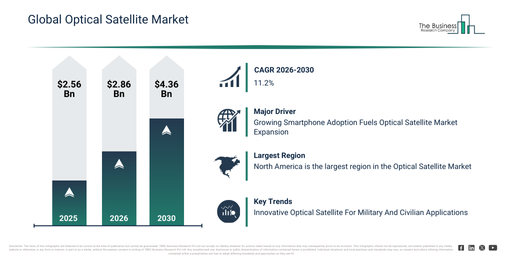
Optical Satellite Market Revenue Growth On Track For A 11.2% CAGR Through 2030
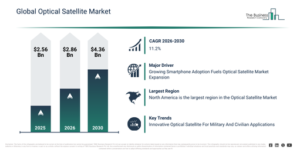
The optical satellite market has expanded considerably in recent years. It is anticipated to increase from $2.56 billion in 2025 to $2.86 billion in 2026, demonstrating a compound annual growth rate (CAGR) of 11.4%. This historical growth can be linked to a heightened demand for earth observation and land-use monitoring, progress in high-resolution optical sensor technology, the growing deployment of optical satellites for disaster and environmental management, investments from government and defense sectors in optical imaging, and the expansion of agricultural monitoring facilitated by satellite imagery.
The optical satellite market is predicted to undergo substantial expansion over the next few years, reaching $4.36 billion by 2030, with a compound annual growth rate (CAGR) of 11.2%. This expected growth can be attributed to several factors, including the proliferation of multi-sensor and constellation optical satellite networks, the incorporation of AI and machine learning for image processing and analytics, an increasing commercial demand for high-resolution earth observation data, the emergence of cost-effective small and medium optical satellites, and the expanded utilization of optical satellites for climate change monitoring and sustainable resource management. Throughout this forecast period, significant trends will involve the adoption of high-resolution imaging, the integration of multi-sensor satellites, the deployment of constellation satellites, real-time disaster monitoring, and the broadening of agricultural and environmental monitoring efforts.
Get A Free Sample Report With In-Depth Market Insights:
Optical Satellite Market Growth Factors: What’s Supporting Expansion?
The rising number of smartphone users is projected to boost the growth of the optical satellite market moving forward. A smartphone user is an individual who owns and operates a smartphone, a mobile device that combines a computer’s functionalities with the convenience of a mobile phone. Smartphone users utilize optical satellite data to enhance their experiences, fulfill specific requirements, and provide valuable information for navigation, exploration, emergency preparedness, environmental awareness, agriculture, urban planning, research, and education. For example, in February 2024, as per Uswitch Limited, a UK-based financial conduct authority, the UK had 84.3 million active mobile subscriptions by the end of 2023, representing an increase of over 3% compared to 2022. Hence, the increasing count of smartphone users is propelling the expansion of the optical satellite market.
Optical Satellite Market Segment Analysis: What Are The Core Market Categories?
The optical satellite market covered in this report is segmented –
1) By Component: Imaging And Sensing Systems, Optical Communication Systems
2) By Size: Small, Medium, Large
3) By Application: Earth Observation, Communication
4) By End User: Commercial, Government, Defense
Subsegments:
1) By Imaging And Sensing Systems: Earth Observation Cameras, Remote Sensing Sensors, Multispectral And Hyperspectral Sensors, Infrared Sensors
2) By Optical Communication Systems: Optical Transmitters, Optical Receivers, Fiber Optic Cables, Ground Stations And Terminals
Optical Satellite Market Industry Trends: What’s Reshaping Demand?
Major companies operating in the optical satellite industry market are concentrating on developing innovative technologies, including the Long March 5 Rocket and Optical Remote Sensing Technology, to enhance satellite imaging and data collection capabilities. The Long March 5 Rocket is a heavy-lift launch vehicle designed to carry large payloads, such as satellites, into various orbits, with a capacity of up to 14,000 kg to the Geostationary Transfer Orbit (GTO). Optical Remote Sensing Technology involves utilizing satellite technology to capture images of the Earth’s surface for diverse applications, such as military reconnaissance and environmental monitoring. For instance, in December 2023, China Aerospace Science and Technology Corporation (CASC), a China-based aerospace technology company, launched the Yaogan-41 optical satellite. This launch was intended to enhance China’s remote sensing capabilities, with implications for both military and civilian applications. The primary aim of this deployment is to improve land survey, crop yield estimation, environmental management, meteorological warning and forecasting, and comprehensive disaster prevention and reduction.
Optical Satellite Market Top Companies Driving Competitive Growth
Major companies operating in the optical satellite market are Raytheon Technologies Corporation, Lockheed Martin Corporation, Mitsubishi Electric Corporation, Northrop Grumman Corporation, Honeywell International Inc., NEC Corporation, Boeing Company, Safran SA, Thales Group, L3 Harris Corporation, Ball Aerospace & Technologies Corp., Leonardo S.p.A., Maxar Technologies Holdings Inc., Orbital Sciences Corporation, OHB SE, Tesat-Space GmbH & Co. KG, Surrey Satellite Technology, Planet Labs Inc., Sitael S.p.A., Analytical Space Inc., Hisdesat Servicios Estrategicos S.A., Mynaric AG, Airbus Defence and Space Company
View The Full Optical Satellite Market Report:
Optical Satellite Market Top Region By Revenue And Market Share
North America was the largest region in the optical satellite market in 2025. Asia-Pacific is expected to be the fastest-growing region in the forecast period. The regions covered in the optical satellite market report are Asia-Pacific, South East Asia, Western Europe, Eastern Europe, North America, South America, Middle East, Africa.
Reach Out To Our Team:
The Business Research Company: https://www.thebusinessresearchcompany.com/
Americas: +1 310-496-7795
Asia: +44 7882 955267 & +91 8897263534
Europe: +44 7882 955267
Email us at: marketing@tbrc.info
Follow us on:
LinkedIn: https://in.linkedin.com/company/the-business-research-company
YouTube: https://www.youtube.com/channel/UC24_fI0rV8cR5DxlCpgmyFQ
Global Market Model: https://www.thebusinessresearchcompany.com/global-market-model

Wasay has over a decade of experience in market research, data modelling, and analytics, with prior experience at GlobalData and Decision Tree Consulting Services. At The Business Research Company , he leads research operations across syndicated studies, customized consulting engagements, and the Global Market Model platform. His professional experience includes supporting organizations such as Boston Consulting Group, KPMG, and Ernst & Young. Wasay holds a degree in Electronics and Communications Engineering, postgraduate management qualifications from International Management Institute Belgium and Indian School of Business and Entrepreneurship, and completed the Integrated Program in Business Analytics from Indian Institute of Management Indore.