Backed by market attractiveness analysis, total addressable market sizing, company benchmarking matrices, interactive Excel dashboards, wider supply chain intelligence, emerging startup coverage, and detailed product-level insights, The Business Research Company’s 2026 market reports are designed to offer research that is more actionable and strategically valuable than ever.
Orbital Defense Systems Market Forecast: Value Set To Climb From $19.69 Billion To $25.89 Billion
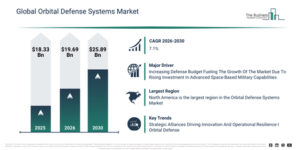
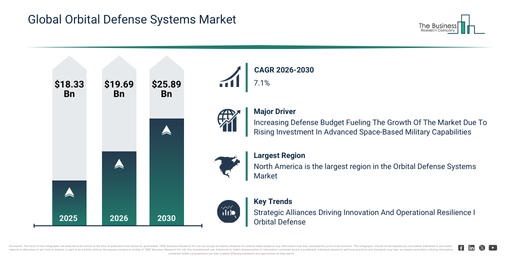
The orbital defense systems market has experienced robust expansion in recent years. It is projected to increase from $18.33 billion in 2025 to $19.69 billion by 2026, demonstrating a compound annual growth rate (CAGR) of 7.4%. This historical growth can be attributed to factors such as the escalating deployment of early space-surveillance satellites for monitoring orbital entities, a heightened demand for missile detection systems crucial for strategic early-warning missions, significant improvements in command-and-control networks facilitating the coordination of orbital defense assets, the increasing militarization of space prompting investment in high-altitude defense platforms, and the broadened integration of orbital threat-monitoring instruments developed from terrestrial defense technologies.
The orbital defense systems market is projected to experience substantial expansion over the upcoming years. This market is anticipated to reach $25.89 billion by 2030, achieving a compound annual growth rate (CAGR) of 7.1%. The anticipated growth during this period is driven by several factors, including a rising need for integrated orbital defense networks connecting space and lunar assets, intensified development of turreted weapon modules designed for neutralizing threats in space, increased capital expenditure in autonomous space-surveillance and interception capabilities, broader multinational cooperation to address new orbital threats, and rapid innovation in resilient space systems built for enduring orbital defense operations. Key trends projected for the forecast horizon encompass the expansion of space-based missile-warning constellations, an increase in multi-orbit hybrid defense frameworks, a growing requirement for systems mitigating debris and cleaning up orbits, enhanced integration of moon-to-earth defense command systems, and progress in reusable launch technologies for defense missions.
Get A Free Sample Report With In-Depth Market Insights:
Orbital Defense Systems Market Industry Drivers: What’s Behind The Revenue Growth?
The increasing defense budget is anticipated to drive the expansion of the orbital defense systems market moving forward. A defense budget represents the financial resources allocated by a nation’s military for acquiring, replenishing, and maintaining its stock of bullets, shells, missiles, and other armaments. This budget is on the rise primarily due to heightened geopolitical tensions, expanded military operations, and the necessity to restock depleted ammunition supplies. Orbital defense systems depend significantly on defense budgets to secure funding for advanced technology development, deployment, and ongoing maintenance, thereby ensuring effective protection against space-based threats. For instance, in December 2023, the House of Commons Library, a UK-based institution, reported that the UK secured defense orders totaling $16.04 billion (£12.0 billion) in real terms during 2022. This figure represents a $6.15 (£4.6 billion) increase compared to 2021, indicating a substantial surge in defense procurement and investment in sophisticated military capabilities. Consequently, the rising defense budget is stimulating growth within the orbital defense systems market.
Orbital Defense Systems Market Segments: Where Is Growth Concentrated?
The orbital defense systems market covered in this report is segmented –
1) By Component: Satellites, Ground Stations, Launch Vehicles, Other Components
2) By Technology: Laser Systems, Kinetic Systems, Electronic Warfare Systems, Other Technologies
3) By Application: Military, Civil, Commercial
4) By End-User: Government, Defense Contractors, Commercial Enterprises
Subsegments:
1) By Satellites: Communication Satellites, Surveillance Satellites, Navigation Satellites, Reconnaissance Satellites, Anti-satellite (ASAT) Weapons, Earth Observation Satellites
2) By Ground Stations: Command And Control Centers, Data Processing Units, Antenna Systems, Power Systems, Security Infrastructure
3) By Launch Vehicles: Small Launch Vehicles (SLVs), Medium Launch Vehicles (MLVs), Heavy Launch Vehicles (HLVs), Reusable Launch Systems, Ballistic Missiles
4) By Other Components: Space Debris Removal Systems, Propulsion Systems, Sensors And Detectors, Software And Artificial Intelligence Systems, Payload Modules
#Orbital Defense Systems Market Growth Trends: What’s Shaping The Future Outlook?
Major companies within the orbital defense systems market are concentrating on strategic partnerships to accelerate technological innovation, improve space-based surveillance and defense capabilities, and secure government contracts for large-scale deployment. Strategic partnerships involve companies leveraging each other’s strengths and resources to achieve mutual benefits and success. For instance, in May 2025, Atmos Space Cargo GmbH, a Germany-based aerospace company, collaborated with ARX Robotics GmbH, a Germany-based autonomous company, to launch Europe’s first orbital depot for autonomous defense systems, combining ATMOS’s re-entry capsules with ARX’s unmanned technologies. This alliance supports the rapid deployment of autonomous systems for disaster response, surveillance, and defense, thereby boosting Europe’s operational resilience and expanding both companies’ strategic networks across the continent.
Orbital Defense Systems Market Key Participants And Competitive Landscape
Major companies operating in the orbital defense systems market are Raytheon Technologies Corporation, Lockheed Martin Corporation, General Dynamics Corporation, Northrop Grumman Corporation, L3Harris Technologies, Amentum Holdings Inc, General Atomics, AXIENT CORP, Rocket Lab USA Inc, Capella Space, Blue Canyon Technologies Inc, Loft Orbital Solutions Inc, LeoLabs Inc., Slingshot Aerospace Inc, SpaceWorks Enterprises Inc, Alba Orbital Limited, Voyager Technologies Inc, Kayhan Space Corp., FlyPix AI GmbH, Blackstar Orbital Technologies Corporation.
View The Full Orbital Defense Systems Market Report:
Orbital Defense Systems Market Geographic Spread And Regional Opportunities
North America was the largest region in the orbital defense system market in 2025. The regions covered in the orbital defense systems market report are Asia-Pacific, South East Asia, Western Europe, Eastern Europe, North America, South America, Middle East, Africa.
Reach Out To Our Team:
The Business Research Company: https://www.thebusinessresearchcompany.com/
Americas: +1 310-496-7795
Asia: +44 7882 955267 & +91 8897263534
Europe: +44 7882 955267
Email us at: marketing@tbrc.info
Follow us on:
LinkedIn: https://in.linkedin.com/company/the-business-research-company
YouTube: https://www.youtube.com/channel/UC24_fI0rV8cR5DxlCpgmyFQ
Global Market Model: https://www.thebusinessresearchcompany.com/global-market-model

Wasay has over a decade of experience in market research, data modelling, and analytics, with prior experience at GlobalData and Decision Tree Consulting Services. At The Business Research Company , he leads research operations across syndicated studies, customized consulting engagements, and the Global Market Model platform. His professional experience includes supporting organizations such as Boston Consulting Group, KPMG, and Ernst & Young. Wasay holds a degree in Electronics and Communications Engineering, postgraduate management qualifications from International Management Institute Belgium and Indian School of Business and Entrepreneurship, and completed the Integrated Program in Business Analytics from Indian Institute of Management Indore.