Built to provide research that’s more actionable and strategically valuable, The Business Research Company’s 2026 market reports include market attractiveness analysis, total addressable market sizing, company benchmarking matrices, interactive Excel dashboards, broader supply chain intelligence, emerging startup tracking, and in-depth product insights.
Orbital Infrastructure Market Set To Climb From $16.25 Billion In 2026 To $23.32 Billion By 2030
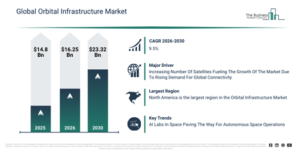
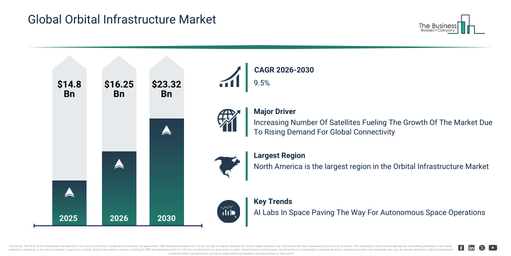
The orbital infrastructure market has experienced significant growth in recent years. This market is forecast to expand from $14.8 billion in 2025 to $16.25 billion in 2026, exhibiting a compound annual growth rate (CAGR) of 9.8%. Historically, this growth can be attributed to several factors: the increasing deployment of communication and navigation satellites supporting global connectivity; the growth in earth observation programs requiring robust orbital platforms; the rising demand for managed IT and network services delivered via space-based systems; advancements in satellite hardware, including circuit breakers and switchgear for orbital use; and the expansion of governmental and commercial initiatives investing in orbital infrastructure development.
The orbital infrastructure market is projected to experience substantial expansion over the upcoming years. By 2030, its size is anticipated to reach $23.32 billion, driven by a compound annual growth rate (CAGR) of 9.5%. This anticipated growth throughout the forecast period stems from several factors: the increasing uptake of high-speed satellite broadband to broaden global digital access, the enhanced incorporation of cybersecurity services for safeguarding orbital networks, a heightened need for robust orbital infrastructure to underpin developing space economy operations, the proliferation of large satellite constellations demanding extensive support infrastructure and materials, and the rapid advancements in orbital construction technologies, particularly those involving modular and scalable designs. Key trends characterizing this period encompass the enlargement of LEO satellite constellations, an escalating requirement for multi-orbit ground station interoperability, the growing implementation of reusable orbital servicing and refueling systems, augmented investment in space-debris reduction technologies, and a significant uptick in commercial space exploration and in-orbit manufacturing activities.
Get A Free Sample Report With In-Depth Market Insights:
Orbital Infrastructure Market Development Factors: What’s Supporting Demand?
The increasing quantity of satellites is poised to stimulate expansion within the orbital infrastructure market. These satellites are artificial objects launched into orbit around Earth or other celestial bodies to fulfill specific roles, including communication, navigation, Earth observation, scientific inquiry, and military surveillance. The proliferation of satellites stems from a heightened demand for worldwide connectivity through satellite-based internet services, particularly as terrestrial networks frequently cannot reach isolated and underserved locales. Orbital infrastructure offers vital in-orbit assistance to satellites, thereby fostering more sustainable satellite deployment and operations. It enhances the efficiency of missions through functionalities such as refueling, repair, and data processing, which collectively improve satellite performance and extend their operational lifespan. For instance, in May 2024, the National Space Operations Centre (NSpOC), a UK-based government agency, reported that the number of active satellites in orbit exceeded 9,000 as of April 2024, and some analyses suggest this figure could surpass 60,000 active satellites in space by 2030. Consequently, the rising count of satellites is a primary catalyst for the growth of the orbital infrastructure market.
Orbital Infrastructure Market Segment Landscape: Which Areas Lead Development?
The orbital infrastructure market covered in this report is segmented –
1) By Component: Satellites, Ground Stations, Launch Vehicles, Other Components
2) By Application: Communication, Earth Observation, Navigation, Space Exploration, Other Applications
3) By End-User: Commercial, Government, Military, Other End-Users
Subsegments:
1) By Satellites: Communication Satellites, Earth Observation Satellites, Navigation Satellites, Scientific Satellites, Military Or Defense Satellites, Small Satellites
2) By Ground Stations: Telemetry, Tracking, And Command (TT&C) Stations, Mission Control Centers, Antenna Systems, Data Processing Centers, Remote Ground Terminals, Satellite Communication Gateways
3) By Launch Vehicles: Small-Lift Launch Vehicles, Medium-Lift Launch Vehicles, Heavy-Lift Launch Vehicles, Reusable Launch Vehicles, Dedicated Launch Services, Rideshare Launch Services
4) By Other Components: Space Tugs And In-Orbit Transfer Vehicles, On-Orbit Servicing Modules, Orbital Refueling Systems, Debris Removal Systems, Power And Propulsion Modules, Satellite Constellation Management Systems
Orbital Infrastructure Market Transformation Trends: What Innovations Are Driving Change?
Major entities operating within the orbital infrastructure market are directing their efforts towards developing technologically advanced solutions, including AI labs in space, aimed at enabling autonomous research, enhancing satellite functionalities, and supporting real-time data processing and decision-making while in orbit. An AI lab in space represents a dedicated research and computational facility, typically positioned on a satellite, space station, or orbital platform, specifically designed to develop, test, and deploy artificial intelligence (AI) technologies within the distinctive conditions of space. As an example, in November 2024, TM2Space Technologies Pvt. Ltd., an aerospace company based in India, launched My Orbital Infrastructure-Technology Demonstrator (MOI-TD), which functions as an AI lab in space. This particular AI lab is configured to conduct autonomous experiments in microgravity, employing advanced radiation-hardened systems to ensure operational reliability even in deep-space environments. MOI-TD features advanced real-time in-orbit data processing capabilities that work to minimize both latency and transmission costs, and it is outfitted with cutting-edge hardware, including reaction wheels, magnetometers, an AI accelerator, and an advanced onboard computer, all safeguarded by radiation shielding. It is powered by flexible solar cells, thereby establishing the groundwork for future sustainable space-based data centers.
Orbital Infrastructure Market Industry Leaders And Competitive Landscape
Major companies operating in the orbital infrastructure market are Northrop Grumman Corporation, Thales Group, Airbus SE, Space Exploration Technologies Corp., Blue Origin Enterprises L.P., Viasat Inc., Astrium SAS, Maxar Technologies Inc., United Launch Alliance L.L.C., Telesat Corporation, OneWeb Holdings Limited, Axiom Space Inc., Sierra Space Corporation, Rocket Lab USA Inc., Isar Aerospace Technologies GmbH, Loft Orbital Solutions Inc., Astroscale Holdings Inc., ClearSpace SA, Firefly Aerospace Inc., Orbit Fab Inc.
View The Full Orbital Infrastructure Market Report:
Orbital Infrastructure Market Regional Analysis: Which Geography Leads On Revenue?
North America was the largest region in the orbital infrastructure market in 2025. The regions covered in the orbital infrastructure market report are Asia-Pacific, South East Asia, Western Europe, Eastern Europe, North America, South America, Middle East, Africa.
Reach Out To Our Team:
The Business Research Company: https://www.thebusinessresearchcompany.com/
Americas: +1 310-496-7795
Asia: +44 7882 955267 & +91 8897263534
Europe: +44 7882 955267
Email us at: marketing@tbrc.info
Follow us on:
LinkedIn: https://in.linkedin.com/company/the-business-research-company
YouTube: https://www.youtube.com/channel/UC24_fI0rV8cR5DxlCpgmyFQ
Global Market Model: https://www.thebusinessresearchcompany.com/global-market-model

Wasay has over a decade of experience in market research, data modelling, and analytics, with prior experience at GlobalData and Decision Tree Consulting Services. At The Business Research Company , he leads research operations across syndicated studies, customized consulting engagements, and the Global Market Model platform. His professional experience includes supporting organizations such as Boston Consulting Group, KPMG, and Ernst & Young. Wasay holds a degree in Electronics and Communications Engineering, postgraduate management qualifications from International Management Institute Belgium and Indian School of Business and Entrepreneurship, and completed the Integrated Program in Business Analytics from Indian Institute of Management Indore.