
Featuring market attractiveness scoring, total addressable market sizing, company benchmarking matrices, interactive Excel dashboards, deeper supply chain intelligence, emerging startup tracking, and granular product-level insights, The Business Research Company’s 2026 market reports are built to deliver research that is both more actionable and more strategically valuable.
#Space Debris Monitoring And Removal Market Forecast: What Value Will The Market Reach By 2030?#_x000D_
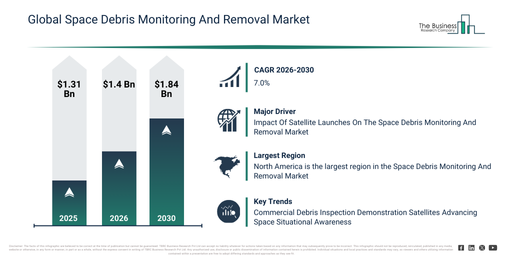
The space debris monitoring and removal market has experienced robust growth in recent years. Its size is expected to expand from $1.31 billion in 2025 to $1.4 billion in 2026, demonstrating a compound annual growth rate (CAGR) of 7.1%. This historical expansion can be attributed to several factors, such as the increasing number of active satellites elevating the risk of collisions, advancements in space-based sensor and tracking technologies, a heightened awareness of space sustainability and the hazards posed by debris, governmental initiatives and regulations promoting space situational awareness, and the early adoption of services for cataloging space debris and conducting orbital analysis._x000D_
_x000D_
The space debris monitoring and removal market is projected to experience substantial expansion over the coming years, with its size expected to reach $1.84 billion by 2030, exhibiting a compound annual growth rate (CAGR) of 7.0%. This anticipated growth is primarily driven by several factors, including the advancement of innovative debris removal and remediation technologies, the incorporation of AI and machine learning for predictive collision avoidance, increased investments in space traffic management and monitoring services, a growing demand for commercial space debris mitigation solutions, and the broadening of international collaborations for synchronized space debris tracking and elimination. Key trends anticipated in this period include the rise of real-time orbital debris tracking and prediction solutions, the implementation of cutting-edge debris removal technologies such as robotic capture, nets, and harpoons, the development of space situational awareness platforms that integrate multiple sensor sources, the expansion of services for cataloging and managing space debris databases, and a heightened requirement for satellite collision avoidance and maneuver planning systems._x000D_
_x000D_
#Get A Free Sample Report With In-Depth Market Insights:#_x000D_
_x000D_
#Space Debris Monitoring And Removal Market Growth Catalysts And Demand Drivers#_x000D_
The expansion of the space debris monitoring and removal market is anticipated to be fueled by the rising volume of satellite launches in the future. Satellite deployments involve placing man-made satellites into orbit using rockets or other launch mechanisms, serving diverse applications including communication, Earth observation, and scientific studies. The escalation in satellite launches stems from heightened requirements for worldwide connectivity, Earth observation, scientific inquiry, commercial uses, and an expanding fascination with space exploration. Space debris surveillance assists satellite operators and launch companies in pinpointing and tracking orbital fragments that might endanger satellites during their launch and deployment phases. Furthermore, initiatives to remove space debris seek to diminish the total amount of orbital junk, consequently lessening the probability of crashes with active satellites. For instance, reports from June 2024 by the US-based Satellite Industry Association indicate that the commercial satellite sector experienced unprecedented growth in 2023, deploying 2,781 satellites, which represents a 20% increase compared to 2022. The broader space industry also reached a new milestone with 190 total launches, marking the highest number ever recorded. By the close of that year, the count of active satellites reached 9,691, showing a significant 361% rise over the preceding five years. Consequently, the expanding volume of satellite launches is a key factor propelling the advancement of the space debris monitoring and removal market._x000D_
_x000D_
#Space Debris Monitoring And Removal Market Segment Landscape: Which Areas Lead Development?#_x000D_
The space debris monitoring and removal market covered in this report is segmented – _x000D_
_x000D_
1) By Debris Size Range: 1mm To 1cm Debris Size, 1cm To 10cm Debris Size, Greater Than 10 cm_x000D_
2) By Orbit Type: Low Earth Orbit (LEO), Medium-Earth Orbit (MEO), Geostationary Earth Orbit (GEO)_x000D_
3) By End User: Commercial, Defense_x000D_
_x000D_
Subsegments:_x000D_
1) By 1mm to 1cm Debris Size: Micrometeoroid and Orbital Debris (MMOD) Monitoring, Small Object Tracking and Removal Technologies _x000D_
2) By 1cm to 10cm Debris Size: Small-Scale Orbital Debris Removal, Laser Ablation for Debris Removal, Tether-based Debris Removal Systems _x000D_
3) By Greater Than 10 cm Debris Size: Large Object Tracking and Removal, Robotic Capture and De-orbiting Solutions, Net or Harpoon-based Debris Capture Systems _x000D_
_x000D_
#Space Debris Monitoring And Removal Market Trends Shaping Long-Term Demand#_x000D_
Major companies operating in the space debris monitoring and removal market are concentrating on developing novel solutions, such as commercial satellites designed for debris inspection demonstrations, to bolster space situational awareness and encourage sustainable practices in space. These satellites are intended to exhibit cutting-edge technologies for tracking and managing space debris, thereby contributing to orbital safety and long-term space viability. As an illustration, Astroscale Japan Inc., an aerospace firm based in Japan, deployed the world’s inaugural debris inspection spacecraft, ADRAS-J, in February 2024. The ADRAS-J undertaking represents the first global effort to securely approach, identify characteristics of, and survey a significant piece of existing debris utilizing RPO (Rendezvous and Proximity Operations) capabilities. ADRAS-J is engineered to link with a Japanese H2A upper-stage rocket body, carry out proximity maneuvers, and gather photographs to analyze the rocket body’s motion and structural state. The mission is set to demonstrate the most intricate RPO capabilities vital for on-orbit services, achieved through exhibiting proximity operations, capturing images, and evaluating the rocket body’s movement and structural condition._x000D_
_x000D_
#Space Debris Monitoring And Removal Market Industry Leaders And Competitive Landscape#_x000D_
Major companies operating in the space debris monitoring and removal market are Raytheon Technologies, The Boeing Company, Lockheed Martin Corporation, Airbus SE, Mitsubishi Electric Corporation, Northrop Grumman Corporation, British Aerospace systems, L3Harris Technologies Inc., IHI Corporation, Teledyne Technologies, Thales Alenia Space, Ball Aerospace & Technologies Corp., Maxar Technologies Inc, Japan Aerospace Exploration Agency, The Aerospace Corporation, Kratos Defense & Security Solutions, Electro Optic Systems Holdings Limited, Rocket Lab Limited, Surrey Satellite Technology Limited, ClearSpace SA, Tethers Unlimited, Kongsberg Satellite Services _x000D_
_x000D_
#View The Full Space Debris Monitoring And Removal Market Report:#_x000D_
_x000D_
#Space Debris Monitoring And Removal Market Geographic Distribution And Regional Opportunities#_x000D_
North America was the largest region in the space debris monitoring and removal market in 2025. Asia-Pacific is expected to be the fastest-growing region in the forecast period. The regions covered in the space debris monitoring and removal market report are Asia-Pacific, South East Asia, Western Europe, Eastern Europe, North America, South America, Middle East, Africa._x000D_
_x000D_
#Reach Out To Our Team:#_x000D_
_x000D_
The Business Research Company: https://www.thebusinessresearchcompany.com/_x000D_
Americas: +1 310-496-7795_x000D_
Asia: +44 7882 955267 & +91 8897263534_x000D_
Europe: +44 7882 955267_x000D_
Email us at: marketing@tbrc.info_x000D_
_x000D_
#Follow us on:#_x000D_
_x000D_
LinkedIn: https://in.linkedin.com/company/the-business-research-company_x000D_
YouTube: https://www.youtube.com/channel/UC24_fI0rV8cR5DxlCpgmyFQ_x000D_
Global Market Model: https://www.thebusinessresearchcompany.com/global-market-model

Wasay has over a decade of experience in market research, data modelling, and analytics, with prior experience at GlobalData and Decision Tree Consulting Services. At The Business Research Company , he leads research operations across syndicated studies, customized consulting engagements, and the Global Market Model platform. His professional experience includes supporting organizations such as Boston Consulting Group, KPMG, and Ernst & Young. Wasay holds a degree in Electronics and Communications Engineering, postgraduate management qualifications from International Management Institute Belgium and Indian School of Business and Entrepreneurship, and completed the Integrated Program in Business Analytics from Indian Institute of Management Indore.
