Enhanced with market attractiveness analysis, total addressable market evaluation, company benchmarking matrices, interactive Excel dashboards, expanded supply chain intelligence, emerging startup coverage, and detailed product insights, The Business Research Company’s 2026 market reports deliver more actionable and strategically valuable research.
Space Debris Monitoring And Removal Market Value Analysis: What Growth Is Expected Over The Forecast Period?
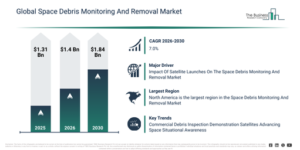
The space debris monitoring and removal market is anticipated to experience substantial expansion in the coming years. This market is projected to reach $1.84 billion by 2030, exhibiting a compound annual growth rate (CAGR) of 7.0%. This projected increase is driven by factors such as the advancement of sophisticated debris removal and remediation technologies, the incorporation of AI and machine learning for proactive collision avoidance, a surge in investments towards space traffic management and monitoring services, a growing need for commercial solutions to mitigate space debris, and the broadening of international partnerships for synchronized space debris tracking and removal efforts. Key developments during this period will encompass the rise of real-time orbital debris tracking and prediction tools, the implementation of cutting-edge debris removal techniques (such as robotic capture, nets, and harpoons), the creation of space situational awareness platforms that merge various sensor inputs, an increase in space debris cataloging and database management offerings, and a heightened requirement for satellite collision avoidance and maneuver planning systems.
The projected expansion of the space debris monitoring and removal market is anticipated to be driven by the rising volume of satellite launches. These launches entail placing artificial satellites into orbit using rockets or launch vehicles, serving diverse functions like communication, Earth observation, and scientific inquiry. This increase in satellite deployments is fueled by a heightened need for global connectivity, earth observation, scientific investigation, commercial uses, and an expanding curiosity in space exploration. Monitoring space debris assists satellite operators and launch companies in detecting and tracking objects that might present a collision hazard to satellites during their launch and deployment phases. Furthermore, initiatives for space debris removal strive to diminish the total amount of debris in orbit, consequently lowering the probability of impacts with active satellites. Illustratively, in June 2024, the US-based Satellite Industry Association reported that the commercial satellite sector experienced unprecedented growth in 2023, deploying 2,781 satellites, which signifies a 20% increase compared to 2022. The broader space industry also achieved a new landmark, conducting 190 total launches, the highest number ever documented. By year-end, the count of operational satellites reached 9,691, representing a substantial 361% surge over the last five years. Consequently, the growing volume of satellite launches is a key factor boosting the expansion of the space debris monitoring and removal market.
Download A Free Sample Report For Comprehensive Market Insights:
Space Debris Monitoring And Removal Market Industry Drivers: What Is Driving Revenue Growth?
Leading companies active in the space debris monitoring and removal market are prioritizing the creation of novel solutions, including commercial debris inspection demonstration satellites, to enhance space situational awareness and encourage sustainable space operations. These satellites aim to showcase advanced technologies for monitoring and managing space debris, thereby supporting space sustainability and contributing to safer orbital environments. For instance, in February 2024, Astroscale Japan Inc., a Japan-based aerospace company, launched the world’s first debris inspection spacecraft, ADRAS-J. The ADRAS-J mission represents the world’s initial attempt to safely approach, characterize, and survey an existing piece of massive debris through RPO (Rendezvous and Proximity Operations) capabilities. ADRAS-J is designed to connect with a Japanese H2A upper-stage rocket body, perform proximity operations, and collect photos to examine the rocket body’s movement and structural condition. The mission will highlight the most intricate RPO capabilities required for on-orbit services. It demonstrates challenging RPO capabilities crucial for in-orbit services by exhibiting close-range operations, gathering images, and evaluating the rocket body’s movement and structural integrity.
Space Debris Monitoring And Removal Market Segmentation: How Is The Market Structured Across Key Categories?
The space debris monitoring and removal market covered in this report is segmented –
1) By Debris Size Range: 1mm To 1cm Debris Size, 1cm To 10cm Debris Size, Greater Than 10 cm
2) By Orbit Type: Low Earth Orbit (LEO), Medium-Earth Orbit (MEO), Geostationary Earth Orbit (GEO)
3) By End User: Commercial, Defense
Subsegments:
1) By 1mm to 1cm Debris Size: Micrometeoroid and Orbital Debris (MMOD) Monitoring, Small Object Tracking and Removal Technologies
2) By 1cm to 10cm Debris Size: Small-Scale Orbital Debris Removal, Laser Ablation for Debris Removal, Tether-based Debris Removal Systems
3) By Greater Than 10 cm Debris Size: Large Object Tracking and Removal, Robotic Capture and De-orbiting Solutions, Net or Harpoon-based Debris Capture Systems
Space Debris Monitoring And Removal Market Trends Reshaping Industry Growth
Leading companies active in the space debris monitoring and removal market are prioritizing the creation of novel solutions, including commercial debris inspection demonstration satellites, to enhance space situational awareness and encourage sustainable space operations. These satellites aim to showcase advanced technologies for monitoring and managing space debris, thereby supporting space sustainability and contributing to safer orbital environments. For instance, in February 2024, Astroscale Japan Inc., a Japan-based aerospace company, launched the world’s first debris inspection spacecraft, ADRAS-J. The ADRAS-J mission represents the world’s initial attempt to safely approach, characterize, and survey an existing piece of massive debris through RPO (Rendezvous and Proximity Operations) capabilities. ADRAS-J is designed to connect with a Japanese H2A upper-stage rocket body, perform proximity operations, and collect photos to examine the rocket body’s movement and structural condition. The mission will highlight the most intricate RPO capabilities required for on-orbit services. It demonstrates challenging RPO capabilities crucial for in-orbit services by exhibiting close-range operations, gathering images, and evaluating the rocket body’s movement and structural integrity.
Space Debris Monitoring And Removal Market Competitive Landscape And Leading Companies
Major companies operating in the space debris monitoring and removal market are Raytheon Technologies, The Boeing Company, Lockheed Martin Corporation, Airbus SE, Mitsubishi Electric Corporation, Northrop Grumman Corporation, British Aerospace systems, L3Harris Technologies Inc., IHI Corporation, Teledyne Technologies, Thales Alenia Space, Ball Aerospace & Technologies Corp., Maxar Technologies Inc, Japan Aerospace Exploration Agency, The Aerospace Corporation, Kratos Defense & Security Solutions, Electro Optic Systems Holdings Limited, Rocket Lab Limited, Surrey Satellite Technology Limited, ClearSpace SA, Tethers Unlimited, Kongsberg Satellite Services
Access The Complete Space Debris Monitoring And Removal Market Report:
Space Debris Monitoring And Removal Market Global Footprint: Which Region Holds Market Leadership?
North America was the largest region in the space debris monitoring and removal market in 2025. Asia-Pacific is expected to be the fastest-growing region in the forecast period. The regions covered in the space debris monitoring and removal market report are Asia-Pacific, South East Asia, Western Europe, Eastern Europe, North America, South America, Middle East, Africa.
Access a Customized Space Debris Monitoring And Removal Market Report for Deeper Competitive Insights
https://www.thebusinessresearchcompany.com/customise?id=14504&type=smp
The Business Research Company: https://www.thebusinessresearchcompany.com/
Americas: +1 310-496-7795
Asia: +44 7882 955267 & +91 8897263534
Europe: +44 7882 955267
Email us at: marketing@tbrc.info
Follow us on:
LinkedIn: https://in.linkedin.com/company/the-business-research-company
YouTube: https://www.youtube.com/channel/UC24_fI0rV8cR5DxlCpgmyFQ
Global Market Model: https://www.thebusinessresearchcompany.com/global-market-model

Wasay has over a decade of experience in market research, data modelling, and analytics, with prior experience at GlobalData and Decision Tree Consulting Services. At The Business Research Company , he leads research operations across syndicated studies, customized consulting engagements, and the Global Market Model platform. His professional experience includes supporting organizations such as Boston Consulting Group, KPMG, and Ernst & Young. Wasay holds a degree in Electronics and Communications Engineering, postgraduate management qualifications from International Management Institute Belgium and Indian School of Business and Entrepreneurship, and completed the Integrated Program in Business Analytics from Indian Institute of Management Indore.