Delivering more actionable and strategically valuable research, The Business Research Company’s 2026 market reports feature market attractiveness analysis, total addressable market evaluation, company benchmarking matrices, interactive Excel dashboards, expanded supply chain intelligence, emerging startup coverage, and detailed product insights.
Plant-Based Texturizers Market Expected To Reach $5.01 Billion By 2030 At 5.7% CAGR
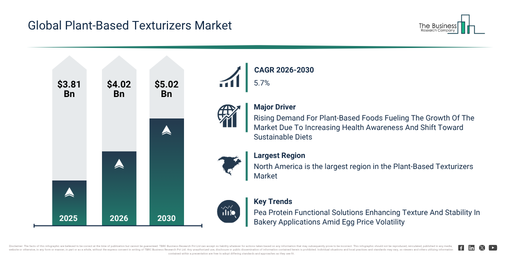
The plant-based texturizers market has experienced robust expansion in recent years. Its value is projected to increase from $3.81 billion in 2025 to $4.02 billion in 2026, reflecting a compound annual growth rate (CAGR) of 5.5%. This past growth has been driven by factors such as the growing prevalence of vegan and vegetarian diets, a rise in the consumption of processed and packaged foods, heightened awareness regarding synthetic food additives, the globalization of food supply networks, and the early embrace of the clean label movement.
The plant-based texturizers market is anticipated to experience significant expansion over the coming years, with its value projected to reach $5.02 billion by 2030, reflecting a compound annual growth rate (CAGR) of 5.7%. This forecast period growth is driven by several key factors, including a heightened demand for functional and fortified foods, the swift development of alternative protein ecosystems, an increasing consumer inclination toward personalized nutrition, stricter global food safety and labeling requirements, and the growing prevalence of ready-to-eat and convenience food offerings. Notable trends shaping this period involve the adoption of clean-label plant-based ingredients, the use of hydrocolloids to refine food texture, advanced protein structuring methods aimed at improving mouthfeel, the reduction of sugar and fat through plant-derived fibers, and the application of multifunctional texturizers to enhance product stability and extend shelf life.
Download A Free Sample Report For Comprehensive Market Insights:
Plant-Based Texturizers Market Opportunity Drivers: What Is Creating New Revenue Potential?
The anticipated expansion of the plant-based texturizers market is being driven forward by increasing consumer interest in plant-based foods. These foods are made entirely or largely from plant-derived sources including fruits, vegetables, grains, legumes, nuts, milk, and seeds. Their rising popularity can be attributed to a growing focus on health, as more individuals adopt eating patterns associated with reduced chronic disease risks and enhanced general wellness. Plant-based texturizers play a key role in supporting these products by enhancing their texture, consistency, and mouthfeel, enabling them to replicate the sensory qualities of meat and dairy. For example, the Good Food Institute Europe, a nonprofit organization headquartered in Belgium, reported in June 2025 that sales of plant-based milk in discount store chains surged by 45% from 2022 to 2024, far exceeding the 11% increase seen in other supermarkets during the same timeframe. Consequently, the growing appetite for plant-based foods is fueling the expansion of the plant-based texturizers market.
Plant-Based Texturizers Market Segment Analysis And Revenue Opportunities
The plant-based texturizers market covered in this report is segmented –
1) By Product Type: Hydrocolloids, Plant Proteins (Texturized), Starches, Cellulose Derivatives, Other Plant-Based Texturizers
2) By Technology Method: Extrusion Technology, Fermentation-Based Production, Extraction And Fractionation, Novel Texturization Technologies, Chemical Or Physical Modification
3) By End-User: Food And Beverage Manufacturing, Grain And Oilseed Processing, Dairy Alternative Manufacturers, Bakery And Confectionery, Foodservice And Institutional, Retail And Consumer Packaged Goods
Subsegments:
1) By Hydrocolloids: Pectin, Agar, Carrageenan, Guar Gum, Xanthan Gum, Locust Bean Gum, Gellan Gum
2) By Plant Proteins (Texturized): Soy Protein, Pea Protein, Wheat Protein (Gluten), Rice Protein, Faba Bean Protein, Chickpea Protein
3) By Starches: Native Starch, Modified Starch, Tapioca Starch, Corn Starch, Potato Starch, Rice Starch
4) By Cellulose Derivatives: Carboxymethyl Cellulose, Methyl Cellulose, Hydroxypropyl Methylcellulose, Microcrystalline Cellulose
5) By Other Plant-Based Texturizers: Inulin, Dietary Fibers, Plant-Based Emulsifiers, Resistant Starch, Algal Extracts
Plant-Based Texturizers Market Innovation Trends Driving Future Development
Leading firms in the plant-based texturizers sector are prioritizing the creation of inventive products, including functional texturizers derived from pea protein, to enhance texture, stability, and the capacity to replace eggs or dairy in food applications as consumer preference grows for plant-based and cost-consistent formulas. Developed from processed pea proteins, these functional texturizers are plant-derived ingredients that replicate the binding, gelling, and emulsifying properties of animal-based components like eggs and dairy, thereby boosting the texture, structure, and stability of food products. By way of example, in December 2025, Lasenor Emul, S.L., a bakery ingredient company based in Spain, introduced the VP-100 pea protein texturizer to counteract egg price fluctuations, facilitating partial or complete egg substitution in bakery recipes while preserving texture, structure, and moisture in items such as cakes and muffins. These texturizers provide strong egg-replacement capabilities (up to 100%), achieving similar aeration, binding, and moisture retention in baked goods. Created specifically to stabilize recipes amidst volatile egg prices, they also promote clean-label, plant-based bakery innovation.
Plant-Based Texturizers Market Leading Players Shaping Industry Direction
Major companies operating in the plant-based texturizers market are Cargill Incorporated, Archer Daniels Midland Company, International Flavors And Fragrances Inc., Ingredion Incorporated, Kerry Group Public Limited Company, ICL Group Ltd., Roquette Frères, Tate And Lyle Public Limited Company, Ashland Global Holdings Inc., Palsgaard A/S, PURIS Holdings LLC, Cosucra Groupe Warcoing SA, Lasenor Emul S.L., Alland And Robert S.A.S., Fiberstar Inc., Axiom Foods Inc., Burcon NutraScience Corporation, Socius Ingredients LLC, Marine Hydrocolloids, Evopulse Industries Pvt. Ltd.
Access The Complete Plant-Based Texturizers Market Report:
https://www.thebusinessresearchcompany.com/report/plant-based-texturizers-market-report
Plant-Based Texturizers Market Largest Region By Revenue And Market Share
North America was the largest region in the plant-based texturizers market in 2025. Asia-Pacific is expected to be the fastest-growing region in the forecast period. The regions covered in the plant-based texturizers market report are Asia-Pacific, South East Asia, Western Europe, Eastern Europe, North America, South America, Middle East, Africa.
Access a Customized Plant-Based Texturizers Market Report for Deeper Competitive Insights
Get in touch with us:
The Business Research Company: https://www.thebusinessresearchcompany.com/
Americas: +1 310-496-7795
Asia: +44 7882 955267 & +91 8897263534
Europe: +44 7882 955267
Email us at: marketing@tbrc.info
Follow us on:
LinkedIn: https://in.linkedin.com/company/the-business-research-company
YouTube: https://www.youtube.com/channel/UC24_fI0rV8cR5DxlCpgmyFQ
Global Market Model: https://www.thebusinessresearchcompany.com/global-market-model

Wasay has over a decade of experience in market research, data modelling, and analytics, with prior experience at GlobalData and Decision Tree Consulting Services. At The Business Research Company , he leads research operations across syndicated studies, customized consulting engagements, and the Global Market Model platform. His professional experience includes supporting organizations such as Boston Consulting Group, KPMG, and Ernst & Young. Wasay holds a degree in Electronics and Communications Engineering, postgraduate management qualifications from International Management Institute Belgium and Indian School of Business and Entrepreneurship, and completed the Integrated Program in Business Analytics from Indian Institute of Management Indore.