
Enhanced with market attractiveness analysis, total addressable market evaluation, company benchmarking matrices, interactive Excel dashboards, expanded supply chain intelligence, emerging startup coverage, and detailed product insights, The Business Research Company’s 2026 market reports deliver more actionable and strategically valuable research.
Aircraft Auxiliary Power Unit Market CAGR Analysis And Future Market Development
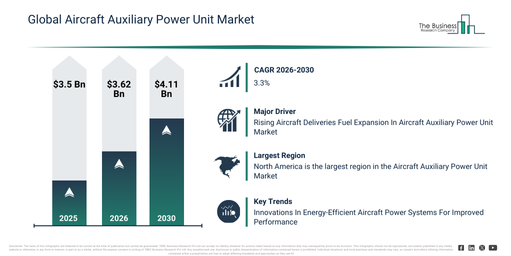
The aircraft auxiliary power unit market has seen steady expansion in recent years. It is projected to grow from $3.5 billion in 2025 to $3.62 billion in 2026, achieving a compound annual growth rate (CAGR) of 3.4%. The historical increase can be attributed to several factors: the early adoption of auxiliary power units to enable independent aircraft operation without ground support, a rising demand for reliable electric power supply for onboard aviation systems, the development of combustion engine–based APUs utilizing diesel, gas, or propane fuels, the increasing use of batteries and hydraulic accumulators to support engine starting functions, and the expansion of commercial aircraft fleets which has driven the standardized installation of APUs.
The aircraft auxiliary power unit market size is projected to experience steady growth over the next few years, with an anticipated rise to $4.11 billion by 2030, demonstrating a compound annual growth rate (CAGR) of 3.3%. This expansion during the forecast period is driven by several factors, including the increasing demand for fuel-efficient and low-emission APU technologies, the growing adoption of hybrid and electric APUs to lower operational costs, a rise in aircraft production and modernization programs requiring advanced auxiliary power systems, and continuous technological advancements improving APU reliability, noise reduction, and thermal efficiency. Furthermore, an expanding regulatory emphasis on reducing ground emissions and enhancing energy efficiency in aviation also contributes to this growth. Prominent trends expected during this period include a strong demand for efficient auxiliary power units, the development of lightweight and compact APU designs, the integration of hybrid and fuel-efficient engines, a heightened focus on safety and redundancy systems, and an expansion of APUs in unmanned aerial vehicles.
Download A Free Sample Report For Comprehensive Market Insights:
Aircraft Auxiliary Power Unit Market Expansion Drivers: What Is Shaping Future Growth?
The anticipated rise in aircraft deliveries is projected to drive the expansion of the aircraft auxiliary power unit market in the future. Aircraft deliveries involve the manufacturing, assembly, and subsequent supply of aircraft to various clients, such as airlines, private individuals, or military bodies. The APU supplies power to both the electrical and pneumatic systems of an aircraft, enabling autonomous operation while on the ground or during maintenance procedures. This capability lessens the dependence on outside power sources, offering enhanced operational flexibility for airlines. For example, as reported in January 2024 by Airbus SE, a France-based aerospace and defense firm, 2023 saw Airbus dispatch 735 commercial aircraft, representing an 11% increase over the figures from 2022. Furthermore, the company logged 2,319 gross orders (2,094 net), comprising 1,835 A320 Family aircraft and 300 A350 Family aircraft. Consequently, the growing volume of aircraft deliveries is fueling the aircraft auxiliary power unit market.
Aircraft Auxiliary Power Unit Market Segments: Where Are The Largest Growth Opportunities?
The aircraft auxiliary power unit market covered in this report is segmented –
1) By Product: Battery Power, Electric Ground Power
2) By Aircraft Type: Fixed Wind, Wide Body, Narrow Body, Rotary Wing, Unmanned Aerial Vehicle, Other Types
3) By End User: Military Aircrafts, Commercial Aircrafts, General Aviation
Subsegments:
1) By Battery Power: Lithium-Ion Battery Systems, Nickel-Cadmium Battery Systems
2) By Electric Ground Power: Ground Power Units (GPU), Mobile Ground Power Units
Aircraft Auxiliary Power Unit Market Strategic Trends: What Is Defining The Next Phase Of Growth?
Major companies operating in the aircraft auxiliary power unit market are concentrating on creating innovative products, specifically energy-efficient units, to decrease fuel usage, reduce emissions, and boost aircraft capabilities. These energy-efficient units are engineered to consume less fuel or power while delivering the same output, thereby cutting operating expenses, lowering greenhouse gas emissions, lessening environmental impact, and improving overall aircraft performance and reliability, making them crucial for modern commercial and military aviation. For instance, in September 2025, Pratt & Whitney, a US-based aerospace manufacturing company, partnered with PBS Group, a Czech Republic-based technology company, to design a next-generation auxiliary power unit (APU) intended to offer increased power density, lighter weight, and improved efficiency for both commercial and military planes. Utilizing the combined technical expertise of both organizations, these APUs can start quickly, operate at high altitudes, and support sophisticated aircraft systems, ultimately contributing to lower fuel consumption, decreased emissions, and enhanced overall aircraft performance. Furthermore, the new APU is anticipated to enable greater versatility in aircraft design by minimizing space and weight demands, while also supplying extra electrical power, improved thermal management, and assistance for electronic warfare systems in defense applications.
#Aircraft Auxiliary Power Unit Market Industry Leaders: Which Organizations Are Driving Competition?
Major companies operating in the aircraft auxiliary power unit market are Honeywell International Inc., Hamilton Sundstrand Corporation, Technodinamika, Kinetics Ltd., Rolls-Royce PLC, AEGIS Power Systems Inc., Pratt & Whitney Canada Corp., Safran Power Units SAS, United Technologies Corporation, The Dewey Electronics Corporation, Liebherr-Aerospace Lindenberg GmbH, General Electric Company, BAE Systems plc., Raytheon Technologies Corporation, BOSA S.A., JSC NPP Aerosila, PBS Group a. s., Microturbo, Falck Schmidt Defence Systems A/S, Hartzell Aerospace, The Marvin Group, AMETEK Airtechnology Group, Behlman Electronics Inc., Tecknowledgey, UTC Aerospace Systems, Aerospace Turbine Rotables Inc., AeroVironment Inc., Airborne Systems North America, Aircraft Electronics Associatio
Access The Complete Aircraft Auxiliary Power Unit Market Report:
Aircraft Auxiliary Power Unit Market Geographic Analysis: Where Is Demand Growing The Fastest?
North America was the largest region in the aircraft auxiliary power unit market in 2025. Asia-Pacific is expected to be the fastest-growing region in the global aircraft auxiliary power unit market report during the forecast period. The regions covered in the aircraft auxiliary power unit market report are Asia-Pacific, South East Asia, Western Europe, Eastern Europe, North America, South America, Middle East, Africa.
Access a Customized Aircraft Auxiliary Power Unit Market Report for Deeper Competitive Insights
https://www.thebusinessresearchcompany.com/customise?id=10403&type=smp
Get in touch with us:
The Business Research Company: https://www.thebusinessresearchcompany.com/
Americas: +1 310-496-7795
Asia: +44 7882 955267 & +91 8897263534
Europe: +44 7882 955267
Email us at: marketing@tbrc.info
Follow us on:
LinkedIn: https://in.linkedin.com/company/the-business-research-company
YouTube: https://www.youtube.com/channel/UC24_fI0rV8cR5DxlCpgmyFQ
Global Market Model: https://www.thebusinessresearchcompany.com/global-market-model

Wasay has over a decade of experience in market research, data modelling, and analytics, with prior experience at GlobalData and Decision Tree Consulting Services. At The Business Research Company , he leads research operations across syndicated studies, customized consulting engagements, and the Global Market Model platform. His professional experience includes supporting organizations such as Boston Consulting Group, KPMG, and Ernst & Young. Wasay holds a degree in Electronics and Communications Engineering, postgraduate management qualifications from International Management Institute Belgium and Indian School of Business and Entrepreneurship, and completed the Integrated Program in Business Analytics from Indian Institute of Management Indore.

