Delivering more actionable and strategically valuable research, The Business Research Company’s 2026 market reports feature market attractiveness analysis, total addressable market evaluation, company benchmarking matrices, interactive Excel dashboards, expanded supply chain intelligence, emerging startup coverage, and detailed product insights.
Aircraft Brake System Market Size, Value And Growth Trends Through 2030
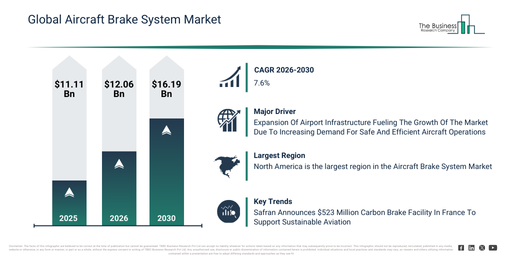
The aircraft brake system market has experienced significant expansion recently. Projections indicate a rise from $11.11 billion in 2025 to $12.06 billion in 2026, demonstrating a compound annual growth rate of 8.6%. This historical expansion is largely due to several factors, including an increase in worldwide aircraft manufacturing, which boosts the need for dependable brake systems. Additionally, the growing use of multi-disc brake designs for better efficiency, the expanding commercial aviation sector leading to greater demand for brake parts, a heightened emphasis on improving runway safety with sophisticated braking innovations, and the integration of carbon brakes for weight reduction and better heat dissipation have all contributed to this growth.
The aircraft brake system market is poised for robust expansion in the foreseeable future, with its valuation expected to climb to $16.19 billion by 2030, demonstrating a compound annual growth rate (CAGR) of 7.6%. This projected growth can be attributed to several factors, including an anticipated surge in next-generation aircraft platforms necessitating more advanced brake systems, an increasing demand for lightweight and durable brake materials to enhance operational efficiency, the rising adoption of brake-by-wire technologies for improved control and responsiveness, expanding fleet renewal and maintenance, repair, and overhaul (MRO) activities driving the replacement of aircraft brake systems, and technological innovations enabling superior heat management and extended brake longevity. During this forecast period, significant market trends will encompass the increasing adoption of carbon composite braking materials, the expanded integration of advanced anti-skid brake control units, a growing preference for lightweight wheel and brake assemblies, broader usage of high-performance heat-dissipation technologies, and the continued development of multi-disc brake configurations tailored for large aircraft.
Download A Free Sample Report For Comprehensive Market Insights:
Aircraft Brake System Market Growth Momentum: Which Factors Are Influencing Demand?
The continued expansion of airport infrastructure is projected to drive the growth of the aircraft brake system market. This involves the enhancement and modernization of airport facilities, including runways, terminals, hangars, and support systems, to accommodate increased air traffic and larger aircraft. The rising demand for air travel is accelerating this infrastructure expansion, prompting governments and private operators to upgrade existing facilities and construct new terminals. Aircraft brake systems are crucial for supporting this expansion by ensuring safe and efficient aircraft landings and ground operations, which allows airports to manage higher traffic volumes and larger aircraft. For instance, in March 2023, according to Airports Council International-North America (ACI-NA), a US-based government organization, the total U.S. airport infrastructure needs for the 2023-2027 period were estimated at $151 billion, marking a 30.9% increase from the prior period and reflecting a substantial commitment to expanding and modernizing airport capacity. Therefore, the expansion of airport infrastructure is a key factor propelling the growth of the aircraft brake system market.
Aircraft Brake System Market Segment Landscape: Which Areas Lead Market Development?
The aircraft brake system market covered in this report is segmented –
1) By Component: Braking System Components, Brakes, Wheels
2) By Actuation: Power Brake, Boosted Brake, Independent Brake
3) By Brake Type: Carbon Breaks, Steel Breaks, Others
4) By Aircraft Type: Fixed Wing, Rotary Wing, Unmanned Aerial Vehicles
5) By End-User: Commercial Aircraft, Defense Aircraft
Subsegments:
1) By Braking System Components: Brake Control Systems, Anti-Skid Control Units, Brake Actuators, Hydraulic Lines and Fittings, Sensors and Monitoring Systems
2) By Brakes: Disc Brakes, Drum Brakes, Carbon Brake Systems, Steel Brake Systems, Emergency Brakes
3) By Wheels: Main Wheels, Nose Wheels, Wheel Assembly Components
Aircraft Brake System Market Trends Reshaping Industry Growth
Leading firms within the aircraft braking systems market are concentrating on employing advanced methods, particularly carbon brake technologies, to improve efficiency, decrease mass, and further environmental objectives. This carbon brake technology, utilizing high-performance carbon composites, enables aircraft to attain superior braking effectiveness, diminished wear, and a lessened ecological footprint by cutting down emissions and energy expenditure during flight activities. As an illustration, in August 2025, Safran S.A., an aerospace and defense corporation based in France, revealed plans for a new $523 million (€450 million) carbon brake production site in France, scheduled to commence operations in 2030. Established to address the increasing worldwide need for environmentally conscious and efficient aircraft braking solutions, this plant is structured to enhance production capacities and operational readiness for both commercial and military aircraft. This establishment capitalizes on Safran’s proficiency in carbon composite substances and sophisticated manufacturing processes, facilitating the creation of brakes that are lighter, more robust, and ecologically sound, thereby rendering aircraft operations safer, more effective, and more sustainable than currently available options.
Aircraft Brake System Market Competitive Landscape And Leading Companies
Major companies operating in the aircraft brake system market are Honeywell International Inc., Safran Landing Systems, Raytheon Technologies Corporation, Parker-Hannifin Corporation, Crane Aerospace & Electronics., Beringer Aero a subsidiary of Beringer SAS, MATCO Manufacturing Inc., Grove Aircraft Landing Gear Systems Inc., Jay-Em Aerospace & Machine Inc., Bauer Inc., Nasco Aircraft Brake Inc., AAR Corp., Lufthansa Technik AG, UTC Aerospace Systems, Dunlop Aircraft Tyres Ltd., Goodyear Aviation., Michelin Aircraft Tire Company LLC., Aircraft Braking Systems Corporation., Carlisle Companies Incorporated, Rapco Fleet Support Inc., SGL Carbon SE, Wilwood Engineering Inc., Brembo S.p.A., Hindustan Aeronautics Limited, Magellan Aerospace Corporation, Meggitt Aircraft Braking Systems Corporation
Access The Complete Aircraft Brake System Market Report:
Aircraft Brake System Market Regional Analysis And Leading Geography
North America was the largest region in the aircraft brake system market in 2025. North America is expected to be the fastest-growing region in the forecast period. The regions covered in the aircraft brake system market report are Asia-Pacific, South East Asia, Western Europe, Eastern Europe, North America, South America, Middle East, Africa.
Access a Customized Aircraft Brake System Market Report for Deeper Competitive Insights
https://www.thebusinessresearchcompany.com/customise?id=10106&type=smp
Get in touch with us:
The Business Research Company: https://www.thebusinessresearchcompany.com/
Americas: +1 310-496-7795
Asia: +44 7882 955267 & +91 8897263534
Europe: +44 7882 955267
Email us at: marketing@tbrc.info
Follow us on:
LinkedIn: https://in.linkedin.com/company/the-business-research-company
YouTube: https://www.youtube.com/channel/UC24_fI0rV8cR5DxlCpgmyFQ
Global Market Model: https://www.thebusinessresearchcompany.com/global-market-model

Wasay has over a decade of experience in market research, data modelling, and analytics, with prior experience at GlobalData and Decision Tree Consulting Services. At The Business Research Company , he leads research operations across syndicated studies, customized consulting engagements, and the Global Market Model platform. His professional experience includes supporting organizations such as Boston Consulting Group, KPMG, and Ernst & Young. Wasay holds a degree in Electronics and Communications Engineering, postgraduate management qualifications from International Management Institute Belgium and Indian School of Business and Entrepreneurship, and completed the Integrated Program in Business Analytics from Indian Institute of Management Indore.