Through market attractiveness analysis, total addressable market evaluation, company benchmarking matrices, interactive Excel dashboards, expanded supply chain intelligence, emerging startup coverage, and detailed product insights, The Business Research Company’s 2026 market reports provide more actionable and strategically valuable research.
Aircraft Manufacturing Market Forecast Highlighting Growth From $505.34 Billion To $623.8 Billion
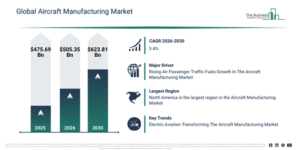
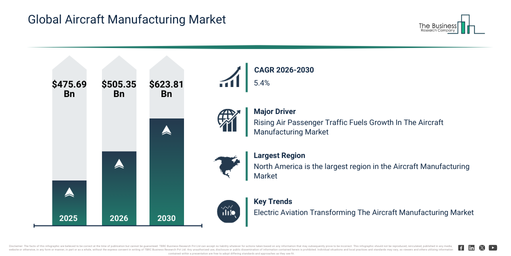
The aircraft manufacturing market size has experienced significant growth in recent years. This market is set to increase from $475.69 billion in 2025 to $505.35 billion in 2026, demonstrating a compound annual growth rate (CAGR) of 6.2%. The historical expansion can be ascribed to a surge in global air passenger and cargo movement, which has propelled aircraft production, the broadening of military procurement programs for advanced aircraft, innovations in aerostructure design and manufacturing technologies, heightened investments in aircraft testing and certification infrastructure, and an escalating demand for specialized aircraft such as cargo planes and business jets.
The aircraft manufacturing market size is anticipated to demonstrate significant expansion in the upcoming years. It is projected to grow to $623.81 billion by 2030, achieving a compound annual growth rate (CAGR) of 5.4%. This growth over the forecast period can be attributed to several factors: an increase in the production of next-generation commercial and military aircraft, the rising adoption of lightweight materials and composite aerostructures, a surging demand for fuel-efficient and low-emission aircraft designs, the broadening of autonomous and unmanned aircraft manufacturing capabilities, and advancements in digital engineering and smart manufacturing which enhance aircraft development efficiency. Prominent trends for the forecast period include the integration of autonomous and AI-assisted flight systems, the utilization of smart manufacturing and robotics in aircraft assembly, the development of eco-friendly and lightweight aircraft materials, a heightened focus on digital twin technology for aircraft design and testing, and advanced predictive maintenance employing big data and IoT sensors.
Download A Free Sample Report For Comprehensive Market Insights:
Aircraft Manufacturing Market Industry Drivers: What Is Driving Revenue Growth?
The upward trend in air passenger traffic is anticipated to stimulate the expansion of the aircraft manufacturing market in the foreseeable future. The quantification of air passenger traffic involves assessing the total number of passengers handled by airlines or airports during a specific timeframe. This metric serves as a crucial gauge of air travel demand, influenced by economic conditions, consumer preferences, travel restrictions, and airline competition. The escalating demand for air travel alongside increasing passenger volumes has created avenues for the aircraft manufacturing industry to grow, as airlines require more aircraft to expand their fleets and introduce new routes and services, thereby stimulating demand for new aircraft orders. For instance, in January 2024, according to the International Air Transport Association a Canda-based Trade association, in 2023, traffic climbed 41.6% compared to 2022. Additionally, by December 2023, international traffic had increased by 24.2% over December 2022. Hence, the growing air passenger traffic will drive the aircraft manufacturing market going forward.
Aircraft Manufacturing Market Segmentation: How Is The Market Structured Across Key Categories?
The aircraft manufacturing market covered in this report is segmented –
1) By Product: Gliders, Helicopters, Ultra-Light, Passenger, Unmanned Aerial Vehicles and Drones, Blimps (Airship)
2) By Aircraft Type: Freighter Aircraft, Passenger Aircraft
3) By Application: Military And Defense, Civil, Commercial (Freight), Other Applications
Subsegments:
1) By Gliders: Sailplanes, Motor Gliders, Thermal Gliders
2) By Helicopters: Light Helicopters, Medium Helicopters, Heavy Lift Helicopters, Military Helicopters
3) By Ultra-Light: Fixed-Wing Ultra-Light Aircraft, Powered Paragliders, Trikes and Powered Hang Gliders
4) By Passenger Aircraft: Regional Jets, Narrow-Body Aircraft, Wide-Body Aircraft, Business Jets
5) By Unmanned Aerial Vehicles and Drones: Fixed-Wing Drones, Multi-Rotor Drones, Hybrid Drones, Military UAVs
6) By Blimps (Airship): Rigid Airships, Semi-Rigid Airships, Non-Rigid Airships (Blimps), Advertising and Surveillance Airships
Aircraft Manufacturing Market Innovation Trends: Which Developments Are Transforming The Industry?
Leading companies in the aircraft manufacturing market are concentrating on creating new solutions, such as electric aircraft production plants, to achieve a competitive advantage. Electric aircraft are airborne vehicles that derive power from electric propulsion systems, using electric motors to generate thrust. For example, in October 2023, Beta Technologies, a US-based aerospace company, inaugurated an advanced electric aircraft manufacturing plant at the Patrick Leahy Burlington International Airport. This 188,500-square-foot facility, engineered to be net-zero and fitted with sustainable technology, will produce BETA’s complete range of electric aircraft, including the ALIA CTOL and the ALIA VTOL, aimed at both military and commercial markets. The facility’s sustainable elements feature geothermal wells, roof-mounted solar panels, and a strong emphasis on efficiency and people-centric design. BETA’s integrated manufacturing strategy incorporates both vertical integration and partnerships with key aerospace suppliers, with ambitions to produce as many as 300 aircraft annually.
Aircraft Manufacturing Market Key Companies And Competitive Benchmarking
Major companies operating in the aircraft manufacturing market are The Boeing Company, Lockheed Martin Corporation, Airbus SE, General Dynamics Corporation, Northrop Grumman Corporation, BAE Systems plc, Leonardo S.p.A., Textron Aviation Inc., Kawasaki Heavy Industries Aerospace Company, Commercial Aircraft Corporation of China Ltd. (COMAC), Gulfstream Aerospace Corporation, Dassault Aviation, Bombardier Inc., United Aircraft Corporation, Mitsubishi Aircraft Corporation, Embraer S.A., Saab AB, Irkut Corporation, Korea Aerospace Industries Ltd. (KAI), Sukhoi Company, Piper Aircraft Inc., Diamond Aircraft Industries GmbH, Antonov State Company, Hindustan Aeronautics Limited, Pilatus Aircraft Ltd., ATR – GIE Avions de Transport Régional
Access The Complete Aircraft Manufacturing Market Report:
Aircraft Manufacturing Market Geographic Landscape: Which Region Dominates Industry Growth?
North America was the largest region in the aircraft manufacturing market in 2025. Asia-pacific is expected to be the fastest-growing region in the global aircraft manufacturing market report during the forecast period. The regions covered in the aircraft manufacturing market report are Asia-Pacific, South East Asia, Western Europe, Eastern Europe, North America, South America, Middle East, Africa.
Access a Customized Aircraft Manufacturing Market Report for Deeper Competitive Insights
https://www.thebusinessresearchcompany.com/customise?id=3060&type=smp
Get in touch with us:
The Business Research Company: https://www.thebusinessresearchcompany.com/
Americas: +1 310-496-7795
Asia: +44 7882 955267 & +91 8897263534
Europe: +44 7882 955267
Email us at: marketing@tbrc.info
Follow us on:
LinkedIn: https://in.linkedin.com/company/the-business-research-company
YouTube: https://www.youtube.com/channel/UC24_fI0rV8cR5DxlCpgmyFQ
Global Market Model: https://www.thebusinessresearchcompany.com/global-market-model

Wasay has over a decade of experience in market research, data modelling, and analytics, with prior experience at GlobalData and Decision Tree Consulting Services. At The Business Research Company , he leads research operations across syndicated studies, customized consulting engagements, and the Global Market Model platform. His professional experience includes supporting organizations such as Boston Consulting Group, KPMG, and Ernst & Young. Wasay holds a degree in Electronics and Communications Engineering, postgraduate management qualifications from International Management Institute Belgium and Indian School of Business and Entrepreneurship, and completed the Integrated Program in Business Analytics from Indian Institute of Management Indore.