Backed by market attractiveness analysis, total addressable market sizing, company benchmarking matrices, interactive Excel dashboards, wider supply chain intelligence, emerging startup coverage, and detailed product-level insights, The Business Research Company’s 2026 market reports are designed to offer research that is more actionable and strategically valuable than ever.
#Aircraft Manufacturing Market Size, Value And Growth Trajectory Through 2030#_x000D_
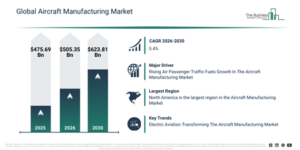
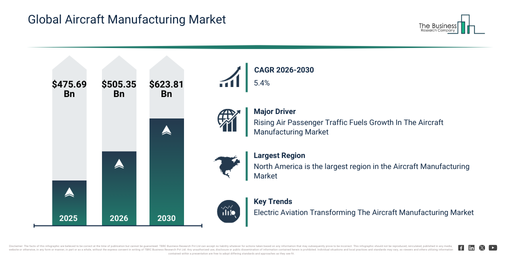
The aircraft manufacturing market has experienced robust expansion in recent years. It is projected to increase from $475.69 billion in 2025 to $505.35 billion in 2026, demonstrating a compound annual growth rate (CAGR) of 6.2%. This historical growth can be attributed to various factors, including the surge in global air passenger and cargo traffic driving aircraft production, the broadening of military procurement programs for advanced aircraft, advancements in aerostructure design and manufacturing technologies, increased investments in aircraft testing and certification infrastructure, and a rising demand for specialized aircraft such as cargo planes and business jets._x000D_
_x000D_
The aircraft manufacturing market is anticipated to show considerable expansion over the next few years. It is projected to reach $623.81 billion in 2030, exhibiting a compound annual growth rate (CAGR) of 5.4%. The upward trend during this forecast period can be attributed to the increasing output of next-generation commercial and military aircraft, the rising adoption of lightweight materials and composite aerostructures, a surging demand for aircraft designs that are fuel-efficient and produce low emissions, the broadening of autonomous and unmanned aircraft manufacturing capacities, and advancements in digital engineering and smart manufacturing that enhance aircraft development efficiency. Prominent trends for the forecast period encompass the integration of autonomous and AI-assisted flight systems, the utilization of smart manufacturing and robotics in aircraft assembly, the innovation of eco-friendly and lightweight aircraft materials, a greater emphasis on digital twin technology for aircraft design and testing, and sophisticated predictive maintenance powered by big data and IoT sensors._x000D_
_x000D_
#Get A Free Sample Report With In-Depth Market Insights:#_x000D_
_x000D_
#Aircraft Manufacturing Market Growth Backed By Core Demand Fundamentals#_x000D_
Rising air passenger volumes are anticipated to boost the aircraft manufacturing market’s future expansion. This traffic metric quantifies the number of individuals transported by air carriers or facilities within a specified timeframe. It serves as a crucial gauge of air travel demand, shaped by economic factors, passenger choices, travel limitations, and competitive airline landscapes. Greater demand for air journeys and increased passenger movement have generated prospects for the aircraft manufacturing sector to expand, given that airlines need additional aircraft to enlarge their fleets and introduce new routes and services, thereby stimulating the demand for fresh aircraft orders. For example, in January 2024, data from the International Air Transport Association, a Canada-based Trade association, revealed that in 2023, traffic saw an increase of 41.6% when contrasted with 2022. By December 2023, international traffic had grown by 24.2% relative to December 2022. Consequently, the uptick in air passenger traffic is poised to fuel the aircraft manufacturing market in the coming period._x000D_
_x000D_
#Aircraft Manufacturing Market Segment Landscape: Which Areas Lead Development?#_x000D_
The aircraft manufacturing market covered in this report is segmented – _x000D_
_x000D_
1) By Product: Gliders, Helicopters, Ultra-Light, Passenger, Unmanned Aerial Vehicles and Drones, Blimps (Airship)_x000D_
2) By Aircraft Type: Freighter Aircraft, Passenger Aircraft_x000D_
3) By Application: Military And Defense, Civil, Commercial (Freight), Other Applications_x000D_
_x000D_
Subsegments:_x000D_
1) By Gliders: Sailplanes, Motor Gliders, Thermal Gliders _x000D_
2) By Helicopters: Light Helicopters, Medium Helicopters, Heavy Lift Helicopters, Military Helicopters _x000D_
3) By Ultra-Light: Fixed-Wing Ultra-Light Aircraft, Powered Paragliders, Trikes and Powered Hang Gliders _x000D_
4) By Passenger Aircraft: Regional Jets, Narrow-Body Aircraft, Wide-Body Aircraft, Business Jets _x000D_
5) By Unmanned Aerial Vehicles and Drones: Fixed-Wing Drones, Multi-Rotor Drones, Hybrid Drones, Military UAVs _x000D_
6) By Blimps (Airship): Rigid Airships, Semi-Rigid Airships, Non-Rigid Airships (Blimps), Advertising and Surveillance Airships _x000D_
_x000D_
#Aircraft Manufacturing Market Growth Trends Reshaping The Competitive Landscape#_x000D_
Leading companies engaged in the aircraft manufacturing market are prioritizing the development of novel solutions, including electric aircraft production plants, to secure a competitive edge. Electric aircraft are airborne vehicles that operate using electric propulsion systems, deriving thrust from electric motors. For example, in October 2023, Beta Technologies, an aerospace company based in the US, unveiled an advanced electric aircraft manufacturing facility at the Patrick Leahy Burlington International Airport. This 188,500-square-foot establishment, designed for net-zero operation and outfitted with sustainable technology, will be responsible for manufacturing BETA’s fully electric aircraft, specifically the ALIA CTOL and the ALIA VTOL, targeting both military and commercial sectors. The facility’s sustainable attributes encompass geothermal wells, solar panels installed on the roof, and an emphasis on efficiency and user-centric design. BETA’s integrated manufacturing approach combines vertical integration with collaborations involving top aerospace suppliers, with projections to produce as many as 300 aircraft each year._x000D_
_x000D_
#Aircraft Manufacturing Market Industry Leaders And Competitive Landscape#_x000D_
Major companies operating in the aircraft manufacturing market are The Boeing Company, Lockheed Martin Corporation, Airbus SE, General Dynamics Corporation, Northrop Grumman Corporation, BAE Systems plc, Leonardo S.p.A., Textron Aviation Inc., Kawasaki Heavy Industries Aerospace Company, Commercial Aircraft Corporation of China Ltd. (COMAC), Gulfstream Aerospace Corporation, Dassault Aviation, Bombardier Inc., United Aircraft Corporation, Mitsubishi Aircraft Corporation, Embraer S.A., Saab AB, Irkut Corporation, Korea Aerospace Industries Ltd. (KAI), Sukhoi Company, Piper Aircraft Inc., Diamond Aircraft Industries GmbH, Antonov State Company, Hindustan Aeronautics Limited, Pilatus Aircraft Ltd., ATR – GIE Avions de Transport Régional _x000D_
_x000D_
#View The Full Aircraft Manufacturing Market Report:#_x000D_
_x000D_
#Aircraft Manufacturing Market Geographic Landscape: Which Region Dominates Industry Growth?#_x000D_
North America was the largest region in the aircraft manufacturing market in 2025. Asia-pacific is expected to be the fastest-growing region in the global aircraft manufacturing market report during the forecast period. The regions covered in the aircraft manufacturing market report are Asia-Pacific, South East Asia, Western Europe, Eastern Europe, North America, South America, Middle East, Africa._x000D_
_x000D_
#Reach Out To Our Team:#_x000D_
_x000D_
The Business Research Company: https://www.thebusinessresearchcompany.com/_x000D_
Americas: +1 310-496-7795_x000D_
Asia: +44 7882 955267 & +91 8897263534_x000D_
Europe: +44 7882 955267_x000D_
Email us at: marketing@tbrc.info_x000D_
_x000D_
#Follow us on:#_x000D_
_x000D_
LinkedIn: https://in.linkedin.com/company/the-business-research-company_x000D_
YouTube: https://www.youtube.com/channel/UC24_fI0rV8cR5DxlCpgmyFQ_x000D_
Global Market Model: https://www.thebusinessresearchcompany.com/global-market-model

Wasay has over a decade of experience in market research, data modelling, and analytics, with prior experience at GlobalData and Decision Tree Consulting Services. At The Business Research Company , he leads research operations across syndicated studies, customized consulting engagements, and the Global Market Model platform. His professional experience includes supporting organizations such as Boston Consulting Group, KPMG, and Ernst & Young. Wasay holds a degree in Electronics and Communications Engineering, postgraduate management qualifications from International Management Institute Belgium and Indian School of Business and Entrepreneurship, and completed the Integrated Program in Business Analytics from Indian Institute of Management Indore.