
Through market attractiveness analysis, total addressable market evaluation, company benchmarking matrices, interactive Excel dashboards, expanded supply chain intelligence, emerging startup coverage, and detailed product insights, The Business Research Company’s 2026 market reports provide more actionable and strategically valuable research.
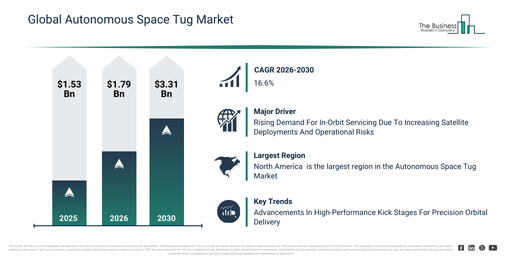
Autonomous Space Tug Market Forecast Highlighting Growth From $1.79 Billion To $3.31 Billion
The autonomous space tug market has experienced substantial growth in recent years. This market is set to expand from $1.53 billion in 2025 to $1.79 billion in 2026, achieving a compound annual growth rate (CAGR) of 17.0%. Key drivers for this historical growth include an escalating number of satellite launches that demand orbital management, significant advancements in autonomous spacecraft navigation and propulsion technologies, the initial implementation of in-orbit servicing missions, strategic collaborations between satellite operators and aerospace technology providers, and increased investment in space logistics and debris mitigation solutions.
The autonomous space tug market is anticipated to experience substantial growth in the upcoming years. It is projected to expand to $3.31 billion by 2030, achieving a compound annual growth rate (CAGR) of 16.6%. This expected expansion during the forecast period stems from the advancement of multifunctional autonomous tugs for satellite repositioning and refueling, the incorporation of AI for autonomous mission planning and collision prevention, an increasing requirement for end-of-life deorbiting and the removal of space debris, the expansion of commercial in-orbit servicing and logistics offerings, and a prioritization of modular, reusable, and cost-efficient tug platforms. Prominent trends for this period include the wider adoption of in-orbit servicing and refueling, technologies for space debris mitigation and removal, adaptable and reconfigurable space tug designs, cost reduction through reusability and swift operational turnarounds, and the capability for cross-orbit transfers and diverse missions.
Download A Free Sample Report For Comprehensive Market Insights:
Autonomous Space Tug Market Growth Factors Supporting Long-Term Expansion
The future expansion of the autonomous space tug market is anticipated to be driven by the rising need for in-orbit servicing. This servicing encompasses actions like satellite refueling, repair work, repositioning, and extending their operational life to maintain continuous functionality. The surge in in-orbit servicing stems from the increasing requirement to prolong the operational existence of costly satellites via maintenance, refueling, and upgrades, thereby lowering replacement expenditures. By necessitating sophisticated tugs for effective satellite repositioning, refueling, and debris clearance, in-orbit servicing fosters the expansion of the autonomous space tug market. For example, the Government Accountability Office (GAO), a US-based federal agency, reported in July 2025 that the count of active satellites in orbit, approximately 11,000 in 2025, is projected to exceed 18,000 by 2030. Consequently, the heightened demand for in-orbit servicing is fueling the development of the autonomous space tug market.
Autonomous Space Tug Market Categorization By Product Type And Application
The autonomous space tug market covered in this report is segmented –
1) By Type: Reusable Space Tugs, Single-Use Space Tugs
2) By Propulsion System: Chemical Propulsion, Electric Propulsion, Hybrid Propulsion
3) By Application: Satellite Deployment, Satellite Servicing, Orbital Transfer, Debris Removal, Other Applications
4) By End-User: Commercial, Government And Defense, Research Organizations
Subsegments:
1) Reusable Space Tugs: Modular Reusable Tugs, Heavy-Lift Reusable Tugs, Long-Duration Orbital Tugs, Rapid Turnaround Tugs
2) Single-Use Space Tugs: Dedicated Mission Tugs, Small Payload Delivery Tugs, High-Energy Orbit Transfer Tugs, De-Orbit Or Disposal Tugs
#Autonomous Space Tug Market Growth Trends: What Is Influencing The Future Outlook?
Companies operating in the autonomous space tug market are heavily investing in technological advancements, such as high-performance kick stages, to optimize last-mile orbital delivery. A high-performance kick stage serves as an additional propulsion unit integrated into a launch vehicle or space tug, providing supplementary thrust and maneuverability after the primary rocket has released its payload into orbit. For instance, in January 2024, Impulse Space Inc., a US-based in-space transportation company, launched Helios, a high-performance kick stage specifically designed to improve precision in payload deployment and increase orbital transfer efficiency. Helios is constructed with high-thrust chemical propulsion, sophisticated avionics, and a large propellant capacity, allowing it to execute complex movements like orbit raising, plane changes, and deploying multiple satellites. Its main applications include last-mile orbital delivery, enhancing rideshare missions, and transferring payloads to higher orbits such as GEO or lunar trajectories. The significant advantages of Helios encompass its mission flexibility, greater accuracy in orbital insertion, cost reduction by minimizing the requirement for dedicated launches, and expanded operational capabilities for various payloads.
Autonomous Space Tug Market Company Landscape And Strategic Competition
Major companies operating in the autonomous space tug market are Maxar Technologies Inc., Sierra Space Corporation, Astroscale Holdings Inc., Impulse Space Inc., ClearSpace SA, D-Orbit S.p.A., Starfish Space Inc., Space Machines Company Pty Ltd., Exotrail SAS, Orbit Fab Inc., Skycorp Inc., Infinite Orbits SAS, Rogue Space Systems Corporation, TransAstra Corporation, Momentus Inc., Kurs Orbital S.r.l., Obruta Space Solutions Inc., Viridian Space Corp., Neumann Space Pty Ltd., Bellatrix Aerospace Private Limited
Access The Complete Autonomous Space Tug Market Report:
Autonomous Space Tug Market Regional Outlook: Where Are The Largest Opportunities Located?
North America was the largest region in the autonomous space tug market in 2025. Asia-Pacific is expected to be the fastest-growing region in the forecast period. The regions covered in the autonomous space tug market report are Asia-Pacific, South East Asia, Western Europe, Eastern Europe, North America, South America, Middle East, Africa.
Access a Customized Autonomous Space Tug Market Report for Deeper Competitive Insights
https://www.thebusinessresearchcompany.com/customise?id=27766&type=smp
Get in touch with us:
The Business Research Company: https://www.thebusinessresearchcompany.com/
Americas: +1 310-496-7795
Asia: +44 7882 955267 & +91 8897263534
Europe: +44 7882 955267
Email us at: marketing@tbrc.info
Follow us on:
LinkedIn: https://in.linkedin.com/company/the-business-research-company
YouTube: https://www.youtube.com/channel/UC24_fI0rV8cR5DxlCpgmyFQ
Global Market Model: https://www.thebusinessresearchcompany.com/global-market-model

Wasay has over a decade of experience in market research, data modelling, and analytics, with prior experience at GlobalData and Decision Tree Consulting Services. At The Business Research Company , he leads research operations across syndicated studies, customized consulting engagements, and the Global Market Model platform. His professional experience includes supporting organizations such as Boston Consulting Group, KPMG, and Ernst & Young. Wasay holds a degree in Electronics and Communications Engineering, postgraduate management qualifications from International Management Institute Belgium and Indian School of Business and Entrepreneurship, and completed the Integrated Program in Business Analytics from Indian Institute of Management Indore.
