Delivering more actionable and strategically valuable research, The Business Research Company’s 2026 market reports feature market attractiveness analysis, total addressable market evaluation, company benchmarking matrices, interactive Excel dashboards, expanded supply chain intelligence, emerging startup coverage, and detailed product insights.
Autonomous Rocket Navigation Market Revenue Growth Supported By A CAGR Of $4.85 Through 2030
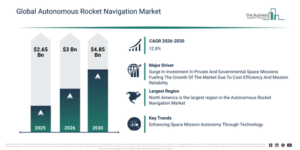
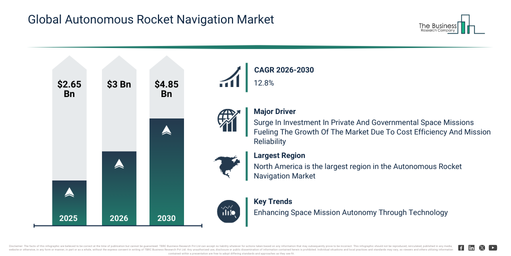
The autonomous rocket navigation market size has experienced rapid expansion in recent years. This market is projected to grow from $2.65 billion in 2025 to $3 billion in 2026, demonstrating a compound annual growth rate (CAGR) of 13.2%. The historical growth can be attributed to the development of inertial navigation units for early rocket guidance, the adoption of GNSS modules for position tracking, the integration of star trackers for orientation and trajectory accuracy, the deployment of vision-based navigation systems for autonomous flight, and the rising use of onboard flight computers and GNC solutions for precise control.
The autonomous rocket navigation market size is anticipated to experience substantial growth over the coming years. It is projected to reach $4.85 billion in 2030, demonstrating a compound annual growth rate (CAGR) of 12.8%. This expansion in the forecast period can be attributed to several factors, including a surging demand for AI-driven autonomous guidance, navigation, and control systems, the broadening of real-time trajectory planning and decision-making capabilities, increased integration of multi-sensor navigation systems for deep space missions, a concentrated focus on compact and high-performance flight computers for advanced rockets, and rising procurement for reusable and long-range autonomous rocket programs. Significant trends expected during this period involve the development of autonomous flight decision-making algorithms, an increased application of sensor fusion-based navigation enhancements, advancements in precision trajectory correction systems, a growing adoption of vision-based deep space navigation, and the rising integration of intelligent GNC redundancy architectures.
Download A Free Sample Report For Comprehensive Market Insights:
#Autonomous Rocket Navigation Market Demand Drivers Creating New Revenue Opportunities
The future growth of the autonomous rocket navigation market is anticipated to be driven by increasing investment in private and governmental space missions. These investments pertain to funds allocated for space exploration and operations conducted by commercial companies and government agencies. The rise in financial commitment to private and governmental space missions is due to technological advancements in space, as these innovations reduce launch expenses and enhance mission efficiency, making space exploration more economically feasible and strategically significant. Investment in private and governmental space missions fuels the development of sophisticated technologies, including autonomous rocket navigation systems. For example, Space Capital, a US–based venture capital firm that invests in space technology and related infrastructure companies, reported that in 2023, private markets firms deployed $12.5 billion into space-sector companies, marking a 30% increase compared to 2022. Therefore, the escalating investment in private and governmental space missions is propelling the expansion of the autonomous rocket navigation market.
Autonomous Rocket Navigation Market Segment Analysis And Revenue Opportunities
The autonomous rocket navigation market covered in this report is segmented –
1) By Component: Hardware, Software, Services
2) By Technology: Artificial Intelligence and Machine Learning, Global Positioning System, Inertial Navigation Systems, Other Technologies
3) By Application: Commercial Space Exploration, Military and Defense, Scientific Research, Other Applications
4) By End-User: Space Agencies, Private Space Companies, Defense Organizations, Other End-Users
Subsegments:
1) By Hardware: Sensors, Actuators, Navigation systems, Propulsion control units, Onboard computers
2) By Software: Guidance, Navigation, and Control (GNC) software, Mission planning software, Artificial Intelligence or Machine Learning algorithms for trajectory optimization, Simulation and testing software
4) By Services: Integration and testing services, Maintenance and support, Software updates and customization, Consulting and training services, Mission operations support
Autonomous Rocket Navigation Market Industry Trends: What Changes Are Reshaping Demand?
Major companies operating in the autonomous rocket navigation market are concentrating on developing sophisticated technologies, such as the quantum inertial sensor, to enable accurate, real-time trajectory management and fully autonomous guidance for rockets during their launch, flight, and landing. A quantum inertial sensor is a highly precise navigation device that leverages quantum phenomena, like atom interferometry, to measure acceleration and rotation without depending on GPS or external signals. For instance, in August 2025, The U.S. Space Force, a US-based branch of the Armed Forces responsible for space operations, tested a quantum inertial sensor for autonomous navigation on the X-37B spaceplane mission. This sensor aims to provide precise navigation capabilities without relying on external signals, thereby enhancing the autonomy of space missions.
Autonomous Rocket Navigation Market Leading Players Shaping Industry Direction
Major companies operating in the autonomous rocket navigation market are The Boeing Company, Lockheed Martin Corporation, China Aerospace Science and Technology Corporation (CASC), Northrop Grumman Corporation, Honeywell International Inc., BAE Systems plc, Leonardo S.p.A., Elbit Systems Ltd., Thales Alenia Space SAS, OHB System AG (part of OHB SE), Sierra Space Corporation, GMV Innovating Solutions S.L., Rocket Lab USA Inc., Gilmour Space Technologies Pty Ltd, Advanced Navigation Pty Ltd, Exotrail SAS, Astrobotic Technology Inc., Masten Space Systems Inc., Indian Space Research Organisation (ISRO), Japan Aerospace Exploration Agency (JAXA)
Access The Complete Autonomous Rocket Navigation Market Report:
Autonomous Rocket Navigation Market Geographic Landscape: Which Region Dominates Industry Growth?
North America was the largest region in the autonomous rocket navigation market in 2025. The regions covered in the autonomous rocket navigation market report are Asia-Pacific, South East Asia, Western Europe, Eastern Europe, North America, South America, Middle East, Africa.
Access a Customized Autonomous Rocket Navigation Market Report for Deeper Competitive Insights
https://www.thebusinessresearchcompany.com/customise?id=25237&type=smp
Get in touch with us:
The Business Research Company: https://www.thebusinessresearchcompany.com/
Americas: +1 310-496-7795
Asia: +44 7882 955267 & +91 8897263534
Europe: +44 7882 955267
Email us at: marketing@tbrc.info
Follow us on:
LinkedIn: https://in.linkedin.com/company/the-business-research-company
YouTube: https://www.youtube.com/channel/UC24_fI0rV8cR5DxlCpgmyFQ
Global Market Model: https://www.thebusinessresearchcompany.com/global-market-model

Wasay has over a decade of experience in market research, data modelling, and analytics, with prior experience at GlobalData and Decision Tree Consulting Services. At The Business Research Company , he leads research operations across syndicated studies, customized consulting engagements, and the Global Market Model platform. His professional experience includes supporting organizations such as Boston Consulting Group, KPMG, and Ernst & Young. Wasay holds a degree in Electronics and Communications Engineering, postgraduate management qualifications from International Management Institute Belgium and Indian School of Business and Entrepreneurship, and completed the Integrated Program in Business Analytics from Indian Institute of Management Indore.