Built to provide research that’s more actionable and strategically valuable, The Business Research Company’s 2026 market reports include market attractiveness analysis, total addressable market sizing, company benchmarking matrices, interactive Excel dashboards, broader supply chain intelligence, emerging startup tracking, and in-depth product insights.
Stationary Battery Storage Market Set To Climb From $67.91 Billion In 2026 To $146.62 Billion By 2030
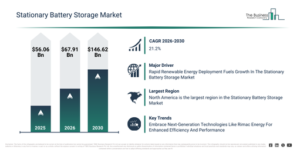
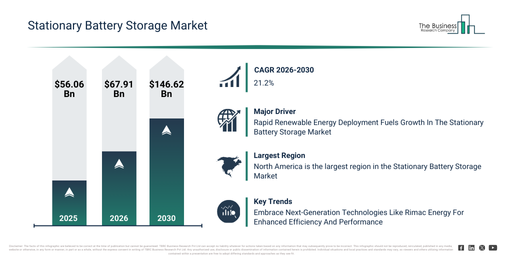
The stationary battery storage market has experienced substantial growth in recent years. Its value is projected to climb from $56.06 billion in 2025 to $67.91 billion in 2026, at a compound annual growth rate (CAGR) of 21.1%. Historically, this expansion has been driven by several factors, including the increasing integration of renewable energy sources necessitating grid balancing, a surging requirement for peak shaving and load shifting, the initial rollout of utility-scale battery storage pilot programs, a growing demand for backup power in crucial facilities, and decreasing battery expenses making wider adoption possible.
The stationary battery storage market is poised for significant expansion in the upcoming years. It is projected to attain a valuation of $146.62 billion by 2030, exhibiting a robust compound annual growth rate (CAGR) of 21.2%. This growth over the forecast period is fueled by several factors, including the increasing spread of virtual power plants and distributed energy systems, the escalating requirement for grid stability alongside a higher proportion of renewable energy, the progress in next-generation battery chemistries, augmented investment in energy resilience infrastructure, and a heightened emphasis on decarbonization and electrification targets. Noteworthy trends during this period involve the greater deployment of long-duration stationary storage solutions, a rise in the adoption of hybrid energy storage configurations, the expanding integration of battery storage into renewable microgrids, advancements in sophisticated safety and thermal management systems, and an increasing demand for modular and scalable stationary storage units.
Get A Free Sample Report With In-Depth Market Insights:
Stationary Battery Storage Market Development Factors: What’s Supporting Demand?
The anticipated swift implementation of renewable energy sources is projected to drive the expansion of the stationary battery storage market. This deployment involves utilizing renewable energy sources, such as solar, wind, hydropower, and geothermal energy, to produce electricity and fulfill diverse energy requirements. The quick increase in renewable energy sources demands effective energy storage for grid stability and reliability. Stationary battery storage is thus emerging as a vital element in the changing energy sector, providing grid operators with greater flexibility and management, and reducing the necessity for costly grid infrastructure enhancements. As an illustration, the International Energy Agency, an intergovernmental organization based in France, reported in January 2024 that global renewable energy capacity additions soared by 50% in 2023, reaching almost 510 gigawatts (GW), with solar PV making up approximately three-quarters of all new installations globally. China’s yearly PV installations increased by 57%, representing 42% of worldwide demand, largely due to distributed PV. Furthermore, annual installations were predicted to surpass 300 GW by 2023 and exceed 400 GW by 2025. Consequently, the swift adoption of renewable energy will fuel the expansion of the stationary battery storage market.
Stationary Battery Storage Market Segments: Where Is Growth Concentrated?
The stationary battery storage market covered in this report is segmented –
1) By Type Of Energy Storage: Hydrogen And Ammonia Storage, Gravitational Energy Storage, Compressed Air Energy Storage, Liquid Air Storage, Thermal Energy Storage
2) By Battery: Lithium Ion, Sodium Sulphur, Lead Acid, Flow Battery, Other Batteries
3) By Application: Grid Services, Behind The Meter, Off Grid
Subsegments:
1) By Hydrogen And Ammonia Storage: Hydrogen Fuel Cells, Ammonia Storage Systems
2) By Gravitational Energy Storage: Pumped Storage Hydropower, Gravity-Based Energy Storage Systems
3) By Compressed Air Energy Storage: Underground Storage Systems, Above-Ground Storage Systems
4) By Liquid Air Storage: Cryogenic Energy Storage Systems, Liquid Air Energy Storage (LAES) Technologies
5) By Thermal Energy Storage: Sensible Heat Storage, Latent Heat Storage
Stationary Battery Storage Market Transformation Trends: What Innovations Are Driving Change?
Leading companies within the stationary battery storage market are innovating with advanced technologies, such as Rimac Energy stationary energy storage systems, to boost profitability in the sector. Rimac Energy features a technologically sophisticated battery architecture that achieves a remarkable 50% reduction in efficiency losses and shrinks the system’s footprint by up to 40%, thereby outperforming existing industry-leading solutions. For instance, in May 2023, Rimac Technology, an automotive manufacturer based in Croatia, introduced Rimac Energy, a new stationary energy storage technology. This system is designed to develop the next generation of stationary energy storage systems (ESS) by leveraging the company’s expertise in creating market-defining electric vehicle technology. The innovative electrical structure underpinning Rimac Energy’s ESS provides considerable benefits in terms of performance, safety, and availability, including up to 50% lower energy losses and a 40% smaller system footprint.
Stationary Battery Storage Market Key Participants And Competitive Landscape
Major companies operating in the stationary battery storage market are Uniper SE, Hitachi Ltd., Tesla Inc., Siemens AG, General Electric Company, Lockheed Martin Corporation, Panasonic Corporation, BYD Company Ltd, LG Chem Ltd., Toshiba Corporation, Johnson Controls International plc, Samsung SDI Co. Ltd., Furukawa Battery Co. Ltd., GS Yuasa International Ltd., Exide Technologies, East Penn Manufacturing Co. Inc., Narada Power Source Co. Ltd., Saft Groupe S.A., Duracell Inc., Fluence Energy LLC, Schmid Group, Hoppecke Batteries, HydraRedox, CMBlu Energy AG, Durapower Group, JenaBatteries GmbH
View The Full Stationary Battery Storage Market Report:
Stationary Battery Storage Market Top Region: Where Does Most Revenue Come From?
North America was the largest region in the stationary battery storage market in 2025. Asia-Pacific is expected to be the fastest-growing region in the forecast period. The regions covered in the stationary battery storage market report are Asia-Pacific, South East Asia, Western Europe, Eastern Europe, North America, South America, Middle East, Africa.
Reach Out To Our Team:
The Business Research Company: https://www.thebusinessresearchcompany.com/
Americas: +1 310-496-7795
Asia: +44 7882 955267 & +91 8897263534
Europe: +44 7882 955267
Email us at: marketing@tbrc.info
Follow us on:
LinkedIn: https://in.linkedin.com/company/the-business-research-company
YouTube: https://www.youtube.com/channel/UC24_fI0rV8cR5DxlCpgmyFQ
Global Market Model: https://www.thebusinessresearchcompany.com/global-market-model

Wasay has over a decade of experience in market research, data modelling, and analytics, with prior experience at GlobalData and Decision Tree Consulting Services. At The Business Research Company , he leads research operations across syndicated studies, customized consulting engagements, and the Global Market Model platform. His professional experience includes supporting organizations such as Boston Consulting Group, KPMG, and Ernst & Young. Wasay holds a degree in Electronics and Communications Engineering, postgraduate management qualifications from International Management Institute Belgium and Indian School of Business and Entrepreneurship, and completed the Integrated Program in Business Analytics from Indian Institute of Management Indore.