Featuring market attractiveness scoring, total addressable market sizing, company benchmarking matrices, interactive Excel dashboards, deeper supply chain intelligence, emerging startup tracking, and granular product-level insights, The Business Research Company’s 2026 market reports are built to deliver research that is both more actionable and more strategically valuable.
Stationary Catalytic Systems Market CAGR Outlook And Future Development
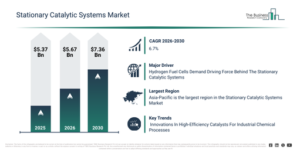
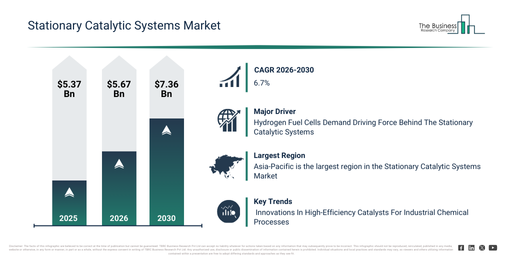
The stationary catalytic systems market has seen significant expansion in recent years. It is anticipated to increase from $5.37 billion in 2025 to $5.67 billion in 2026, achieving a compound annual growth rate (CAGR) of 5.5%. This historical development can be ascribed to stricter industrial emission regulations, a rise in pollution levels from stationary industrial sources, the early uptake of SCR and oxidation catalyst technologies, the growing utilization of platinum and palladium catalysts, and escalating industrialization which stimulates demand for pollutant control.
The stationary catalytic systems market is poised for significant expansion in the coming years. It is projected to grow to $7.36 billion by 2030, driven by a compound annual growth rate (CAGR) of 6.7%. This anticipated growth can be attributed to several factors, including the broadening scope of clean energy policies, an intensified focus on decarbonization within heavy industries, ongoing technological advancements in catalyst regeneration, increasing demand for cost-effective multi-pollutant control systems, and rising investments in modernizing emission controls. Key trends during this period are expected to encompass the growing adoption of high-efficiency catalyst formulations, the expanded deployment of low-temperature catalytic systems, the increasing integration of catalyst monitoring and diagnostic solutions, the expansion of modular catalytic units for industrial retrofits, and a notable shift towards ultra-low emission industrial operations.
Get A Free Sample Report With In-Depth Market Insights:
Stationary Catalytic Systems Market Expansion Drivers: What’s Shaping Future Growth?
The increasing need for hydrogen fuel cells is projected to boost the expansion of the stationary catalytic systems market over the next few years. An electrochemical cell known as a hydrogen fuel cell converts the chemical energy stored in hydrogen into electrical power through redox reactions. This represents a sustainable energy source, producing only electricity, heat, and water as its primary outputs and secondary results. Within stationary catalytic systems, hydrogen fuel cells find applications such as providing battery backup, ensuring an uninterrupted electricity supply (UPS), and facilitating remote energy generation. For example, data from the Global Hydrogen Review 2023, released in September 2023 by the International Energy Agency (IEA), an intergovernmental body based in France, indicates a 45% increase in hydrogen utilization for road transport during 2022. By the close of that year, the number of fuel cell vehicles exceeded 58,000, representing nearly a 40% rise to approximately 63,000 by mid-2023. Consequently, the escalating demand for hydrogen fuel cells is a key driver for the stationary catalytic systems market.
Stationary Catalytic Systems Market Segment Landscape: Which Areas Lead Development?
The stationary catalytic systems market covered in this report is segmented –
1) By Technology: Selective Catalytic Reduction, Oxidation Catalyst
2) By Pollutant Type: Nox (Nitrogen Oxides), CO (Carbon Monoxide) Hydrocarbons, HAP (Hazardous Air Pollutants), DPM (Diesel Particulate Matter), NH3 (Ammonia)
3) By End-Use Industry: Chemical, Oil And Natural Gas, Power Plant, Metal And Mining, Cement, Other End-Use Industries
Subsegments:
1) By Selective Catalytic Reduction (SCR): Ammonia-Based SCR Systems, Urea-Based SCR Systems
2) By Oxidation Catalyst: Platinum-Based Catalysts, Palladium-Based Catalysts
Stationary Catalytic Systems Market Strategic Trends: What Defines The Next Growth Phase?
Leading firms in the stationary catalytic systems market are concentrating on creating novel solutions, particularly high-efficiency catalyst formulations, with the aim of boosting reaction rates, decreasing energy usage, and extending the operational life of industrial chemical processes. These high-efficiency catalyst formulations are sophisticated chemical compositions designed to speed up particular reactions while simultaneously reducing material degradation and associated running expenses. An example of this is MIRATECH, a US-based industrial chemical company, which introduced Apex, an innovative industry-leading catalyst product line, in September 2023. Apex aims to optimize reaction efficiency, prolong catalyst lifespan, and minimize operational downtime in extensive chemical manufacturing operations, thereby allowing businesses to attain greater productivity and lower energy consumption.
Stationary Catalytic Systems Market Industry Leaders And Competitive Landscape
Major companies operating in the stationary catalytic systems market are Shell plc, BASF SE, Honeywell International inc., Bharat Heavy Electricals Limited, Yara International, Tenneco Inc., Johnson Matthey, Hitachi Zosen Corporation, Corning Incorporated, DuPont de Nemours Inc, Clariant AG, Durr Group, Umicore N.V., NIPPON SHOKUBAI CO. LTD, CECO Environmental, Babcock and Wilcox Enterprises Inc., Dinex Group, Ducon Infratechnologies Ltd., Kwangsung Corporation Ltd, Nett Technologies, Unifrax Holding Co., Air Clean Energy, DCL International, Catalytic Products International Inc., APC Technologies Inc., Advanced Catalyst Systems LLC
View The Full Stationary Catalytic Systems Market Report:
Stationary Catalytic Systems Market Regional Split: Which Areas Are Fueling Growth?
Asia-Pacific was the largest region in the stationary catalytic systems market in 2025. The regions covered in the stationary catalytic systems market report are Asia-Pacific, South East Asia, Western Europe, Eastern Europe, North America, South America, Middle East, Africa.
Reach Out To Our Team:
The Business Research Company: https://www.thebusinessresearchcompany.com/
Americas: +1 310-496-7795
Asia: +44 7882 955267 & +91 8897263534
Europe: +44 7882 955267
Email us at: marketing@tbrc.info
Follow us on:
LinkedIn: https://in.linkedin.com/company/the-business-research-company
YouTube: https://www.youtube.com/channel/UC24_fI0rV8cR5DxlCpgmyFQ
Global Market Model: https://www.thebusinessresearchcompany.com/global-market-model

Wasay has over a decade of experience in market research, data modelling, and analytics, with prior experience at GlobalData and Decision Tree Consulting Services. At The Business Research Company , he leads research operations across syndicated studies, customized consulting engagements, and the Global Market Model platform. His professional experience includes supporting organizations such as Boston Consulting Group, KPMG, and Ernst & Young. Wasay holds a degree in Electronics and Communications Engineering, postgraduate management qualifications from International Management Institute Belgium and Indian School of Business and Entrepreneurship, and completed the Integrated Program in Business Analytics from Indian Institute of Management Indore.