
Built to provide research that’s more actionable and strategically valuable, The Business Research Company’s 2026 market reports include market attractiveness analysis, total addressable market sizing, company benchmarking matrices, interactive Excel dashboards, broader supply chain intelligence, emerging startup tracking, and in-depth product insights.
Aircraft Environmental Control Systems Market Size And Revenue Outlook Through 2030
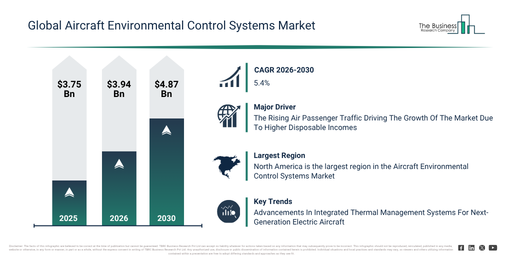
In recent years, the aircraft environmental control systems market has experienced substantial growth. Forecasts indicate it will expand from $3.75 billion in 2025 to $3.94 billion in 2026, progressing at a compound annual growth rate (CAGR) of 5.2%. The market’s expansion in the historic period can be ascribed to several factors, including the escalating demand for passenger comfort and safety, the increasing integration of advanced avionics systems, the expansion of the commercial aviation fleet, and a heightened focus on aircraft operational efficiency.
The aircraft environmental control systems market size is projected to experience robust expansion over the coming years. This market is anticipated to reach $4.87 billion by 2030, demonstrating a compound annual growth rate (CAGR) of 5.4%. Factors contributing to this growth during the forecast period include the increasing demand for next-generation aircraft, the rising integration of electric and hybrid aircraft systems, a growing requirement for sophisticated thermal management solutions, expanding investments in aircraft modernization initiatives, and a heightened need for effective cabin environmental management. Key trends anticipated during the forecast period encompass the growing adoption of advanced cabin air purification systems, a greater demand for lightweight environmental control system components, an intensified focus on enhanced aircraft thermal management solutions, the increasing integration of sophisticated humidity and pressure regulation systems, and the accelerated development of energy-efficient aircraft environmental control technologies.
Get A Free Sample Report With In-Depth Market Insights:
Aircraft Environmental Control Systems Market Demand Drivers: What’s Powering Industry Growth?
The surging volume of air passengers is projected to stimulate the expansion of the aircraft environmental control systems market moving forward. Air passenger traffic denotes the aggregate count of individuals transported by airlines via domestic and international air services over a defined timeframe, acting as a crucial metric for air travel demand. The increase in air passenger traffic stems from elevated disposable incomes, enabling more individuals to afford air travel for both business and leisure purposes. This uptick in air passenger traffic is fueling the need for new aircraft deliveries and fleet expansions, consequently boosting the requirement for sophisticated aircraft environmental control systems that guarantee passenger comfort, optimal cabin air quality, and effective thermal regulation. For example, in October 2024, the Department of Transportation, a US-based government department, reported that 647,205 flights were operated in August 2024, showing a 2.61% rise from the 630,761 flights in August 2023. Thus, the escalating air passenger traffic is propelling the growth of the aircraft environmental control systems market. The growing number of military modernization programs is anticipated to drive the aircraft environmental control systems market forward. Military modernization programs are extensive efforts by armed forces aimed at upgrading and improving their defense capabilities through advanced weaponry and technologies. The rise in military modernization programs is a result of increasing geopolitical tensions and security threats to national sovereignty and regional stability, as countries strive to bolster their defense capabilities, deter potential adversaries, and protect their strategic interests. Expanding military modernization programs are increasing the demand for advanced aircraft environmental control systems by accelerating the acquisition and enhancement of next-generation military aircraft that necessitate complex cabin pressurization, thermal management, and avionics cooling functionalities. For instance, in March 2023, the European Security and Defence College, a Belgium-based autonomous institution, stated that by 2030, the ongoing US Army modernization program is scheduled to deploy 35 new future force systems, forming the core of over 500 development, acquisition, or upgrade projects currently in progress. Consequently, the rise in military modernization programs is fostering the growth of the aircraft environmental control systems market.
Aircraft Environmental Control Systems Market Segments: Where Is Growth Concentrated?
The aircraft environmental control systems market covered in this report is segmented –
1) By System Type: Air Supply And Management System, Thermal Management And Control System, Cabin Pressure And Control System, Humidity Control And Filtration System
2) By Aircraft Type: Fixed Wing, Rotary Wing
3) By Distribution Channel: Original Equipment Manufacturer, Aftermarket
4) By Application: Cabin Comfort And Air Quality, Avionics Cooling, Engine And Auxiliary Power Unit Thermal Regulation, Weapon Systems Cooling, Electronic Equipment Cooling
5) By End Use: Commercial Aviation, Military And Defense Aviation, General Aviation, Other End Uses
Subsegments:
1) By Air Supply And Management System: Engine Bleed Air Supply System, Auxiliary Power Air Supply System, Air Distribution Ducting System, Air Flow Regulation System, Air Mixing And Conditioning System, Ventilation Air Delivery System
2) By Thermal Management And Control System: Heat Exchanger System, Cooling Air Management System, Temperature Sensing And Monitoring System, Thermal Control Valve System, Equipment Cooling System, Refrigeration And Cooling Cycle System
3) By Cabin Pressure And Control System: Cabin Pressurization Control System, Pressure Relief Valve System, Outflow Valve Control System, Cabin Altitude Monitoring System, Differential Pressure Regulation System, Emergency Depressurization Protection System
4) By Humidity Control And Filtration System: Cabin Humidity Regulation System, Air Filtration System, Particulate Removal System, Contaminant Detection And Control System, Air Purification System, Moisture Separation And Management System
Aircraft Environmental Control Systems Market Trends: What’s Defining The Industry’s Next Phase?
Leading companies within the aircraft environmental control systems market are concentrating on technological innovations, such as integrated thermal management systems, aiming to boost energy efficiency, fine-tune cabin and battery temperature management, and elevate the performance and dependability of electric and future aircraft. These integrated thermal management systems represent sophisticated environmental control solutions that unify functions like battery cooling, avionics cooling, cabin climate regulation, and heat management into a single unit. This integration delivers superior efficiency, reduced weight, and enhanced thermal performance when contrasted with traditional separate cooling and environmental control systems. As an illustration, in June 2023, Intergalactic, an aerospace technology firm from the US, introduced the GS1-EV Eagle5. This product is an innovative and fully integrated thermal management system specifically engineered for electric aircraft and electric vertical takeoff and landing applications. The system incorporates battery thermal management, cabin climate control, avionics cooling, and heat pump capabilities within a space-efficient design. Its design aims to optimize thermal efficiency while concurrently decreasing system complexity, overall weight, and energy usage. The GS1-EV Eagle5 facilitates effective temperature control across vital aircraft subsystems, thereby improving operational dependability and the aircraft’s overall performance. This product launch underscores the industry’s increasing emphasis on integrated environmental control technologies for future electric aviation platforms.
Aircraft Environmental Control Systems Market Key Participants And Competitive Landscape
Major companies operating in the aircraft environmental control systems market are Honeywell International Inc., RTX Corporation, Parker Hannifin Corporation, Liebherr-International AG, Safran S.A., Eaton Corporation plc, Diehl Aviation Holding GmbH, AMETEK Inc., Woodward Inc., ITT Inc., Curtiss-Wright Corporation, Astronics Corporation, GKN Aerospace Services Limited, CTT Systems AB, PBS Velka Bites a.s., FIMAC S.p.A., Omni Aerospace Inc.
View The Full Aircraft Environmental Control Systems Market Report:
Aircraft Environmental Control Systems Market Top Region By Revenue And Market Share
North America was the largest region in the aircraft environmental control systems market in 2025. Asia-Pacific is expected to be the fastest-growing region in the forecast period. The regions covered in the aircraft environmental control systems market report are Asia-Pacific, South East Asia, Western Europe, Eastern Europe, North America, South America, Middle East, Africa.
Reach Out To Our Team:
The Business Research Company: https://www.thebusinessresearchcompany.com/
Americas: +1 310-496-7795
Asia: +44 7882 955267 & +91 8897263534
Europe: +44 7882 955267
Email us at: marketing@tbrc.info
Follow us on:
LinkedIn: https://in.linkedin.com/company/the-business-research-company
YouTube: https://www.youtube.com/channel/UC24_fI0rV8cR5DxlCpgmyFQ
Global Market Model: https://www.thebusinessresearchcompany.com/global-market-model

Wasay has over a decade of experience in market research, data modelling, and analytics, with prior experience at GlobalData and Decision Tree Consulting Services. At The Business Research Company , he leads research operations across syndicated studies, customized consulting engagements, and the Global Market Model platform. His professional experience includes supporting organizations such as Boston Consulting Group, KPMG, and Ernst & Young. Wasay holds a degree in Electronics and Communications Engineering, postgraduate management qualifications from International Management Institute Belgium and Indian School of Business and Entrepreneurship, and completed the Integrated Program in Business Analytics from Indian Institute of Management Indore.