
Backed by market attractiveness analysis, total addressable market sizing, company benchmarking matrices, interactive Excel dashboards, wider supply chain intelligence, emerging startup coverage, and detailed product-level insights, The Business Research Company’s 2026 market reports are designed to offer research that is more actionable and strategically valuable than ever.
Aircraft Engine Casting Market Growth From $10.4 Billion In 2026 To $13.71 Billion By 2030 At A CAGR Of 7.17%
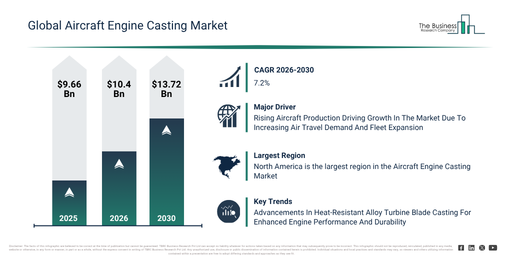
The aircraft engine casting market size has experienced robust growth recently. This market is set to expand from $9.66 billion in 2025 to $10.4 billion in 2026, exhibiting a compound annual growth rate (CAGR) of 7.6%. The historical growth trajectory can be attributed to factors such as increased aircraft manufacturing, a surging requirement for fuel-efficient engines, the greater adoption of advanced aerospace materials, the expansion of the commercial aviation fleet, and a heightened focus on engine performance and durability.
The aircraft engine casting market is projected to experience substantial expansion over the coming years. By 2030, this market is anticipated to reach a value of $13.72 billion, exhibiting a compound annual growth rate (CAGR) of 7.2%. This anticipated growth during the forecast period is primarily driven by factors such as the increasing demand for next-generation aircraft engines, the growing adoption of lightweight casting materials, a surge in investments within aerospace manufacturing capabilities, the expanding needs for aircraft engine maintenance, and the escalating requirement for high-precision engine components. Key trends anticipated during this period encompass the increased adoption of advanced casting techniques for aircraft engine components, a rising demand for lightweight and high-strength aerospace alloys, the expanding application of precision investment casting for intricate engine parts, an intensifying focus on enhancing casting quality and minimizing defects, and the broader integration of additive manufacturing within aircraft engine casting processes.
Get A Free Sample Report With In-Depth Market Insights:
Aircraft Engine Casting Market Growth Drivers: What’s Behind The Acceleration?
The projected rise in aircraft manufacturing is anticipated to boost the expansion of the aircraft engine casting market in the future. Aircraft production involves the creation and assembly of all necessary components to form a fully operational and airworthy aircraft, adhering to rigorous safety and performance criteria. This increase in aircraft manufacturing primarily stems from a surge in global air travel, with an expanding middle class and more accessible airfares stimulating greater demand for new planes to enlarge existing fleets and substitute older models. Aircraft engine casting facilitates aircraft production by allowing for the precise and efficient creation of resilient engine parts, which in turn enhances performance and scalability during aircraft assembly. A notable example is provided by Airbus SE, a France-based aircraft manufacturer, which reported that commercial aircraft deliveries grew from 735 units in 2023 to 766 units in 2024, as stated in January 2025. Consequently, the escalating volume of aircraft production is a key factor fueling the expansion of the aircraft engine casting market.
Aircraft Engine Casting Market Segment Analysis: What Are The Core Market Categories?
The aircraft engine casting market covered in this report is segmented –
1) By Component Type: Airfoils, Casings, Discs, Shafts, Combustor Components, Other Component Types
2) By Aircraft Type: Commercial Aircraft, Regional Aircraft, Helicopter, Military Aircraft, General Aviation
3) By Engine Type: Turbofan, Turboprop, Turbojet, Turboshaft
4) By Application Type: Fans, Compressor, Combustion, Turbine, Other Application Types
5) By End User: Original Equipment Manufacturers, Aftermarket
Subsegments:
1) By Airfoils: Turbine Blades, Compressor Blades, Guide Vanes, Fan Blades
2) By Casings: Compressor Casings, Turbine Casings, Fan Casings, Combustor Casings
3) By Discs: Compressor Discs, Turbine Discs, Fan Discs, Rotor Discs
4) By Shafts: Low Pressure Shafts, High Pressure Shafts, Intermediate Shafts, Compressor Shafts
5) By Combustor Components: Combustion Liners, Fuel Nozzles, Flame Tubes, Dome Assemblies
6) By Other Component Types: Seal Segments, Mounting Brackets, Support Structures, Fastener Components
Aircraft Engine Casting Market Trends: What’s Defining The Industry’s Next Phase?
Leading companies within the aircraft engine casting market are concentrating on creating sophisticated products, including heat-resistant alloy turbine blade casting, with the goal of improving the performance, thermal resilience, component lifespan, and fuel economy of future aircraft engines. This specific technique, heat-resistant alloy turbine blade casting, involves manufacturing turbine blades from alloys capable of withstanding high temperatures through cutting-edge casting processes, thereby boosting aircraft engine performance, longevity, and thermal effectiveness. As an illustration, during February 2024, Rostec, a defense and technology enterprise based in Russia, initiated the manufacturing of PD-8 aircraft engine turbine blades using advanced heat-resistant nickel-based alloys at its pioneering UEC-Saturn casting facility located in Rybinsk, Russia. These blades are engineered to endure exceptionally high loads and temperatures. The components incorporate five freshly developed cast alloys for both low- and high-pressure turbine sections, which in turn improves engine durability, thermal resilience, and overall performance, aiding future regional aircraft propulsion systems.
Aircraft Engine Casting Market Top Companies Driving Competitive Growth
Major companies operating in the aircraft engine casting market are Howmet Aerospace Inc., GE Aerospace, Rolls-Royce PLC, RTX Corporation, Safran S.A., Consolidated Precision Products Corp., ITP Aero Group S.A., Bharat Forge Limited, Magellan Aerospace Corporation, Doncasters Group Ltd., Impro Precision Industries Limited, ZOLLERN GmbH And Co. KG, MetalTek International Inc., Hitchiner Manufacturing Co. Inc., Bescast Inc., PTC Industries Limited, Milwaukee Precision Casting Inc., RLM Industries Inc., PBS Velka Bites a.s., Aerospace Industrial Development Corporation
View The Full Aircraft Engine Casting Market Report:
Aircraft Engine Casting Market Regional Analysis And Top Geography
North America was the largest region in the aircraft engine casting market in 2025. Asia-Pacific is expected to be the fastest-growing region in the forecast period. The regions covered in the aircraft engine casting market report are Asia-Pacific, South East Asia, Western Europe, Eastern Europe, North America, South America, Middle East, Africa.
Reach Out To Our Team:
The Business Research Company: https://www.thebusinessresearchcompany.com/
Americas: +1 310-496-7795
Asia: +44 7882 955267 & +91 8897263534
Europe: +44 7882 955267
Email us at: marketing@tbrc.info
Follow us on:
LinkedIn: https://in.linkedin.com/company/the-business-research-company
YouTube: https://www.youtube.com/channel/UC24_fI0rV8cR5DxlCpgmyFQ
Global Market Model: https://www.thebusinessresearchcompany.com/global-market-model

Wasay has over a decade of experience in market research, data modelling, and analytics, with prior experience at GlobalData and Decision Tree Consulting Services. At The Business Research Company , he leads research operations across syndicated studies, customized consulting engagements, and the Global Market Model platform. His professional experience includes supporting organizations such as Boston Consulting Group, KPMG, and Ernst & Young. Wasay holds a degree in Electronics and Communications Engineering, postgraduate management qualifications from International Management Institute Belgium and Indian School of Business and Entrepreneurship, and completed the Integrated Program in Business Analytics from Indian Institute of Management Indore.