
Built to provide research that’s more actionable and strategically valuable, The Business Research Company’s 2026 market reports include market attractiveness analysis, total addressable market sizing, company benchmarking matrices, interactive Excel dashboards, broader supply chain intelligence, emerging startup tracking, and in-depth product insights.
Next Generation Memory Market Size, Value And Growth Trajectory Through 2030
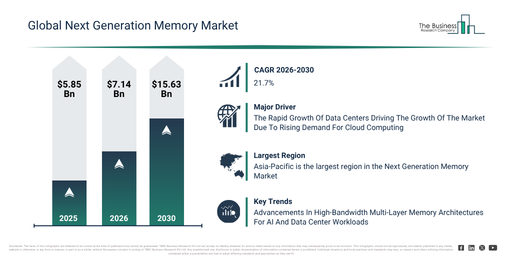
The next generation memory market size has witnessed substantial growth in recent years. It is anticipated to increase from $5.85 billion in 2025 to $7.14 billion in 2026, achieving a compound annual growth rate (CAGR) of 22.1%. This historical expansion can be attributed to the increasing need for quicker computing systems, the growing adoption of semiconductor-based electronic devices, the rising demand for data storage capacity, the ongoing development of advanced computing infrastructure, and the continuous requirement for improved memory performance and reliability.
The next generation memory market size is poised for substantial expansion in the coming years. It is projected to achieve a value of $15.63 billion by 2030, growing at a compound annual growth rate (CAGR) of 21.7%. The anticipated growth during this period stems from heightened demand for AI and high performance computing applications, increased adoption of advanced memory solutions in data centers, expanding deployment of edge computing infrastructure, a rising need for energy efficient memory technologies, and broader utilization of next generation memory in automotive and industrial applications. Significant trends expected in the forecast period include the increasing uptake of high bandwidth memory for advanced computing applications, the continuous development of low power and energy efficient memory technologies, a surging demand for high density memory solutions in data intensive applications, greater integration of advanced memory architectures in next generation computing systems, and an intensifying focus on durable and high performance memory technologies.
Get A Free Sample Report With In-Depth Market Insights:
Next Generation Memory Market Demand Drivers Opening New Revenue Streams
The increasing expansion of data centers is anticipated to drive the advancement of the next generation memory market in the future. These specialized facilities, known as data centers, accommodate computer systems, servers, storage units, and networking gear for storing, processing, and handling significant amounts of digital data. The quick rise in data centers stems from the growing need for cloud computing, which demands extensive, centralized infrastructure to effectively store, process, and distribute substantial data and applications via the internet. Next generation memory enhances data centers by providing very high bandwidth, reduced latency, and better energy efficiency, thus facilitating quicker data processing and adaptable performance for cloud computing and AI workloads. For example, as reported by the Office for National Statistics, a UK government department, in July 2024, data centers experienced the highest percentage increase in investment among all assets in 2022, climbing by 77.7% to attain $2.79 billion. Consequently, the swift expansion of data centers is fueling the growth of the next generation memory market.
Next Generation Memory Market Segment Analysis Spotlighting Growth Areas
The next generation memory market covered in this report is segmented –
1) By Technology: Nonvolatile Memories, Volatile Memories
2) By Memory Wafer Size: Two Hundred Millimeter, Three Hundred Millimeter, Other Memory Wafer Sizes
3) By Material Type: Ferroelectric Materials, Magnetic Materials, Phase Change Materials, Metal Oxides, Carbon Based Materials, Other Material Types
4) By Application: Consumer Electronics, Automotive Electronics, Data Centers And High Performance Computing, Industrial Internet Of Things, Neuromorphic Computing Or Artificial Intelligence Hardware, Telecommunications, Aerospace And Defense, Other Applications
Subsegments:
1) By Nonvolatile Memories: Phase Change Memory, Resistive Random Access Memory, Magnetoresistive Random Access Memory, Ferroelectric Random Access Memory, Conductive Bridge Random Access Memory, Three Dimensional Crosspoint Memory, Spin Transfer Torque Memory, Domain Wall Memory
2) By Volatile Memories: Static Random Access Memory, Dynamic Random Access Memory, Embedded Dynamic Random Access Memory, Pseudo Static Random Access Memory, Zero Capacitor Random Access Memory, Twin Transistor Random Access Memory, High Bandwidth Memory, Graphics Dynamic Random Access Memory
Next Generation Memory Market Trends Shaping Long-Term Demand
Major companies operating in the next generation memory market are concentrating on developing innovative solutions, including high-bandwidth multi-layer memory architectures, to enhance data processing speed, improve energy efficiency, and support large-scale artificial intelligence and data center workloads. These high-bandwidth multi-layer memory architectures are advanced semiconductor memory systems that stack multiple DRAM layers vertically to significantly increase data transfer rates and capacity compared to conventional memory technologies, facilitating faster computation and reduced latency in AI training and inference tasks. For instance, in January 2026, SK Hynix Inc., a South Korea-based semiconductor memory manufacturer, launched its next-generation AI memory solutions at CES 2026, introducing advanced HBM and AI memory modules designed for high-performance computing and generative AI workloads. These solutions feature vertically stacked DRAM layers, ultra-wide memory interfaces, and improved power efficiency to support the massive data throughput required by AI model training and inference. They are engineered to reduce latency, enhance bandwidth scalability, and optimize thermal performance in hyperscale data centers and AI accelerators, making them suitable for cloud computing, autonomous systems, and advanced analytics applications.
Next Generation Memory Market Leading Companies: Who Holds The Strongest Market Presence?
Major companies operating in the next generation memory market are Avalanche Technology Inc., Everspin Technologies Inc., Ferroelectric Memory Company, GlobalFoundries Inc., Infineon Technologies AG, Intel Corporation, Kioxia Holdings Corporation, Macronix International Co. Ltd., Micron Technology Inc., Nanya Technology Corporation, NXP Semiconductors N.V., Powerchip Semiconductor Manufacturing Corporation, Rambus Inc., Renesas Electronics Corporation, Samsung Electronics Co. Ltd., SK hynix Inc., Sony Semiconductor Solutions Corporation, STMicroelectronics N.V., Taiwan Semiconductor Manufacturing Company Ltd., Weebit Nano Ltd., Western Digital Corporation, Winbond Electronics Corporation
View The Full Next Generation Memory Market Report:
Next Generation Memory Market Geographic Spread And Regional Opportunities
Asia-Pacific was the largest region in the next generation memory market in 2025. Asia-Pacific is expected to be the fastest-growing region in the forecast period. The regions covered in the next generation memory market report are Asia-Pacific, South East Asia, Western Europe, Eastern Europe, North America, South America, Middle East, Africa.
Reach Out To Our Team:
The Business Research Company: https://www.thebusinessresearchcompany.com/
Americas: +1 310-496-7795
Asia: +44 7882 955267 & +91 8897263534
Europe: +44 7882 955267
Email us at: marketing@tbrc.info
Follow us on:
LinkedIn: https://in.linkedin.com/company/the-business-research-company
YouTube: https://www.youtube.com/channel/UC24_fI0rV8cR5DxlCpgmyFQ
Global Market Model: https://www.thebusinessresearchcompany.com/global-market-model

Wasay has over a decade of experience in market research, data modelling, and analytics, with prior experience at GlobalData and Decision Tree Consulting Services. At The Business Research Company , he leads research operations across syndicated studies, customized consulting engagements, and the Global Market Model platform. His professional experience includes supporting organizations such as Boston Consulting Group, KPMG, and Ernst & Young. Wasay holds a degree in Electronics and Communications Engineering, postgraduate management qualifications from International Management Institute Belgium and Indian School of Business and Entrepreneurship, and completed the Integrated Program in Business Analytics from Indian Institute of Management Indore.