
Backed by market attractiveness analysis, total addressable market sizing, company benchmarking matrices, interactive Excel dashboards, wider supply chain intelligence, emerging startup coverage, and detailed product-level insights, The Business Research Company’s 2026 market reports are designed to offer research that is more actionable and strategically valuable than ever.
Photosensitive Semiconductor Market Size, Value And Growth Trajectory Through 2030
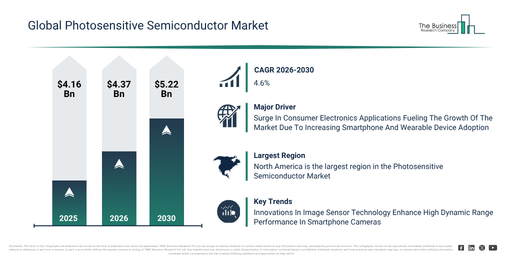
The photosensitive semiconductor market has seen its size increase steadily over recent years. It is anticipated to grow from $4.16 billion in 2025 to $4.37 billion in 2026, progressing at a compound annual growth rate (CAGR) of 5.0%. This past growth can be ascribed to an escalating demand for image sensing technologies, the wider adoption of optical communication systems, a rising utilization of semiconductor-based photodetectors, the expansion of consumer electronics manufacturing, and increasing investments in the advancement of optoelectronic devices.
The photosensitive semiconductor market is projected to experience steady expansion in the next few years. Its market size is forecasted to reach $5.22 billion by 2030, achieving a compound annual growth rate (CAGR) of 4.6%. This expansion during the forecast period is driven by factors such as the increasing demand for autonomous sensing systems, the growing deployment of advanced optical communication networks, rising investments in silicon photonics, the expanding adoption of smart industrial sensing solutions, and the increasing demand for high efficiency imaging technologies. Key trends observed during this period encompass the growing adoption of high sensitivity image sensors, an increasing demand for advanced photodetector technologies, the rising development of wide spectrum photosensitive semiconductor materials, expanding integration of silicon photonic devices, and the increasing commercialization of quantum dot photodetectors.
Get A Free Sample Report With In-Depth Market Insights:
Photosensitive Semiconductor Market Industry Drivers: What’s Behind The Revenue Growth?
The photosensitive semiconductor market is projected to grow significantly due to increasing demand from consumer electronics applications. Consumer electronics broadly refers to electronic devices and technologies used for personal, household, entertainment, communication, and daily consumer needs. This surge in demand is primarily fueled by the growing adoption of smartphones and wearable devices, which rely on advanced electronic components for improved performance, connectivity, and energy efficiency. Photosensitive semiconductors play a vital role in these devices by converting light into electrical signals, enabling features such as image sensing, facial recognition, ambient light adjustment, gesture detection, and optical communication in products like smartphones, cameras, and wearable devices. As an illustration, the Japan Electronics and Information Technology Industries Association, a Japan-based trade association, reported that the total consumer electronic equipment production in Japan reached $209.16 million (¥32,099 million) in May 2023, up from $164.65 million (¥25,268 million) in May 2022. Thus, the escalating demand from consumer electronics applications is a major catalyst driving the expansion of the photosensitive semiconductor market.
Photosensitive Semiconductor Market Segment Analysis: What Are The Core Market Categories?
The photosensitive semiconductor market covered in this report is segmented –
1) By Device Type: Photodiodes, Phototransistors, Complementary Metal Oxide Semiconductor Image Sensors, Charge Coupled Device Image Sensors, Photoresistors, Optical Integrated Circuits, Other Device Types
2) By Form Factor: Chips, Packaged Sensors, Modules, Other Form Factors
3) By Operating Wavelength Range: Ultraviolet, Visible Light, Infrared, Near Infrared, Short Wave Infrared
4) By Material Type: Silicon, Germanium, Compound Semiconductors, Emerging Materials
5) By End Use Industry: Consumer Electronics, Automotive, Industrial Manufacturing, Healthcare, Telecommunications, Aerospace And Defense, Energy And Utilities, Research Institutions
Subsegments:
1) By Photodiodes: P-N Photodiodes, P-I-N Photodiodes, Avalanche Photodiodes, Schottky Photodiodes, Metal Semiconductor Metal Photodiodes
2) By Phototransistors: Bipolar Phototransistors, Darlington Phototransistors, Field Effect Phototransistors
3) By Complementary Metal Oxide Semiconductor Image Sensors: Front Side Illuminated Image Sensors, Back Side Illuminated Image Sensors, Stacked Image Sensors, Global Shutter Image Sensors, Rolling Shutter Image Sensors
4) By Charge Coupled Device Image Sensors: Full Frame Charge Coupled Device Image Sensors, Frame Transfer Charge Coupled Device Image Sensors, Interline Transfer Charge Coupled Device Image Sensors, Electron Multiplying Charge Coupled Device Image Sensors
5) By Photoresistors: Cadmium Sulfide Photoresistors, Cadmium Selenide Photoresistors, Lead Sulfide Photoresistors, Indium Antimonide Photoresistors
6) By Optical Integrated Circuits: Monolithic Optical Integrated Circuits, Hybrid Optical Integrated Circuits, Planar Lightwave Circuits, Silicon Photonic Integrated Circuits
7) By Other Device Types: Photothyristors, Phototriacs, Photoconductive Detectors, Quantum Dot Photodetectors
Photosensitive Semiconductor Market Trends: What’s Defining The Industry’s Next Phase?
Major companies operating within the photosensitive semiconductor market are prioritizing the creation of advanced image sensing solutions, including single-exposure high dynamic range (HDR) image sensors. This focus aims to elevate image quality, enhance performance in dimly lit environments, and achieve more accurate scene reproduction across different lighting conditions. Single-exposure HDR image sensors are photosensitive semiconductor devices that capture an extensive dynamic range of light in a single shot, resulting in clearer and more detailed images devoid of motion artifacts. For instance, in March 2024, OMNIVISION, a US-based provider of semiconductor solutions, unveiled the OV50K40, which is the industry’s premier smartphone image sensor featuring TheiaCel technology. This 50-megapixel image sensor incorporates lateral overflow integration capacitor (LOFIC)-based HDR technology to attain human eye-level dynamic range from a single exposure, while also offering superior low-light performance. It is specifically designed for flagship smartphone rear cameras. The sensor significantly improves image clarity, color accuracy, and overall photography performance across a wide array of lighting environments.
Photosensitive Semiconductor Market Top Companies Driving Competitive Growth
Major companies operating in the photosensitive semiconductor market are ams OSRAM AG, Analog Devices Inc., Broadcom Inc., Canon Inc., Everlight Electronics Co. Ltd., GalaxyCore Inc., Gpixel Inc., Hamamatsu Photonics K.K., Infineon Technologies AG, Laser Components GmbH, ON Semiconductor Corporation, OmniVision Integrated Circuits Group Inc., Panasonic Holdings Corporation, PixArt Imaging Inc., Renesas Electronics Corporation, ROHM Co. Ltd., Samsung Electronics Co. Ltd., Silicon Optronics Inc., SmartSens Technology Co. Ltd., Sony Semiconductor Solutions Corporation, STMicroelectronics N.V., Teledyne Technologies Incorporated, Thorlabs Inc., Vishay Intertechnology Inc.
View The Full Photosensitive Semiconductor Market Report:
Photosensitive Semiconductor Market Regional Split: Which Areas Are Fueling Growth?
North America was the largest region in the photosensitive semiconductor market in 2025. Asia-Pacific is expected to be the fastest-growing region in the forecast period. The regions covered in the photosensitive semiconductor market report are Asia-Pacific, South East Asia, Western Europe, Eastern Europe, North America, South America, Middle East, Africa.
Reach Out To Our Team:
The Business Research Company: https://www.thebusinessresearchcompany.com/
Americas: +1 310-496-7795
Asia: +44 7882 955267 & +91 8897263534
Europe: +44 7882 955267
Email us at: marketing@tbrc.info
Follow us on:
LinkedIn: https://in.linkedin.com/company/the-business-research-company
YouTube: https://www.youtube.com/channel/UC24_fI0rV8cR5DxlCpgmyFQ
Global Market Model: https://www.thebusinessresearchcompany.com/global-market-model

Wasay has over a decade of experience in market research, data modelling, and analytics, with prior experience at GlobalData and Decision Tree Consulting Services. At The Business Research Company , he leads research operations across syndicated studies, customized consulting engagements, and the Global Market Model platform. His professional experience includes supporting organizations such as Boston Consulting Group, KPMG, and Ernst & Young. Wasay holds a degree in Electronics and Communications Engineering, postgraduate management qualifications from International Management Institute Belgium and Indian School of Business and Entrepreneurship, and completed the Integrated Program in Business Analytics from Indian Institute of Management Indore.