Backed by market attractiveness analysis, total addressable market sizing, company benchmarking matrices, interactive Excel dashboards, wider supply chain intelligence, emerging startup coverage, and detailed product-level insights, The Business Research Company’s 2026 market reports are designed to offer research that is more actionable and strategically valuable than ever.
Smart Homes Market Revenue Outlook: What CAGR Lies Ahead Through 2030?
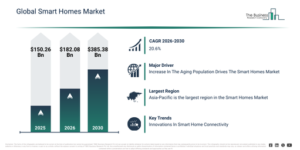
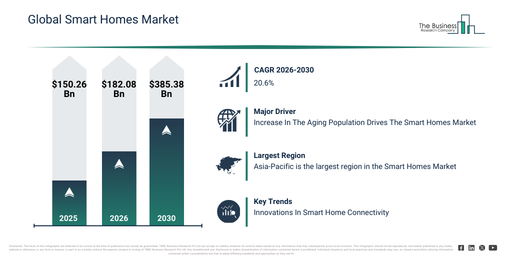
The smart homes market has experienced significant expansion in recent years. This market is projected to grow from $150.26 billion in 2025 to $182.08 billion in 2026, at a compound annual growth rate (CAGR) of 21.2%. The historical increase can be attributed to increasing penetration of broadband connectivity, rising consumer demand for home convenience solutions, adoption of wireless home technologies, growth of smart consumer electronics usage, and an increasing focus on residential energy management.
The smart homes market is anticipated to experience substantial growth in the coming years, with its valuation expected to reach $385.38 billion in 2030, demonstrating a compound annual growth rate (CAGR) of 20.6%. This expansion during the forecast period can be attributed to the increasing embrace of AI-enabled home automation, a rising demand for sustainable smart home solutions, the broadening of IoT-based residential ecosystems, the growing integration of home healthcare technologies, and increasing investments in connected living platforms. Significant trends for the forecast period include the increasing adoption of integrated home automation systems, a growing demand for energy-efficient smart devices, the wider use of voice-controlled home interfaces, the expansion of connected home security solutions, and an enhanced focus on user-centric smart living.
Get A Free Sample Report With In-Depth Market Insights:
Smart Homes Market Growth Drivers: What’s Behind The Acceleration?
The projected increase in the aging population is expected to drive the growth of the smart homes market in the future. The aging population encompasses individuals in the later stages of life, typically those aged 65 and older. Smart homes offer substantial support to this demographic by enhancing their quality of life and promoting independence. These residences feature technologies such as fall detection systems, remote health monitoring, voice-activated controls, and automated safety functions, allowing seniors to live comfortably in their own homes while receiving necessary assistance and healthcare oversight. For instance, in 2023, according to an article issued by the United Nations, a US-based intergovernmental organization, the worldwide number of people aged 65 years or older is anticipated to more than double, climbing from 761 million in 2021 to 1.6 billion in 2050. Therefore, a rise in the aging population will propel the smart homes market.
Smart Homes Market Segment Performance And Emerging Opportunities
The smart homes market covered in this report is segmented –
1) By Product: Lighting Control, Security And Access Control, Heating, Ventilation, And Air Conditioning (HVAC) Control, Entertainment Control And Other Controls, Smart Speaker, Smart Kitchen, Home Appliances, Smart Furniture
2) By Component: Software, Services, Hardware
3) By Sales Channel: Direct, Indirect
4) By Technology: Wireless Technology, Cellular Network Technology
Subsegments:
1) By Lighting Control: Smart Bulbs, Smart Switches, Lighting Sensors, Dimming Systems
2) By Security And Access Control: Smart Locks, Security Cameras, Alarm Systems, Motion Sensors, Video Doorbells
3) By Heating, Ventilation, And Air Conditioning (HVAC) Control: Smart Thermostats, Smart HVAC Systems, Ventilation Systems, Air Quality Sensors
4) By Entertainment Control And Other Controls: Smart TVs, Streaming Devices, Multi-Room Audio Systems, Home Theater Systems
5) By Smart Speaker: Voice-Activated Speakers, Smart Displays, Integrated Sound Systems
6) By Smart Kitchen: Smart Refrigerators, Smart Ovens, Smart Coffee Makers, Smart Dishwashers
7) By Home Appliances: Smart Washers And Dryers, Smart Vacuum Cleaners, Smart Irrigation Systems
8) By Smart Furniture: Smart Beds, Adjustable Desks, Integrated Charging Stations
Smart Homes Market Trends: What’s Defining The Industry’s Next Phase?
Leading corporations within the smart homes market are unveiling novel products to uphold their standing. Innovative smart home products are sophisticated, interconnected devices and systems designed to elevate convenience, efficiency, and automation, encompassing items like voice-controlled assistants, smart thermostats, and security cameras equipped with AI recognition. For instance, in January 2023, SwitchBot US, a US-based smart home technology company, introduced the SwitchBot Hub 2, a smart home device functioning as a bridge to link SwitchBot Bluetooth devices to Wi-Fi and render them Matter-compatible. With Matter support, the SwitchBot Hub 2 allows customers to integrate and manage SwitchBot devices from their preferred home automation platforms, such as Apple HomeKit or Google applications. In addition to Matter support for SwitchBot Bluetooth products and temperature and humidity sensors, the Hub 2 boasts twice the infrared control range compared to other home devices and features two scene keys on its display that can be customized for device control within the SwitchBot app.
Smart Homes Market Key Players: Which Companies Lead Industry Competition?
Major companies operating in the smart homes market are Honeywell International Inc.; Siemens Aktiengesellschaft; Johnson Controls International plc; Schneider Electric SE; United Technologies Corporation; Amazon. com Inc.; Apple Inc.; Google LLC; ADT Inc.; Robert Bosch GmbH; Samsung Electronics Co. Ltd.; LG Electronics Inc.; ABB Ltd; Sony Group Corporation; Control4 Corporation; Comcast Corporation; Lutron Electronics Co. Inc.; Legrand SA; Smart home Inc.; General Electric Company; Ingersoll Rand plc; Xiaomi Corporation; Ooma Inc.; Delta Controls Inc.; Axis Communications AB; Crestron Electronics Inc.; SimpliSafe Inc.; Armorax Corporation; Canary Connect Inc.; Leviton Manufacturing Co. Inc.
View The Full Smart Homes Market Report:
Smart Homes Market Top Region: Where Does Most Revenue Come From?
Asia-Pacific was the largest region in the smart homes market in 2025.Asia-Pacific is expected to be the fastest-growing region in the forecast period. The regions covered in the smart homes market report are Asia-Pacific, South East Asia, Western Europe, Eastern Europe, North America, South America, Middle East, Africa.
Reach Out To Our Team:
The Business Research Company: https://www.thebusinessresearchcompany.com/
Americas: +1 310-496-7795
Asia: +44 7882 955267 & +91 8897263534
Europe: +44 7882 955267
Email us at: marketing@tbrc.info
Follow us on:
LinkedIn: https://in.linkedin.com/company/the-business-research-company
YouTube: https://www.youtube.com/channel/UC24_fI0rV8cR5DxlCpgmyFQ
Global Market Model: https://www.thebusinessresearchcompany.com/global-market-model

Wasay has over a decade of experience in market research, data modelling, and analytics, with prior experience at GlobalData and Decision Tree Consulting Services. At The Business Research Company , he leads research operations across syndicated studies, customized consulting engagements, and the Global Market Model platform. His professional experience includes supporting organizations such as Boston Consulting Group, KPMG, and Ernst & Young. Wasay holds a degree in Electronics and Communications Engineering, postgraduate management qualifications from International Management Institute Belgium and Indian School of Business and Entrepreneurship, and completed the Integrated Program in Business Analytics from Indian Institute of Management Indore.