Built to provide research that’s more actionable and strategically valuable, The Business Research Company’s 2026 market reports include market attractiveness analysis, total addressable market sizing, company benchmarking matrices, interactive Excel dashboards, broader supply chain intelligence, emerging startup tracking, and in-depth product insights.
Smart Space Market Poised To Hit $43.12 Billion By 2030 With A 13.7% CAGR
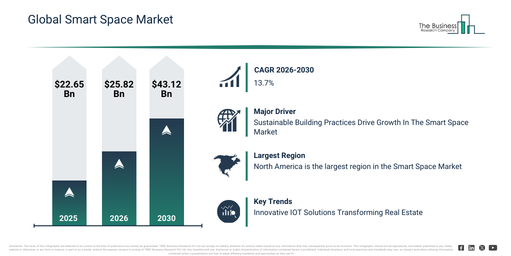
The smart space market has experienced significant expansion over recent years. It is anticipated to expand from $22.65 billion in 2025 to $25.82 billion in 2026, achieving a compound annual growth rate (CAGR) of 14.0%. Historical growth drivers include the increasing digitization of urban infrastructure, the rising adoption of IoT sensors in buildings, a greater emphasis on operational efficiency within public spaces, the spread of smart city initiatives, and the accessibility of cloud-based analytics platforms.
The smart space market is projected for substantial expansion in the coming years. It is expected to reach $43.12 billion by 2030, exhibiting a compound annual growth rate (CAGR) of 13.7%. This growth over the forecast period is driven by factors such as increasing investments in smart infrastructure projects, a rising demand for data-driven space optimization, the expansion of AI-powered space management solutions, a growing focus on sustainability-driven building operations, and the increasing integration of smart spaces with city-wide platforms. Prominent trends for this period include a greater deployment of sensor-rich environments, the rising adoption of real-time space analytics platforms, enhanced integration of intelligent energy management systems, the broadening of occupant-centric space design solutions, and an amplified focus on safety and environmental monitoring.
Get A Free Sample Report With In-Depth Market Insights:
Smart Space Market Opportunity Drivers: What’s Unlocking New Revenue Potential?
The smart space market is anticipated to expand, primarily propelled by green building initiatives and growing environmental concerns. A green or sustainable building is characterized by its ability to maintain or improve the environmental quality of its location. These structures incorporate smart technology throughout their entire system to enhance overall performance and functionality. Such technologies are designed not only to store data but also to analyze it and deliver relevant insights. For instance, in July 2024, the U.S. Green Building Council, a US-based non-profit organization, indicated that in 2024, they were associated with over 46,000 residential projects certified under the LEED green building rating system. This came after 2023 saw nearly a 5% rise in new LEED residential project registrations. Therefore, the smart space market’s growth is clearly being driven by green building initiatives and environmental concerns.
Smart Space Market Segment Landscape: Which Areas Lead Development?
The smart space market covered in this report is segmented –
1) By Component: Hardware, Software, Services
2) By Space Type: Smart Indoor Space, Smart Outdoor Space
3) By Application: Energy Management And Optimization, Layout And Space management, Emergency And Disaster Management, Security Management, Other Applications
4) By Industry: Banking, Financial Services And Insurance (BFSI), Retail And E-Commerce, Government, Media And Entertainment, Food And Beverages, Healthcare, Other Industries
Subsegments:
1) By Hardware: IoT Devices And Sensors, Smart Lighting Systems, Smart Thermostats, Security Cameras And Systems, Networking Equipment
2) By Software: Management Platforms, Data Analytics Software, Security Software, User Interface Applications, Integration Solutions
3) By Services: Consulting Services, Installation And Deployment Services, Maintenance And Support Services, Managed Services, Training And Education Services
Smart Space Market Innovation Trends Shaping Future Development
Major companies operating in the smart space market are increasingly deploying IoT technology to enhance their market profitability. The integration of IoT into smart environments enables the collection and analysis of data in real-time, thereby optimizing and automating processes, elevating user experiences, and improving resource management in diverse settings such as homes, offices, and cities. For example, in September 2023, Vantiva SA, a broadband firm headquartered in France, unveiled a new technology named Vantiva Smart Storage. Vantiva Smart Storage functions as a comprehensive IoT SaaS solution, converting self-storage facilities into intelligent spaces. The primary objective of this system is to provide real estate managers and owners with an integrated hardware and software package that boosts productivity and unlocks new revenue opportunities. This solution, which incorporates advanced IoT technology, is simple to implement and administer, guaranteeing a low-risk investment with a clear and quantifiable return on investment. The platform is also fully configurable and future-proof, supporting numerous communication protocols and allowing for the integration of third-party linked devices and subsystems.
Smart Space Market Industry Leaders And Competitive Landscape
Major companies operating in the smart space market are Cisco Systems Inc.; Microsoft Corporation; International Business Machines Corporation; Schneider Electric SE; Siemens AG; ABB Ltd.; Honeywell International Inc.; Johnson Controls International plc; Huawei Technologies Co. Ltd.; Hitachi Ltd.; Mitsubishi Electric Corporation; Legrand SA; Juniper Networks Inc.; Hewlett Packard Enterprise Company; Spacewell; SmartSpace Software PLC; ICONICS Inc.; Ubisense Limited; Adappt Intelligence Inc.; Smarten Spaces Inc.; Metrikus Ltd.; SpaceOS Limited
View The Full Smart Space Market Report:
Smart Space Market Regional Analysis: Which Geography Leads On Revenue?
North America was the largest region in the smart space market in 2025. Asia-Pacific is expected to be the fastest-growing region in the forecast period. The regions covered in the smart space market report are Asia-Pacific, South East Asia, Western Europe, Eastern Europe, North America, South America, Middle East, Africa.
Reach Out To Our Team:
The Business Research Company: https://www.thebusinessresearchcompany.com/
Americas: +1 310-496-7795
Asia: +44 7882 955267 & +91 8897263534
Europe: +44 7882 955267
Email us at: marketing@tbrc.info
Follow us on:
LinkedIn: https://in.linkedin.com/company/the-business-research-company
YouTube: https://www.youtube.com/channel/UC24_fI0rV8cR5DxlCpgmyFQ
Global Market Model: https://www.thebusinessresearchcompany.com/global-market-model

Wasay has over a decade of experience in market research, data modelling, and analytics, with prior experience at GlobalData and Decision Tree Consulting Services. At The Business Research Company , he leads research operations across syndicated studies, customized consulting engagements, and the Global Market Model platform. His professional experience includes supporting organizations such as Boston Consulting Group, KPMG, and Ernst & Young. Wasay holds a degree in Electronics and Communications Engineering, postgraduate management qualifications from International Management Institute Belgium and Indian School of Business and Entrepreneurship, and completed the Integrated Program in Business Analytics from Indian Institute of Management Indore.