Featuring market attractiveness scoring, total addressable market sizing, company benchmarking matrices, interactive Excel dashboards, deeper supply chain intelligence, emerging startup tracking, and granular product-level insights, The Business Research Company’s 2026 market reports are built to deliver research that is both more actionable and more strategically valuable.
Smart Stadium Market Value Growth And Long-Term Outlook
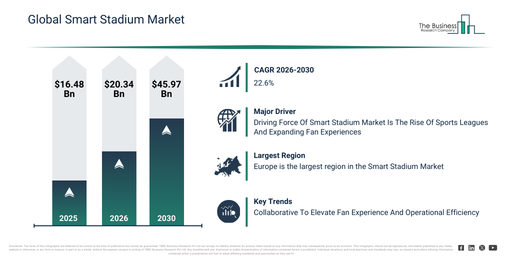
The smart stadium market has witnessed substantial expansion in recent years. It is anticipated to increase from $16.48 billion in 2025 to $20.34 billion in 2026, achieving a compound annual growth rate (CAGR) of 23.4%. Historically, this market’s growth can be linked to the implementation of digital signage, the installation of basic surveillance cameras, the initial adoption of event management software, the convergence of wired and wireless networks, and the need for a superior fan experience.
The smart stadium market size is anticipated to undergo significant expansion over the next few years, with projections indicating a rise to $45.97 billion in 2030, reflecting a compound annual growth rate (CAGR) of 22.6%. This projected growth stems from factors such as AI-driven audience insights, cloud-based solutions for stadium management, immersive technologies for fan experiences, predictive systems for crowd management, and the increasing presence of smart stadiums in emerging markets. Prominent trends for the forecast period include real-time audience analytics, intelligent concession and retail management, improvements in crowd flow and safety, unified ticketing and access control, and customized fan engagement approaches.
Get A Free Sample Report With In-Depth Market Insights:
Smart Stadium Market Growth Catalysts And Demand Drivers
The increasing prevalence of sports league culture is anticipated to drive expansion in the smart stadiums market over the forthcoming period. A sports league consists of multiple clubs competing under established regulations and guidelines. These advanced venues offer extensive data to both spectators and staff regarding match details, available parking, seating enhancements, and the comprehensive experience within the sports complex. For example, in August 2023, according to construction management, a US-based magazine, a stadium’s capacity is set to exceed 50,000 following the incorporation of 7,300 new seats from an upcoming stand, which will also feature retail areas, improved access, and integrated local transport links. Consequently, the expanding sports league culture is a key factor propelling the growth of the smart stadiums market.
Smart Stadium Market Segment Outlook: Which Categories Are Growing Fastest?
The smart stadium market covered in this report is segmented –
1) By Component: Software, Services
2) By Deployment: On-Premise, Cloud, Hybrid
3) By Application: Stadium And Public Security, Building Automation, Event Management, Crowd Management, Other Applications
Subsegments:
1) By Software: Event Management Software, Crowd Management Software, Ticketing Solutions, Digital Signage Solutions
2) By Services: Consulting Services, Integration And Deployment Services, Support and Maintenance Services, Managed Services
Smart Stadium Market Trends Shaping Long-Term Demand
Major companies operating in the smart stadiums market are establishing partnerships to create new products and bolster their market positions. Collaborations and alliances within the smart stadiums market foster innovation, utilize diverse expertise, and accelerate the development and commercialization of advanced therapies by consolidating resources and capabilities. For example, in September 2023, JIG-SAW, a US-based provider of business information and data services, partnered with Climatec LLC, a US-based company offering building technologies and energy solutions. This partnership aims to equip the San Diego Padres (MLB) with Smart Stadium technology. Through this alliance, Petco Park will become an intelligent and connected venue by integrating Climatec’s building automation solutions and deploying JIG-SAW’s IoT technology to develop and manage networks of smart equipment. The collaboration between the two businesses, set to employ IoT and building automation technology to enhance the overall fan experience and streamline stadium operations, represents a significant stride in the digital transformation of sporting stadiums.
Smart Stadium Market Leading Companies And Competitive Benchmarking
Major companies operating in the smart stadium market are Nippon Telegraph and Telephone Corporation; Huawei Technologies Co Ltd.; Intel Corporation; International Business Machines Corporation; Cisco Systems Inc.; Schneider Electric SE; Honeywell International Inc.; Fujitsu Limited; Telefonaktiebolaget LM Ericsson; Johnson Controls International plc; NEC Corporation; CenturyLink Inc.; Infosys Limited; NXP Semiconductors NV; Locbee; Atos SE; Tech Mahindra Limited; HPE Aruba Networking; Vix IP Pty Ltd.; Hawk-Eye Innovations Ltd.; Volteo Technology Pvt Ltd.; Dignia Systems Limited; Precision Sports Technologies Ltd.; AllGoVision Technologies Pvt Ltd.; GP Smart Stadium; Intechnology Byrom Ltd.; Ucopia Communications SA
View The Full Smart Stadium Market Report:
Smart Stadium Market Largest Region: Which Geography Holds The Biggest Share?
Europe was the largest region in the smart stadium market in 2025. Asia-Pacific is expected to be the fastest-growing region in the forecast period. The regions covered in the smart stadium market report are Asia-Pacific, South East Asia, Western Europe, Eastern Europe, North America, South America, Middle East, Africa.
Reach Out To Our Team:
The Business Research Company: https://www.thebusinessresearchcompany.com/
Americas: +1 310-496-7795
Asia: +44 7882 955267 & +91 8897263534
Europe: +44 7882 955267
Email us at: marketing@tbrc.info
Follow us on:
LinkedIn: https://in.linkedin.com/company/the-business-research-company
YouTube: https://www.youtube.com/channel/UC24_fI0rV8cR5DxlCpgmyFQ
Global Market Model: https://www.thebusinessresearchcompany.com/global-market-model

Wasay has over a decade of experience in market research, data modelling, and analytics, with prior experience at GlobalData and Decision Tree Consulting Services. At The Business Research Company , he leads research operations across syndicated studies, customized consulting engagements, and the Global Market Model platform. His professional experience includes supporting organizations such as Boston Consulting Group, KPMG, and Ernst & Young. Wasay holds a degree in Electronics and Communications Engineering, postgraduate management qualifications from International Management Institute Belgium and Indian School of Business and Entrepreneurship, and completed the Integrated Program in Business Analytics from Indian Institute of Management Indore.