Featuring market attractiveness scoring, total addressable market sizing, company benchmarking matrices, interactive Excel dashboards, deeper supply chain intelligence, emerging startup tracking, and granular product-level insights, The Business Research Company’s 2026 market reports are built to deliver research that is both more actionable and more strategically valuable.
Spatial Computing In Retail And E-Commerce Market Size, Value And Growth Trajectory Through 2030
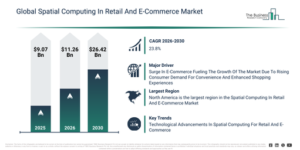
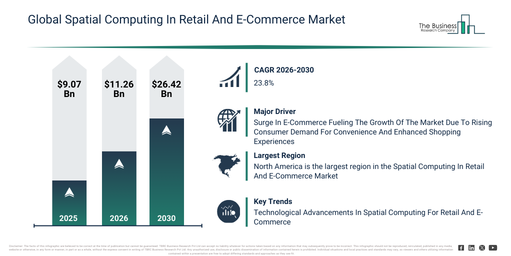
The spatial computing in retail and e-commerce market has experienced significant expansion in recent years. It is projected to increase from $9.07 billion in 2025 to $11.26 billion in 2026, exhibiting a compound annual growth rate (CAGR) of 24.0%. The historical growth of this market can be attributed to the rise of e-commerce platforms, the adoption of AR shopping applications, increasing smartphone penetration, the expansion of online retail channels, and a heightened consumer demand for visual shopping experiences.
The spatial computing in retail and e-commerce market is projected to experience rapid expansion over the coming years. This market is anticipated to reach $26.42 billion by 2030, exhibiting a compound annual growth rate (CAGR) of 23.8%. Factors driving this growth during the projected timeframe include the integration of mixed reality commerce tools, the rise of experiential retail strategies, the broader application of digital twin technologies, the uptake of metaverse commerce platforms, and increased investment in immersive retail solutions. Key trends expected within this forecast period encompass virtual product try-on experiences, interactive digital storefronts, AI-powered product visualization, personalized immersive shopping, and 3D virtual showrooms.
Get A Free Sample Report With In-Depth Market Insights:
Spatial Computing In Retail And E-Commerce Market Growth Factors: What’s Supporting Expansion?
The increasing need for e-commerce is anticipated to fuel the expansion of spatial computing within the retail and e-commerce market in the future. E-commerce denotes the practice of exchanging goods or services via internet-based online platforms. This escalating demand for e-commerce stems from consumers’ rising inclination for convenience, enabling buyers to effortlessly explore, compare, and acquire items from their residences. Spatial computing aids e-commerce by enabling clients to preview goods within their actual surroundings, thereby boosting buying assurance and decreasing the probability of product returns. As an illustration, in February 2025, data from the Census Bureau, a US-based government agency, indicated that overall e-commerce sales for 2024 reached an estimated $1,192.6 billion, showing an 8.1% (±1.1%) rise when contrasted with 2023. Consequently, the expanding demand for e-commerce is propelling the development of spatial computing in the retail and e-commerce market.
Spatial Computing In Retail And E-Commerce Market Segment Landscape: Which Areas Lead Development?
The spatial computing in retail and e-commerce market covered in this report is segmented –
1) By Component: Hardware, Software, Services
2) By Technology: Artificial Intelligence, Augmented Reality, Virtual Reality, Mixed Reality, Internet Of Things (IoT), Digital Twins, Other Technologies
3) By Application: Virtual Try-Ons, Product Visualization, Immersive Shopping Experiences, Virtual Showrooms, Interactive Product Demonstrations, Personalized Shopping Environments, In-Store Navigation And Information, Other Applications
Subsegments:
1) By Hardware: Augmented Reality (AR) Glasses, Virtual Reality (VR) Headsets, Sensors And Cameras, Wearable Devices, Interactive Kiosks, Smart Displays
2) By Software: AR Or VR Software Platforms, 3D Mapping And Modeling Software, Spatial Data Management Software, Retail Visualization Software, Machine Learning Algorithms For Spatial Analytics
3) By Services: Consulting Services, Integration Services, Support And Maintenance Services, Training Services, Customization And Development Services
Spatial Computing In Retail And E-Commerce Market Industry Trends: What’s Reshaping Demand?
Major companies in the spatial computing in retail and e-commerce market are focusing on developing advanced solutions, including immersive spatial environments, designed to improve customer engagement and streamline in-store navigation using augmented reality (AR) and virtual reality (VR) technologies. An immersive spatial environment is a digitally created or enhanced space that allows users to interact with virtual objects and surroundings in a way that replicates real-world experiences. For instance, in July 2024, SYKY Inc., a US-based operator of a Web 3-based fashion platform, launched an innovative fashion experience for Apple Vision Pro users, merging digital and physical fashion through spatial computing. This debut showcase featured the Japanese label Anrealage and offered a 3D exploration of the Pyramid Dress, famously worn by Beyoncé. The experience leverages Apple Vision Pro’s hand-and-eye-tracking, enabling users to navigate immersive, interactive designer spaces. This represents SYKY’s initial entry into spatial computing, with plans for additional partnerships to deliver high-end fashion experiences to users, removing the requirement for physical attendance at fashion shows.
Spatial Computing In Retail And E-Commerce Market Industry Leaders And Competitive Landscape
Major companies operating in the spatial computing in retail and e-commerce market are Amazon.com Inc., Apple Inc., Google LLC, Microsoft Corporation, Samsung Electronics Co Ltd, Alibaba Group Holding Limited, Meta Platforms Inc., Sony Group Corporation, Lenovo Group Limited, Qualcomm Incorporated, NVIDIA Corporation, Zebra Technologies Corporation, Snap Inc., PTC Inc., Unity Technologies Inc., Magic Leap Inc., Varjo Technologies Oy, Infinite Reality Inc., Magnopus, Groove Jones LLC, Blippar Ltd., Reydar Ltd.
View The Full Spatial Computing In Retail And E-Commerce Market Report:
Spatial Computing In Retail And E-Commerce Market Regional Breakdown: Where Is Demand Concentrated?
North America was the largest region in the spatial computing in retail and e-commerce market in 2025. The regions covered in the spatial computing in retail and e-commerce market report are Asia-Pacific, South East Asia, Western Europe, Eastern Europe, North America, South America, Middle East, Africa.
Reach Out To Our Team:
The Business Research Company: https://www.thebusinessresearchcompany.com/
Americas: +1 310-496-7795
Asia: +44 7882 955267 & +91 8897263534
Europe: +44 7882 955267
Email us at: marketing@tbrc.info
Follow us on:
LinkedIn: https://in.linkedin.com/company/the-business-research-company
YouTube: https://www.youtube.com/channel/UC24_fI0rV8cR5DxlCpgmyFQ
Global Market Model: https://www.thebusinessresearchcompany.com/global-market-model

Wasay has over a decade of experience in market research, data modelling, and analytics, with prior experience at GlobalData and Decision Tree Consulting Services. At The Business Research Company , he leads research operations across syndicated studies, customized consulting engagements, and the Global Market Model platform. His professional experience includes supporting organizations such as Boston Consulting Group, KPMG, and Ernst & Young. Wasay holds a degree in Electronics and Communications Engineering, postgraduate management qualifications from International Management Institute Belgium and Indian School of Business and Entrepreneurship, and completed the Integrated Program in Business Analytics from Indian Institute of Management Indore.