Backed by market attractiveness analysis, total addressable market sizing, company benchmarking matrices, interactive Excel dashboards, wider supply chain intelligence, emerging startup coverage, and detailed product-level insights, The Business Research Company’s 2026 market reports are designed to offer research that is more actionable and strategically valuable than ever.
Spatial Computing In Robotics Market Size Outlook: How Quickly Will Revenue Expand Through 2030?
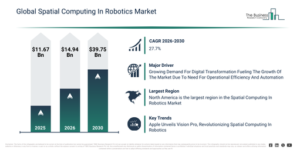
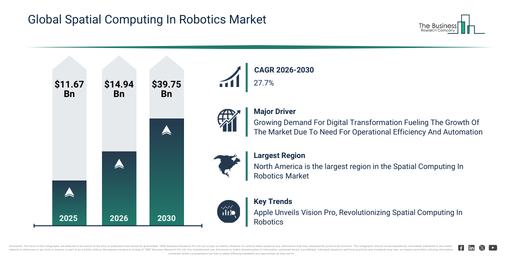
The spatial computing in robotics market has shown significant growth in recent years. It is expected to expand from $11.67 billion in 2025 to $14.94 billion in 2026, achieving a compound annual growth rate (CAGR) of 28.0%. This historical increase can be attributed to several factors including the rising adoption of industrial robotics, the broader expansion of warehouse automation, ongoing advancements in sensor technologies, the increasing integration of artificial intelligence into robotics, and the demand for autonomous navigation systems.
The spatial computing in robotics market is anticipated to undergo significant expansion over the next few years. This market is set to achieve a size of $39.75 billion by 2030, progressing at a compound annual growth rate (CAGR) of 27.7%. The expected increase during this period can be attributed to several factors, including the deployment of collaborative robots, the broadening application of autonomous mobile robots, the uptake of digital twin platforms, the incorporation of AI-based perception systems, and the growth in service robotics uses. Noteworthy trends predicted for the forecast period involve real-time robot navigation systems, the integration of 3D environment mapping, the development of autonomous spatial perception models, improved human-robot interaction interfaces, and digital twin robotics simulation.
Get A Free Sample Report With In-Depth Market Insights:
Spatial Computing In Robotics Market Industry Drivers: What’s Behind The Revenue Growth?
An increasing need for digital transformation is anticipated to drive expansion within the spatial computing in the robotics market. Digital transformation involves embedding digital technologies across all business functions, thereby altering how operations are conducted and value is provided to customers. The escalating demand for this transformation stems from businesses’ pursuit of enhanced operational efficiency and automation, aiming to optimize processes, cut expenses, and boost productivity with smart technologies. Spatial computing in robotics facilitates digital transformation by offering real-time 3D perception and self-governing decision-making, leading to more intelligent and efficient operations. It further improves productivity across various sectors through the automation of intricate tasks and better collaboration between humans and robots. As an illustration, in 2023, the European Investment Bank (EIB), a Luxembourg-based financial institution, reported that the integration of advanced digital technologies by EU firms rose from 69% in 2022 to approximately 70% in 2023, indicating a slight year-on-year increase. Consequently, the rising demand for digital transformation is fueling the growth of the spatial computing in the robotics market.
Spatial Computing In Robotics Market Segment Outlook: Which Categories Are Growing Fastest?
The spatial computing in robotics market covered in this report is segmented –
1) By Component: Hardware, Software, Services
2) By Technology Type: Augmented Reality Technology, Virtual Reality Technology, Mixed Reality Technology
3) By Application: Space Exploration Robots, Industrial Robots, Service Robots, Collaborative Robots, Autonomous Mobile Robots, Other Applications
4) By End-User Industry: Aerospace And Defense, Manufacturing, Healthcare, Retail And E-commerce, Education And Training, Automotive, Information Technology And Telecommunications
Subsegments:
1) By Hardware: Sensors, Cameras, Processing Units, Augmented Reality And Virtual Reality Headsets, Haptic Devices, Robotics Platforms
2) By Software: Mapping And Localization, Spatial Analytics And Artificial Intelligence Algorithms, Simulation And Modeling Tools, Three-Dimensional (3D) Reconstruction And Rendering Software, Augmented Reality And Virtual Reality Interfaces For Robotics Control, Middleware For Integration And Interoperability
3) By Services: System Integration Services, Consulting And Advisory Services, Support And Maintenance Services, Training And Education Services, Custom Application Development
#Spatial Computing In Robotics Market Growth Trends: What’s Shaping The Future Outlook?
Key companies active in the spatial computing in robotics market are prioritizing the development of advanced products, such as mixed reality headsets, to improve immersive interactions and enhance robotic precision. Mixed reality (MR) headsets are wearable technologies that fuse real-world surroundings with computer-generated elements, enabling users to engage simultaneously with both physical and digital components in a fluid and deeply immersive manner. For example, in June 2023, Apple Inc., a US-based technology company, released Apple Vision Pro. This wearable mixed-reality headset effortlessly merges digital content with the physical environment, ushering in a new era of spatial computing. It features intuitive control through eye, hand, and voice tracking, sophisticated spatial audio, and an advanced sensor array to deliver immersive spatial computing experiences.
Spatial Computing In Robotics Market Leading Companies And Competitive Benchmarking
Major companies operating in the spatial computing in robotics market are Apple Inc., Google LLC, Microsoft Corporation, HyundAI Motor Group, Sony Group Corporation, Lenovo Group Limited, Midea Group, Qualcomm Technologies Inc., Nvidia Corporation, Rockwell Automation Inc., SICK AG, PTC Inc., Unity Software Inc., iRobot Corporation, ANYbotics AG, NavVis GmbH, Magic Leap Inc., RoboSense, XGrids Limited, Marxent Labs LLC, DAQRI
View The Full Spatial Computing In Robotics Market Report:
Spatial Computing In Robotics Market Top Region: Where Does Most Revenue Come From?
North America was the largest region in the spatial computing in robotics market in 2025. Asia-Pacific is expected to be the fastest-growing region in the forecast period. The regions covered in the spatial computing in robotics market report are Asia-Pacific, South East Asia, Western Europe, Eastern Europe, North America, South America, Middle East, Africa.
Reach Out To Our Team:
The Business Research Company: https://www.thebusinessresearchcompany.com/
Americas: +1 310-496-7795
Asia: +44 7882 955267 & +91 8897263534
Europe: +44 7882 955267
Email us at: marketing@tbrc.info
Follow us on:
LinkedIn: https://in.linkedin.com/company/the-business-research-company
YouTube: https://www.youtube.com/channel/UC24_fI0rV8cR5DxlCpgmyFQ
Global Market Model: https://www.thebusinessresearchcompany.com/global-market-model

Wasay has over a decade of experience in market research, data modelling, and analytics, with prior experience at GlobalData and Decision Tree Consulting Services. At The Business Research Company , he leads research operations across syndicated studies, customized consulting engagements, and the Global Market Model platform. His professional experience includes supporting organizations such as Boston Consulting Group, KPMG, and Ernst & Young. Wasay holds a degree in Electronics and Communications Engineering, postgraduate management qualifications from International Management Institute Belgium and Indian School of Business and Entrepreneurship, and completed the Integrated Program in Business Analytics from Indian Institute of Management Indore.