Featuring market attractiveness scoring, total addressable market sizing, company benchmarking matrices, interactive Excel dashboards, deeper supply chain intelligence, emerging startup tracking, and granular product-level insights, The Business Research Company’s 2026 market reports are built to deliver research that is both more actionable and more strategically valuable.
Plant-Based Food Packaging Market Value Analysis: What Growth Lies Ahead Over The Forecast Period?
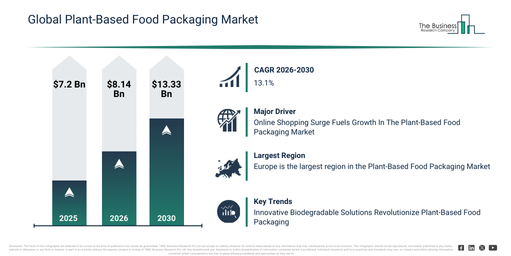
The plant-based food packaging market has experienced rapid growth in recent years. It is anticipated to expand from $7.2 billion in 2025 to $8.14 billion in 2026, demonstrating a compound annual growth rate (CAGR) of 13.1%. This historical increase can be attributed to rising consumer awareness of plastic pollution, the expansion of organic and natural food markets, the availability of agricultural waste feedstock, early adoption by food brands, and supportive environmental regulations.
The plant-based food packaging market size is anticipated to undergo swift expansion in the upcoming years. It is projected to grow to $13.33 billion in 2030, demonstrating a compound annual growth rate (CAGR) of 13.1%. This projected growth can be attributed to several factors including increased investments in bio-based material innovation, a surge in demand from foodservice chains, the broadening of composting infrastructure, tightening regulatory restrictions on single-use plastics, and the scaling up of plant-based packaging production. Notable trends during the forecast period encompass a rising adoption of biodegradable food packaging, an increased utilization of plant-based raw materials, a growing demand for compostable packaging formats, the expansion of molded fiber and mycelium packaging, and a heightened focus on plastic replacement solutions.
Get A Free Sample Report With In-Depth Market Insights:
Plant-Based Food Packaging Market Growth Backed By Core Demand Fundamentals
The expanding prevalence of online shopping is anticipated to boost the development of the plant-based food packaging market in the future. Online shopping involves the acquisition of products and services via the Internet, allowing consumers to buy items from their residences and negating the necessity of visiting physical establishments. This method also conserves time by offering a swift and straightforward way to explore, compare, and acquire products. As online consumers increasingly look for environmentally friendly alternatives, retailers are encouraged to utilize plant-based packaging solutions that provide personalization and ease of use, thereby facilitating brand distinction. For example, in May 2024, data from the United States Census Bureau, a US-based government agency, showed that the e-commerce estimate for the first quarter of 2024 rose by 8.5% compared to the first quarter of 2023, whereas overall retail sales grew by 2.8% during the identical timeframe. Consequently, the rising uptake of online shopping is stimulating the expansion of the plant-based food packaging market.
Plant-Based Food Packaging Market Segment Landscape: Which Areas Lead Development?
The plant-based food packaging market covered in this report is segmented –
1) By Packaging Type: Paper Based, Biodegradable And Compostable Packaging
2) By Material: Bioplastics, Mycelium, Bagasse, Starch Based, Paper
3) By Packaging Formats: Flexible Packaging, Stand-Up Pouches, Flat Bottom Bags, Flow Wraps, Rigid Packaging, Trays, Containers, Bottles
Subsegments:
1) By Paper-Based: Kraft Paper Packaging, Coated Paperboard Packaging, Molded Pulp Packaging, Paper Bags And Pouches, Paper Cups And Containers
2) By Biodegradable And Compostable Packaging: Polylactic Acid (PLA) Packaging, Polyhydroxyalkanoates (PHA) Packaging, Starch-Based Packaging, Mushroom Packaging, Cellulose-Based Packaging, Bagasse Packaging (Sugarcane Pulp)
Plant-Based Food Packaging Market Growth Trends Reshaping The Competitive Landscape
Leading companies within the plant-based food packaging sector are advancing solutions that incorporate sustainable packaging practices, aiming to offer biodegradable alternatives to traditional plastic, thereby reducing waste and environmental impact. Sustainable packaging practices encompass methods for designing, producing, and disposing of packaging materials in a manner that minimizes the ecological footprint, utilizing eco-friendly, resource-efficient materials and procedures that foster a circular economy. For example, in March 2024, Donovan Bros Ltd., a UK-based provider of sustainable packaging solutions, launched its mushroom-based packaging. This represents an environmentally friendly and biodegradable food packaging solution, crafted by combining agricultural waste with mycelium to produce strong and compostable packaging. It provides a flexible, edible, or compostable packaging alternative suitable for various food goods, and this innovative packaging facilitates a distinct ‘unboxing’ experience.
Plant-Based Food Packaging Market Top Companies Driving Competitive Growth
Major companies operating in the plant-based food packaging market are Amcor plc, WestRock Company, International Paper, Tetra Pak International S.A., Stora Enso, Huhtamaki, Mondi Group, Cascades Inc., Glatfelter Corporation, Genpak, Nordic Paper, Danimer Scientific, Good Natured Products Inc., Vegware, Sulapac Oy, Be Green Packaging, BioPak, TIPA LTD, WorldCentric.com, Ecologic, Earthpack
View The Full Plant-Based Food Packaging Market Report:
Plant-Based Food Packaging Market Global Footprint: Which Region Leads The Market?
Europe was the largest region in the plant-based food packaging market in 2025 and is expected to be the fastest-growing region in the forecast period. The regions covered in the plant-based food packaging market report are Asia-Pacific, South East Asia, Western Europe, Eastern Europe, North America, South America, Middle East, Africa.
Reach Out To Our Team:
The Business Research Company: https://www.thebusinessresearchcompany.com/
Americas: +1 310-496-7795
Asia: +44 7882 955267 & +91 8897263534
Europe: +44 7882 955267
Email us at: marketing@tbrc.info
Follow us on:
LinkedIn: https://in.linkedin.com/company/the-business-research-company
YouTube: https://www.youtube.com/channel/UC24_fI0rV8cR5DxlCpgmyFQ
Global Market Model: https://www.thebusinessresearchcompany.com/global-market-model

Wasay has over a decade of experience in market research, data modelling, and analytics, with prior experience at GlobalData and Decision Tree Consulting Services. At The Business Research Company , he leads research operations across syndicated studies, customized consulting engagements, and the Global Market Model platform. His professional experience includes supporting organizations such as Boston Consulting Group, KPMG, and Ernst & Young. Wasay holds a degree in Electronics and Communications Engineering, postgraduate management qualifications from International Management Institute Belgium and Indian School of Business and Entrepreneurship, and completed the Integrated Program in Business Analytics from Indian Institute of Management Indore.