Built to provide research that’s more actionable and strategically valuable, The Business Research Company’s 2026 market reports include market attractiveness analysis, total addressable market sizing, company benchmarking matrices, interactive Excel dashboards, broader supply chain intelligence, emerging startup tracking, and in-depth product insights.
Planetary Defense Market Size Forecast: How Big Could The Market Get By 2030?
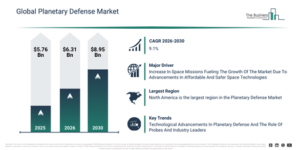
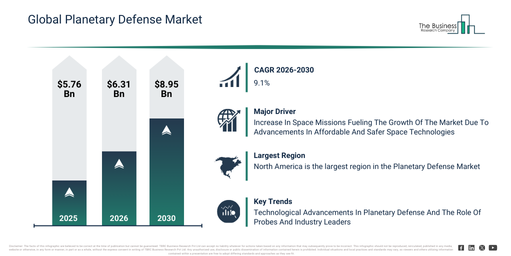
The planetary defense market has experienced considerable growth in recent years. It is projected to expand from $5.76 billion in 2025 to $6.31 billion in 2026, achieving a compound annual growth rate (CAGR) of 9.5%. This historical rise can be attributed to factors such as the discovery of near-earth objects, the development of ground-based observation networks, pioneering asteroid tracking missions, increased scientific research funding, and the establishment of planetary defense frameworks.
The planetary defense market size is anticipated to undergo significant expansion in the coming years. It is projected to achieve a value of $8.95 billion by 2030, demonstrating a compound annual growth rate (CAGR) of 9.1%. The growth expected during the forecast period can be attributed to several factors, including increasing investments in space surveillance infrastructure, rising international cooperation on threat mitigation, the expansion of autonomous space missions, a growing reliance on advanced simulation models, and an increasing focus on global impact risk reduction. Key trends observed in this period encompass the increasing deployment of space-based near-Earth object (NEO) detection systems, the rising utilization of AI-driven orbit modeling, growing investment in deflection technology research, the expansion of international planetary defense collaboration, and an enhanced focus on early warning capabilities.
Get A Free Sample Report With In-Depth Market Insights:
Planetary Defense Market Growth Catalysts And Demand Drivers
The expanding volume of space missions is anticipated to boost the planetary defense market in the future. Space missions are defined as structured expeditions or operations carried out beyond Earth’s atmosphere for scientific, commercial, defense, or exploration objectives. The rise in space missions is due to technological progress, like reusable rockets and miniature satellites, which have rendered space exploration more cost-effective, efficient, and reachable than before. Within these missions, planetary defense serves to improve the capability to identify, monitor, and possibly divert dangerous near-Earth objects (NEOs), thereby safeguarding Earth and operational spacecraft. For example, in 2024, the Space Foundation, a US-based nonprofit organization, reported that global space launch activity reached unprecedented heights for the third straight year, recording 223 launch attempts and 212 successes. This was fueled by a 50% surge in commercial launches, a 33% rise in U.S. launch attempts, and the deployment of over 2, 800 satellites, representing a 23% increase over 2022. Consequently, the increasing frequency of space missions is fueling the expansion of the planetary defense market.
Planetary Defense Market Segments: Where Is Growth Concentrated?
The planetary defense market covered in this report is segmented –
1) By Technology: Kinetic Impact, Nuclear Detonation, Gravity Tractor, Laser Ablation, Other Technologies
2) By Application: Asteroid Detection, Asteroid Deflection, Space Missions, Other Applications
3) By End-User: Government, Space Agencies, Research Institutions, Other End-Users
Subsegments:
1) By Kinetic Impact: Direct Collision Mission, High-Velocity Impact Vehicle, Interceptor Spacecraft, Autonomous Guidance Systems
2) By Nuclear Detonation: Surface Nuclear Blast, Subsurface Nuclear Explosion, Standoff Nuclear Detonation, Radiation Shielding Systems
3) By Gravity Tractor: Mass Accumulation Tractor, Station-Keeping Propulsion System, Long-Duration Trajectory Alteration, Autonomous Navigation And Control
4) By Laser Ablation: Space-Based Laser Platforms, Ground-Based Laser Systems, High-Energy Laser Modules, Targeting And Thermal Tracking Systems
5) By Other Technologies: Ion Beam Deflection, Electromagnetic Rail Systems, Solar Sails For Deflection, Artificial Intelligence-Based Threat Modeling
Planetary Defense Market Trends Shaping Long-Term Demand
Major companies operating in the planetary defense market are concentrating on developing innovative solutions, such as planetary defense probes, to identify, monitor, and lessen potential threats from near-Earth objects (NEOs). A planetary defense probe is a specialized spacecraft engineered to observe, track, or actively engage with potentially hazardous asteroids or comets to prevent them from colliding with Earth. For instance, in October 2024, Space Exploration Technologies Corp., a US-based space technology company, launched the European Space Agency’s Hera planetary defense probe from Cape Canaveral Space Force Station in Florida. The Hera probe is joined by two cubesats, Milani and Juventas, which are set to conduct detailed investigations of Dimorphos, encompassing mineralogical surveys and the inaugural subsurface radar examination of an asteroid. Hera’s chief objective is to meticulously examine the aftermath of this impact, measuring the crater, evaluating the momentum transfer, and assessing Dimorphos’s surface and internal characteristics to confirm and improve the kinetic impactor technique as a planetary defense strategy. This mission represents a crucial advancement in global endeavors to formulate strategies for planetary defense against potentially dangerous asteroids.
Planetary Defense Market Leading Players And Competitive Positioning
Major companies operating in the planetary defense market are Lockheed Martin Corporation, The Boeing Company, Northrop Grumman Corporation, Space Exploration Technologies Corp., Blue Origin LLC., Maxar Technologies Inc., OHB SE, Astroscale Holdings Inc., Rocket Lab USA Inc., Planet Labs PBC, Firefly Aerospace Inc., Redwire Corporation, Terran Orbital Corporation, State Corporation for Space Activities, Orion Space Solutions LLC., Airbus S.A.S, Thales Alenia Space S.A.S, Leonardo S.p.A, L3Harris Technologies Inc., RTX Corporation
View The Full Planetary Defense Market Report:
Planetary Defense Market Regional Split: Which Areas Are Fueling Growth?
North America was the largest region in the planetary defense market in 2025. The regions covered in the planetary defense market report are Asia-Pacific, South East Asia, Western Europe, Eastern Europe, North America, South America, Middle East, Africa.
Reach Out To Our Team:
The Business Research Company: https://www.thebusinessresearchcompany.com/
Americas: +1 310-496-7795
Asia: +44 7882 955267 & +91 8897263534
Europe: +44 7882 955267
Email us at: marketing@tbrc.info
Follow us on:
LinkedIn: https://in.linkedin.com/company/the-business-research-company
YouTube: https://www.youtube.com/channel/UC24_fI0rV8cR5DxlCpgmyFQ
Global Market Model: https://www.thebusinessresearchcompany.com/global-market-model

Wasay has over a decade of experience in market research, data modelling, and analytics, with prior experience at GlobalData and Decision Tree Consulting Services. At The Business Research Company , he leads research operations across syndicated studies, customized consulting engagements, and the Global Market Model platform. His professional experience includes supporting organizations such as Boston Consulting Group, KPMG, and Ernst & Young. Wasay holds a degree in Electronics and Communications Engineering, postgraduate management qualifications from International Management Institute Belgium and Indian School of Business and Entrepreneurship, and completed the Integrated Program in Business Analytics from Indian Institute of Management Indore.