
Delivering more actionable and strategically valuable research, The Business Research Company’s 2026 market reports feature market attractiveness analysis, total addressable market evaluation, company benchmarking matrices, interactive Excel dashboards, expanded supply chain intelligence, emerging startup coverage, and detailed product insights.
Military Information Market Growth Analysis: How Will Revenue Expand During The Forecast Period?
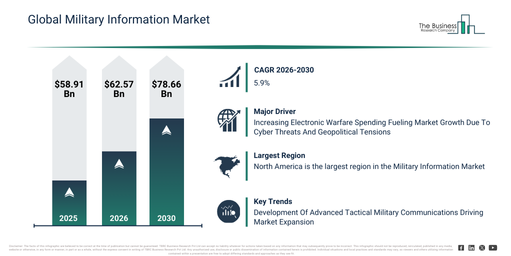
The military information market size has experienced substantial growth in recent years. It is projected to expand from $58.91 billion in 2025 to $62.57 billion in 2026, achieving a compound annual growth rate (CAGR) of 6.2%. This historic expansion is largely due to a heightened dependence on intelligence gathering to support strategic and tactical military operations, an increase in digital data gathered from surveillance, reconnaissance, and sensor networks, an escalating need for threat assessment tools stemming from evolving geopolitical tensions, the broadening of mission debriefing and analysis functions to improve operational outcomes, and progress in data processing technologies facilitating quicker distribution of military information.
The military information market is projected to experience substantial expansion in the coming years. It is anticipated to reach $78.66 billion by 2030, exhibiting a compound annual growth rate (CAGR) of 5.9%. This growth during the forecast period is fueled by several factors, including the increasing integration of artificial intelligence and machine learning for automated intelligence analysis, a heightened demand for integrated decision support platforms in joint military operations, increased spending on secure databases and real-time information dashboards, the expansion of cyber-enabled intelligence tools to combat digital threats, and a surging requirement for cloud-based military information systems to improve scalability and access. Key trends expected throughout this period encompass the growing integration of multi-domain and joint-force intelligence, an uptick in the outsourcing of intelligence analysis and support services, the broadening availability of mission debriefing and after-action analytics solutions, a heightened emphasis on interoperable and standardized military information architectures, and an increased focus on the governance of classified data and regulatory adherence.
Download A Free Sample Report For Comprehensive Market Insights:
Military Information Market Opportunity Drivers: What Is Creating New Revenue Potential?
Elevated defense spending allocated for electronic warfare is anticipated to drive expansion in the military information market moving ahead. Electronic warfare involves utilizing technologies that rely on the electromagnetic spectrum to identify, interfere with, mislead, or neutralize adversary electronic infrastructures like communication, radar, and navigation systems. These defense budgets for electronic warfare are growing because armed forces are upgrading to establish superiority in multi-domain operational environments, where hindering enemy communications and radar is essential for achieving mission objectives. Such defense funding bolsters military information systems through investments in secure communication channels, intelligence collection, and live data analytics, thereby improving operational efficiency and situational understanding on the battlefield. As an illustration, in May 2025, the House of Commons of the United Kingdom, a government organization based in the UK, indicated that UK defense spending is forecast to hit $72.7 billion (£56.9 billion) in 2024-25 and rise to $76.5 billion (£59.8 billion) in 2025-26, demonstrating an average annual real-terms growth rate of 2.4% between 2023-24 and 2025-26. Consequently, the expanding defense budgets allocated for electronic warfare are stimulating the expansion of the military information market.
Military Information Market Segmentation And Category Breakdown
The military information market covered in this report is segmented –
1) By Component: Systems, Satellite Communication Systems, Radar And Sonar Systems, Radio Systems, Services, Consulting, Testing And Integration, Support And Maintenance
2) By Strategic Intelligence: Geospatial Intelligence (GEOINT), Signals Intelligence (SIGINT), Human Intelligence (HUMINT), Cyber Intelligence
3) By Deployment Mode: On-Premises, Cloud
4) By Application: Intelligence, Surveillance And Reconnaissance(ISR), Situational Awareness, Command And Control
5) By End-User: Army, Navy, Air Force, Other End Users
Subsegments:
1) By Systems: Electronic Warfare Systems, Command And Control Systems, Surveillance And Reconnaissance Systems, Navigation Systems, Signal Intelligence (SIGINT) Systems, Geospatial Intelligence (GEOINT) Systems
2) By Satellite Communication Systems: Military Communication Satellites, Ground Control Stations, Secure Satellite Terminals, Tactical Satellite Communication (TACSAT) Systems, Mobile Satcom Systems
3) By Radar And Sonar Systems: Airborne Radar Systems, Ground-Based Radar Systems, Naval Sonar Systems, Synthetic Aperture Radar (SAR), Passive Sonar Systems
4) By Radio Systems: Tactical Radio Systems, Software-Defined Radios (SDRs), High Frequency (HF) And Very High Frequency (VHF) Radios, Encrypted Radios, Handheld And Vehicular Radio Sets
5) By Services: Consulting, Testing And Integration, Support And Maintenance
6) By Consulting: Strategic Advisory Services, Mission Planning And Assessment, Operational Readiness Consulting, Threat Analysis And Countermeasure Planning
7) By Testing And Integration: System Interoperability Testing, Field Trials And Evaluation, Hardware-Software Integration, Environmental And Stress Testing
8) By Support And Maintenance: Lifecycle Support Services, Upgrades And Retrofits, Technical Support And Troubleshooting, Spare Parts Supply And Logistics Support, Preventive And Corrective Maintenance
Military Information Market Strategic Trends: What Is Defining The Next Phase Of Growth?
Leading companies within the military information market are actively creating sophisticated tactical solutions for military communications to improve battlefield connectivity, enable secure real-time data exchange, enhance interoperability among allied forces, and integrate AI-driven networks for resilient, jamming-resistant operations in contested environments. These advanced tactical solutions for military communications refer to cutting-edge, secure, and adaptive systems, including AI-optimized networks, anti-jamming waveforms, and multi-domain interoperable radios, all designed to ensure real-time, robust, and encrypted data exchange in challenging battlefield settings. For example, in February 2025, Kalyani Strategic Systems Limited (KSSL), an India-based aerospace and defense company, partnered with L3Harris Technologies, a US-based defense contractor company, to jointly develop advanced tactical solutions for military communications in India, specifically focusing on C4ISR (Command, Control, Communications, Intelligence, Surveillance, and Reconnaissance) technologies. This alliance aims to strengthen India’s defense capabilities by leveraging L3Harris’s expertise and KSSL’s local manufacturing strengths, thereby fostering indigenous innovation and reducing reliance on foreign imports. The collaboration is well-positioned to deliver next-generation C4ISR solutions that will meet the strategic needs of the Indian Armed Forces and support broader defense industrial cooperation between the U.S. and India.
Military Information Market Competitive Analysis Of Major Industry Participants
Major companies operating in the military information market are Raytheon Technologies Corporation, Lockheed Martin Corporation, Airbus Defence and Space GmbH, General Dynamics Corporation, Northrop Grumman Corporation, BAE Systems plc, Thales Group, Leonardo S.p.A., Atos SE, Booz Allen Hamilton Holding Corporation, Rheinmetall AG, KBR Inc., CACI International Inc., Parsons Corporation, Indra Sistemas S.A., Rohde & Schwarz GmbH & Co. KG, Teledyne FLIR LLC, Palantir Technologies Inc., HENSOLDT AG, Kratos Defense & Security Solutions Inc.
Access The Complete Military Information Market Report:
Military Information Market Regional Analysis And Leading Geography
North America was the largest region in the military information market in 2025. Asia-Pacific is expected to be the fastest-growing region in the forecast period. The regions covered in the military information market report are Asia-Pacific, South East Asia, Western Europe, Eastern Europe, North America, South America, Middle East, Africa.
Access a Customized Military Information Market Report for Deeper Competitive Insights
https://www.thebusinessresearchcompany.com/customise?id=25410&type=smp
The Business Research Company: https://www.thebusinessresearchcompany.com/
Americas: +1 310-496-7795
Asia: +44 7882 955267 & +91 8897263534
Europe: +44 7882 955267
Email us at: marketing@tbrc.info
Follow us on:
LinkedIn: https://in.linkedin.com/company/the-business-research-company
YouTube: https://www.youtube.com/channel/UC24_fI0rV8cR5DxlCpgmyFQ
Global Market Model: https://www.thebusinessresearchcompany.com/global-market-model

Wasay has over a decade of experience in market research, data modelling, and analytics, with prior experience at GlobalData and Decision Tree Consulting Services. At The Business Research Company , he leads research operations across syndicated studies, customized consulting engagements, and the Global Market Model platform. His professional experience includes supporting organizations such as Boston Consulting Group, KPMG, and Ernst & Young. Wasay holds a degree in Electronics and Communications Engineering, postgraduate management qualifications from International Management Institute Belgium and Indian School of Business and Entrepreneurship, and completed the Integrated Program in Business Analytics from Indian Institute of Management Indore.
