Delivering more actionable and strategically valuable research, The Business Research Company’s 2026 market reports feature market attractiveness analysis, total addressable market evaluation, company benchmarking matrices, interactive Excel dashboards, expanded supply chain intelligence, emerging startup coverage, and detailed product insights.
Rocket Deorbiting Systems Market Value Expansion And Long-Term Growth Outlook
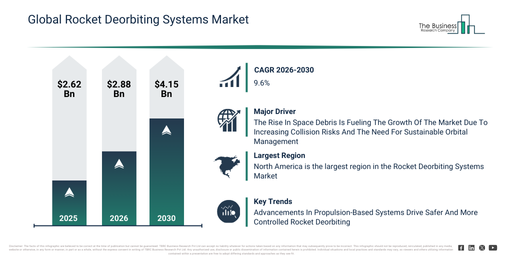
The market for rocket deorbiting systems has experienced robust expansion over recent years. Projections indicate a rise from $2.62 billion in 2025 to $2.88 billion by 2026, exhibiting a compound annual growth rate (CAGR) of 9.9%. This historical growth is attributable to several factors: the escalating frequency of satellite launches generating initial demand for post-mission disposal options, heightened worries concerning orbital debris subsequent to significant fragmentation incidents, preliminary regulatory measures promoting diligent end-of-life protocols, innovations in small satellite propulsion facilitating rudimentary deorbiting functionalities, and the early incorporation of deorbit kits by governmental space initiatives to mitigate enduring debris hazards.
The rocket deorbiting systems market size is projected to experience robust expansion over the next few years. It is expected to swell to $4.15 billion by 2030, exhibiting a compound annual growth rate (CAGR) of 9.6%. This anticipated growth is driven by several factors, including the proliferation of commercial constellations demanding scalable deorbiting solutions, stricter global space sustainability regulations necessitating end-of-life adherence, the increasing integration of autonomous deorbiting technologies to cut mission costs, a heightened need for retrofitting hardware for legacy satellites nearing the end of their operational lifespan, and strengthened collaboration between space agencies and private enterprises to standardize deorbiting frameworks. Prominent trends observed during this period will involve the increasing deployment of autonomous end-of-life deorbiting kits, a rise in the adoption of electrodynamic tethers for passive deorbiting, the expansion of in-orbit servicing and active removal partnerships, the standardization of deorbiting protocols and regulatory compliance, and the development of low-mass retrofits for legacy satellites.
Download A Free Sample Report For Comprehensive Market Insights:
Rocket Deorbiting Systems Market Development Factors: Which Trends Are Supporting Demand?
The increasing amount of space debris is anticipated to drive the expansion of the rocket deorbiting systems market in the future. Space debris, also termed orbital debris or space junk, consists of non-operational, human-made items in Earth’s orbit that have lost their functionality. This category encompasses obsolete satellites, used rocket stages, and pieces created by spacecraft collisions, explosions, or breakdowns. The escalation in space debris stems from the proliferation of satellite constellations, with companies quickly deploying numerous small satellites to offer worldwide coverage for services like broadband internet. Rocket deorbiting systems play a role in reducing space debris by ensuring that obsolete rockets and spacecraft are safely removed from orbit or transferred to designated graveyard orbits. This action lowers the chances of collisions and fosters a tidier, more sustainable environment in space. For example, data from May 2025, provided by the European Space Agency, a France-based entity focused on space exploration, indicates roughly 1.2 million space debris items between 1 cm and 10 cm in size, alongside 140 million smaller fragments ranging from 1 mm to 1 cm. Consequently, the expanding amount of space debris is stimulating the growth of the rocket deorbiting systems market.
Rocket Deorbiting Systems Market Segment Analysis: What Are The Major Market Categories?
The rocket deorbiting systems market covered in this report is segmented –
1) By Type: Active Deorbiting Systems, Passive Deorbiting Systems
2) By Technology: Chemical Propulsion, Electric Propulsion, Hybrid Propulsion, Other Technologies
3) By Application: Commercial, Military, Government, Other Applications
5) By End-User: Satellite Operators, Space Agencies, Defense Organizations, Other End-Users
Subsegments:
1) By Active Deorbiting Systems: Propulsion-Based Systems, Electrodynamic Tethers, Laser Ablation Systems, Robotic Arm Capture Systems
2) By Passive Deorbiting Systems: Drag Augmentation Devices, Aerodynamic Stabilizers, Sublimating Materials, Shape-Memory Polymers
Rocket Deorbiting Systems Market Trends Reshaping Industry Growth
Leading companies in the rocket deorbiting systems market are prioritizing the development of advanced solutions, such as propulsion-based deorbiting systems, to ensure precise and controlled reentry and reduce orbital debris. Propulsion-based deorbiting systems utilize onboard engines to actively guide rockets or spacecraft out of orbit by decreasing their velocity. This accurate and reliable method is ideal for the safe deorbiting of large or high-altitude objects. For instance, in June 2024, The Aerospace Corporation, a US-based nonprofit space research and development organization, unveiled a new prototype deorbit motor. This innovation enables small spacecraft like CubeSats to safely and efficiently deorbit at the conclusion of their missions. The innovative motor employs a commercial off-the-shelf solid-propellant rocket featuring a unique deflector plate and nozzle design, generating spin-stabilized axial thrust for controlled reentry, even for satellites that have experienced some loss of attitude control. This technology addresses new regulatory requirements, such as the FCC’s five-year deorbit rule. It aids in mitigating the increasing risk of space debris by allowing operators to retire satellites on demand, thereby improving sustainability in space operations.
Rocket Deorbiting Systems Market Leading Companies Driving Competitive Growth
Major companies operating in the rocket deorbiting systems market are Kawasaki Heavy Industries Ltd., Space Exploration Technologies Corp. (SpaceX), Astroscale, Firefly Aerospace Inc., Surrey Satellite Technology Limited, ClearSpace SA, Space Flight Laboratory, MMA Design LLC, ThrustMe S.A.S., High Performance Space Structure Systems GmbH, D-Orbit S.p.A., Motiv Space Systems Inc., Orbotic Systems Inc., Kall Morris Inc. (KMI), Kurs Orbital Inc., CU Aerospace L.L.C., OrbitGuardians Inc., Skyrora Limited, Spaceo Inc., Vestigo Aerospace LLC
Access The Complete Rocket Deorbiting Systems Market Report:
Rocket Deorbiting Systems Market Global Footprint: Which Region Holds Market Leadership?
North America was the largest region in the rocket deorbiting systems market in 2025. Asia-Pacific is expected to be the fastest-growing region in the forecast period. The regions covered in the rocket deorbiting systems market report are Asia-Pacific, South East Asia, Western Europe, Eastern Europe, North America, South America, Middle East, Africa.
Access a Customized Rocket Deorbiting Systems Market Report for Deeper Competitive Insights
https://www.thebusinessresearchcompany.com/customise?id=25507&type=smp
The Business Research Company: https://www.thebusinessresearchcompany.com/
Americas: +1 310-496-7795
Asia: +44 7882 955267 & +91 8897263534
Europe: +44 7882 955267
Email us at: marketing@tbrc.info
Follow us on:
LinkedIn: https://in.linkedin.com/company/the-business-research-company
YouTube: https://www.youtube.com/channel/UC24_fI0rV8cR5DxlCpgmyFQ
Global Market Model: https://www.thebusinessresearchcompany.com/global-market-model

Wasay has over a decade of experience in market research, data modelling, and analytics, with prior experience at GlobalData and Decision Tree Consulting Services. At The Business Research Company , he leads research operations across syndicated studies, customized consulting engagements, and the Global Market Model platform. His professional experience includes supporting organizations such as Boston Consulting Group, KPMG, and Ernst & Young. Wasay holds a degree in Electronics and Communications Engineering, postgraduate management qualifications from International Management Institute Belgium and Indian School of Business and Entrepreneurship, and completed the Integrated Program in Business Analytics from Indian Institute of Management Indore.