
Backed by market attractiveness analysis, total addressable market sizing, company benchmarking matrices, interactive Excel dashboards, wider supply chain intelligence, emerging startup coverage, and detailed product-level insights, The Business Research Company’s 2026 market reports are designed to offer research that is more actionable and strategically valuable than ever.
Residential Heat Pump Market Growth Analysis: How Will Revenue Trend Over The Forecast Period?
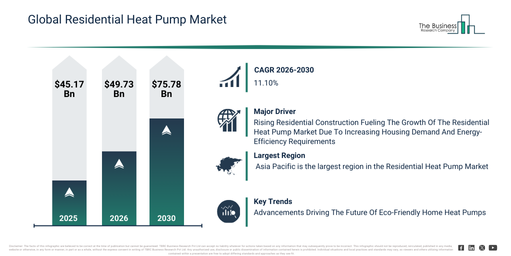
The residential heat pump market size has seen rapid growth in recent years. This market is projected to expand from $45.17 billion in 2025 to $49.73 billion in 2026, demonstrating a compound annual growth rate (CAGR) of 10.1%. The expansion observed in the historic period is due to rising residential heating demand, increasing awareness of energy efficiency, government incentives for heat systems, early adoption in cold regions, and the development of electric powered solutions.
The residential heat pump market is projected to experience substantial growth in the coming years. This market is anticipated to reach $75.78 billion by 2030, exhibiting a compound annual growth rate (CAGR) of 11.1%. Key drivers for this growth during the projected period include a heightened emphasis on sustainable home heating, a noticeable move away from traditional heating methods, increased governmental backing for environmentally friendly heating solutions, an expanding residential infrastructure, and a growing consumer preference for energy-efficient residences. Significant trends expected within this forecast timeframe encompass the wider adoption of smart energy control systems, the increasing use of AI for performance optimization, enhanced connectivity among residential heating solutions, an expansion in advanced manufacturing capabilities for heat pumps, and a reinforced focus on digitally controlled home energy management systems.
Get A Free Sample Report With In-Depth Market Insights:
Residential Heat Pump Market Industry Drivers: What’s Behind The Revenue Growth?
The future expansion of the residential heat pump market is anticipated to be driven by increasing residential construction. This involves the creation, renovation, or remodeling of housing structures such as single-family homes, multi-family apartments, and residential complexes. The rise in residential construction stems from increased urbanization and a greater need for new homes, fueled by demographic expansion. Residential heat pumps assist residential construction efforts by enabling developers to achieve energy efficiency benchmarks, lower carbon footprints, and offer economical heating and cooling options in emerging housing developments. For example, in June 2023, according to the U.S. Census Bureau and the U.S. Department of Housing and Urban Development, US-based government administrations, privately owned home starts in May 2023 occurred at a seasonally adjusted annual pace of 1, 631, 000. This represented an increase of 21.7% over the revised April 2023 prediction of 1, 340, 000 and 5.7% above the May 2022 rate of 1, 543, 000. Additionally, privately owned home completions in May 2023 stood at 1, 518, 000 on a seasonally adjusted annual basis, marking a 5.0% improvement over the May 2022 rate of 1, 446, 000 and a 9.5% increase above the revised April 2023 estimate of 1, 386, 000. Consequently, the rising fertility rate is propelling the expansion of the residential heat pump market.
Residential Heat Pump Market Segment Analysis: What Are The Core Market Categories?
The residential heat pump market covered in this report is segmented –
1) By Type: Water Source, Geothermal, Air Source
2) By Power Source: Electric Powered, Hybrid Electric Systems, Renewable-Assisted Electric Systems
3) By Application: Single Family, Multi Family
Subsegments:
1) By Water Source: Open Loop Systems, Closed Loop Systems
2) By Geothermals: Horizontal Ground Loop Systems, Vertical Ground Loop Systems, Pond Or Lake Systems
3) By Air Source: Air-To-Air Heat Pumps, Air-To-Water Heat Pumps, Ductless Mini-Split Systems
#Residential Heat Pump Market Growth Trends: What’s Shaping The Future Outlook?
Companies prominent within the residential heat pump market are prioritizing the creation of innovative solutions, such as air-to-water propane heat pumps, to boost energy efficiency, decrease carbon emissions, and address the growing need for eco-friendly home heating and cooling systems. Air-to-water propane heat pumps function as highly efficient heating systems employing propane (R290) as the refrigerant to draw heat from outdoor air and deliver it to water for purposes such as space heating, cooling, and domestic hot water. An illustrative example is when, in August 2024, LG Electronics, a South Korea–based consumer and HVAC manufacturer, introduced its latest “Therma V R290 Monobloc” residential air-to-water heat pumps. Available in 7 kW and 9 kW versions, these units utilize propane (R290) as refrigerant and demonstrate a seasonal coefficient of performance (SCOP) of over 5. The units are capable of providing flow temperatures up to 75 °C even at an outdoor temperature as low as –15 °C and can sustain heating functionality down to 28 °C; additionally, they function silently (around 49–50 dB(A)) and offer compatibility with energy-storage systems (ESS) and home energy management via the firm’s ThinQ platform, permitting enhanced performance alongside rooftop solar or other renewables. This release serves to highlight a wider industry movement towards sustainable, high-efficiency, climate-friendly residential heating solutions.
Residential Heat Pump Market Top Companies Driving Competitive Growth
Major companies operating in the residential heat pump market report are Daikin Industries Ltd., Mitsubishi Electric Corporation, Panasonic Corporation, LG Electronics Inc., Carrier Global Corporation, Trane Technologies, Lennox International Inc., Bosch Thermotechnik GmbH, Viessmann Group, NIBE Group, Vaillant Group, Fujitsu General Ltd., Rheem Manufacturing Company, A O Smith Corporation, Stiebel Eltron Group, Ariston Group, Glen Dimplex Group, Samsung Electronics Co Ltd., Midea Group, Enertech Global LLC
View The Full Residential Heat Pump Market Report:
Residential Heat Pump Market Geographic Analysis: Where Is Demand Rising Fastest?
Asia Pacific was the largest region in the residential heat pump market in 2025. Asia Pacific is expected to be the fastest-growing region in the forecast period. The regions covered in the residential heat pump market report are Asia-Pacific, South East Asia, Western Europe, Eastern Europe, North America, South America, Middle East, Africa.
Reach Out To Our Team:
The Business Research Company: https://www.thebusinessresearchcompany.com/
Americas: +1 310-496-7795
Asia: +44 7882 955267 & +91 8897263534
Europe: +44 7882 955267
Email us at: marketing@tbrc.info
Follow us on:
LinkedIn: https://in.linkedin.com/company/the-business-research-company
YouTube: https://www.youtube.com/channel/UC24_fI0rV8cR5DxlCpgmyFQ
Global Market Model: https://www.thebusinessresearchcompany.com/global-market-model

Wasay has over a decade of experience in market research, data modelling, and analytics, with prior experience at GlobalData and Decision Tree Consulting Services. At The Business Research Company , he leads research operations across syndicated studies, customized consulting engagements, and the Global Market Model platform. His professional experience includes supporting organizations such as Boston Consulting Group, KPMG, and Ernst & Young. Wasay holds a degree in Electronics and Communications Engineering, postgraduate management qualifications from International Management Institute Belgium and Indian School of Business and Entrepreneurship, and completed the Integrated Program in Business Analytics from Indian Institute of Management Indore.