
Built to provide research that’s more actionable and strategically valuable, The Business Research Company’s 2026 market reports include market attractiveness analysis, total addressable market sizing, company benchmarking matrices, interactive Excel dashboards, broader supply chain intelligence, emerging startup tracking, and in-depth product insights.
Residue Testing Market Revenue Outlook: What CAGR Lies Ahead Through 2030?
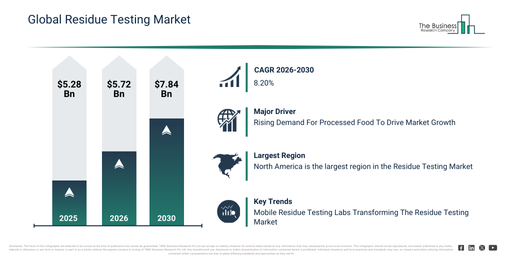
The residue testing market has shown robust expansion in recent years. Its valuation is expected to rise from $5.28 billion in 2025 to $5.72 billion in 2026, reflecting a compound annual growth rate (CAGR) of 8.2%. This historical growth can be attributed to several factors, including increasingly stringent global food trade regulations, heightened concerns regarding contamination, more rigorous government safety standards, the proliferation of testing laboratories, and a greater awareness of consumer safety.
The residue testing market is anticipated to experience robust expansion in the coming years. By 2030, its size is projected to reach $7.84 billion, demonstrating a compound annual growth rate (CAGR) of 8.2%. This growth during the forecast period is attributable to factors such as increasing demand for certified food quality, a rise in export compliance requirements, a growing focus on residue-free products, expanded monitoring of processed foods, and heightened attention to agricultural safety. Key trends identified for this period encompass an increasing emphasis on food safety compliance, the growing adoption of sophisticated analytical testing methods, a rising demand for high-sensitivity contaminant detection, the broadening application in export quality certification, and enhanced attention to consumer health protection.
Get A Free Sample Report With In-Depth Market Insights:
Residue Testing Market Development Factors: What’s Supporting Demand?
A rising demand for processed food is anticipated to drive the expansion of the residue testing market in the future. Processed food is defined as any food product subjected to a sequence of mechanical, physical, thermal, or chemical alterations during its production. A greater need for processed foods results in increased manufacturing and intake of such items, frequently involving intricate supply chains and the application of agricultural raw materials. The global nature of the food supply chain further heightens the necessity for comprehensive residue testing to comply with strict regulatory mandates, particularly since processed foods are widely exchanged internationally. For example, in April 2024, a report from the National Association of Convenience Stores (NACS), a US-based trade association, indicated that total industry foodservice sales, encompassing prepared food, commissary items, and dispensed beverages, constituted 26.9% of in-store sales in 2023, an increase from 25.6% in 2022, and prepared food sales per store per month saw a rise of 12.2%. Consequently, the rising consumption of processed food is fueling the expansion of the residue testing market.
Residue Testing Market Segments: Where Is Growth Concentrated?
The residue testing market covered in this report is segmented –
1) By Testing Method: Chromatography, Spectroscopy, Immunoassay, Other Testing Methods
2) By Product Type: Pesticide Residues, Toxins, Heavy Metals, Food Allergens, Other Product Types
3) By Application: Meat And Poultry, Dairy Products, Processed Foods, Fruits And Vegetables, Cereals, Grains And Pulses, Nuts, Seed And Spice, Other Applications
Subsegments:
1) By Chromatography: Gas Chromatography (GC), Liquid Chromatography (LC), High-Performance Liquid Chromatography (HPLC)
2) By Spectroscopy: Mass Spectrometry (MS), Infrared Spectroscopy (IR), Ultraviolet-Visible Spectroscopy (UV-Vis)
3) By Immunoassay: Enzyme-Linked Immunosorbent Assay (ELISA), Radioimmunoassay (RIA), Lateral Flow Assays
4) By Other Testing Methods: Microbial Testing, Electrochemical Analysis
Residue Testing Market Transformation Trends: What Innovations Are Driving Change?
Leading companies in the residue testing market are developing mobile residue testing labs specifically for tea leaf testing, aiming to improve the efficiency and accuracy of detecting pesticide residues and contaminants in tea leaves. These portable laboratories facilitate on-site testing, which shortens the turnaround time for results and allows for immediate corrective actions if unsafe levels are found. This initiative is significant, highlighting the increasing importance of quality assurance within the tea industry. For example, in June 2024, Eurofins Agro Laboratories, a Luxembourg-based company, launched a mobile residue testing lab. This mobile lab enables rapid on-site testing, thereby enhancing the effectiveness of quality control processes. The new mobile lab incorporates advanced testing technologies such as High-Performance Liquid Chromatography (HPLC) and Gas Chromatography-Mass Spectrometry (GC-MS). These methods are crucial for accurately analyzing chemical compositions, including caffeine and polyphenol levels, which are important indicators of tea quality.
Residue Testing Market Key Participants And Competitive Landscape
Major companies operating in the residue testing market report are Eurofins Scientific SE, Bureau Veritas SA, SGS SA, Intertek Group PLC, Symbio Laboratories Pty Ltd., ALS Limited, AsureQuality Limited, Microbac Laboratories Inc., QTS Analytical Ltd., NSF International, Fera Science Limited, AB Sciex LLC, Trilogy Analytical Laboratory Inc., Waters Agricultural Laboratories Inc., Neogen Corporation, Mérieux NutriSciences Corp., Romer Labs Division Holding GmbH, TÜV SÜD AG, Nelson Laboratories LLC, Pacific BioLabs Inc., Pace Analytical Services LLC, Avomeen Analytical Services, Brooks Applied Labs LLC, EMSL Analytical Inc., Exova Group Limited, Food Safety Net Services, IEH Laboratories & Consulting Group, Maxxam Analytics, Micro Quality Labs Inc., Midwest Laboratories Inc., RJ Lee Group Inc., Silliker Inc., SRC Analytical Laboratories, Summit Environmental Technologies Inc., TestAmerica Laboratories Inc., Whitehouse Laboratories
View The Full Residue Testing Market Report:
Residue Testing Market Regional Analysis And Top Geography
North America was the largest region in the residue testing market in 2025. Asia-Pacific is expected to be the fastest-growing region in the forecast period. The regions covered in the residue testing market report are Asia-Pacific, South East Asia, Western Europe, Eastern Europe, North America, South America, Middle East, Africa.
Reach Out To Our Team:
The Business Research Company: https://www.thebusinessresearchcompany.com/
Americas: +1 310-496-7795
Asia: +44 7882 955267 & +91 8897263534
Europe: +44 7882 955267
Email us at: marketing@tbrc.info
Follow us on:
LinkedIn: https://in.linkedin.com/company/the-business-research-company
YouTube: https://www.youtube.com/channel/UC24_fI0rV8cR5DxlCpgmyFQ
Global Market Model: https://www.thebusinessresearchcompany.com/global-market-model

Wasay has over a decade of experience in market research, data modelling, and analytics, with prior experience at GlobalData and Decision Tree Consulting Services. At The Business Research Company , he leads research operations across syndicated studies, customized consulting engagements, and the Global Market Model platform. His professional experience includes supporting organizations such as Boston Consulting Group, KPMG, and Ernst & Young. Wasay holds a degree in Electronics and Communications Engineering, postgraduate management qualifications from International Management Institute Belgium and Indian School of Business and Entrepreneurship, and completed the Integrated Program in Business Analytics from Indian Institute of Management Indore.