Backed by market attractiveness analysis, total addressable market sizing, company benchmarking matrices, interactive Excel dashboards, wider supply chain intelligence, emerging startup coverage, and detailed product-level insights, The Business Research Company’s 2026 market reports are designed to offer research that is more actionable and strategically valuable than ever.
Artificial Intelligence (AI) In Materials Discovery Market Size And Revenue Outlook Through 2030
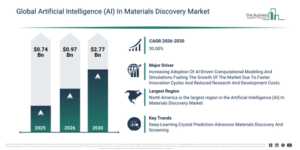
The market size for artificial intelligence (AI) in materials discovery has experienced exponential growth in recent years. It is projected to increase from $0.74 billion in 2025 to $0.97 billion in 2026, advancing at a compound annual growth rate (CAGR) of 30.3%. This expansion during the historic period can be attributed to several factors, including the increasing integration of computational modeling, the expanding availability of digital materials datasets, a rise in investment towards artificial intelligence-based research, the broader application of machine learning in laboratories, and a growth in industry-academia collaborations.
The artificial intelligence (AI) in materials discovery market is poised for significant expansion in the coming years. Its valuation is projected to reach $2.77 billion in 2030, exhibiting a compound annual growth rate (CAGR) of 30.0%. This anticipated growth during the forecast period stems from factors such as the increasing need for rapid discovery of advanced materials, the growing demand for high-performance energy storage materials, the wider adoption of generative artificial intelligence models, the expanding use of cloud-based simulation platforms, and the escalating urgency to reduce research and development timelines. Key trends anticipated for this period encompass breakthroughs in multimodal artificial intelligence models, pioneering efforts in high-throughput computational screening, the evolution of autonomous laboratory systems, dedicated research and development into materials-focused foundation models, and advancements in quantum-enhanced materials simulations.
Get A Free Sample Report With In-Depth Market Insights:
Artificial Intelligence (AI) In Materials Discovery Market Growth Factors Behind Sustained Expansion
The future expansion of the artificial intelligence (AI) in materials discovery market is anticipated, driven by the rising uptake of AI-powered computational modeling and simulations. These AI-driven tools leverage machine learning and computational algorithms to forecast material characteristics, engineer novel compounds, and refine structures, thereby lessening the dependence on conventional experimental methods. The growing adoption of AI-driven modeling is a response to the escalating demand on research bodies and industries to speed up innovation and decrease expenses associated with development. The field of AI in materials discovery facilitates this progression through capabilities like efficient virtual screening, precise property forecasting, and swift identification of new substances. An example illustrates this: in September 2023, the Ames National Laboratory, a US government research facility, reported that AI-based modeling accelerated calculations by 100× over first-principles methods, leading to the discovery of 16 novel P-rich compounds. Consequently, the expanding use of AI-driven computational modeling and simulations is propelling the expansion of the artificial intelligence (AI) in materials discovery market.
Artificial Intelligence (AI) In Materials Discovery Market Segment Analysis Spotlighting Growth Areas
The artificial intelligence (AI) in materials discovery market covered in this report is segmented –
1) By Offering: Software, Hardware, Services
2) By Material Type: Polymers, Metals and Alloys, Ceramics, Composites, Nanomaterials, Semiconductors
3) By Technology: Machine Learning, Deep Learning, Generative Artificial Intelligence, Natural Language Processing
4) By Deployment Mode: On Premise, Cloud Based, Hybrid
5) By End-User: Chemical Companies, Pharmaceutical Companies, Research Institutions, Manufacturing Companies, Other End-Users
Subsegments:
1) By Software: Predictive Modeling Platforms, Materials Simulation Tools, Data Analytics Systems, Molecular Design Software, Materials Informatics Platforms
2) By Hardware: High Performance Computing Systems, Graphics Processing Units, Specialized Accelerators, Data Storage Servers, Workstations For Computational Modeling
3) By Services: Consulting And Integration, Custom Model Development, Data Management Services, Simulation And Testing Services, Training And Support
Artificial Intelligence (AI) In Materials Discovery Market Industry Trends Fueling Future Revenue Growth
Companies operating in the artificial intelligence (AI) in materials discovery market are primarily concentrating on advancing large-scale crystal structure prediction, such as deep-learning-driven exploration of new crystalline compounds, to broaden the accessible chemical space, accelerate material identification, and enhance computational screening workflows. Large-scale crystal structure prediction refers to the utilization of graph-based neural networks and algorithmic exploration systems that generate, evaluate, and rank millions of hypothetical crystal structures based on known stability and performance criteria. For instance, in November 2023, Google DeepMind, a UK-based artificial intelligence company, introduced GNoME, an AI-powered materials discovery system that predicted 2.2 million new crystal structures and identified approximately 380,000 as potentially stable. This system uses graph neural networks to model atomic interactions, integrates active learning to continuously refine predictions, and applies high-accuracy density functional theory (DFT) checks to validate structural stability. This launch signifies a substantial advancement in computational materials discovery by expanding the collection of known stable crystals, speeding up early-stage screening, and enabling researchers to discover candidates with promising functional properties across diverse material classes.
Artificial Intelligence (AI) In Materials Discovery Market Competitive Analysis Of Leading Industry Participants
Major companies operating in the artificial intelligence (AI) in materials discovery market are Google LLC, Microsoft Corporation, BASF SE, International Business Machine Corp, Dassault Systèmes, Nautilus Materials Inc., Schrödinger Inc., Enthought Inc., Citrine Informatics Inc., Iktos SA, Quantum Motion, Aionics Inc., Exabyte.io, Materials Zone Ltd., Aionics Inc., Polymerize AG, Atinary Technologies GmbH, Phaseshift Technologies, Polaron Analytics, Kebotix Inc.
View The Full Artificial Intelligence (AI) In Materials Discovery Market Report:
Artificial Intelligence (AI) In Materials Discovery Market Geographic Spread And Regional Opportunities
North America was the largest region in the artificial intelligence (AI) in materials discovery market in 2025. Asia-Pacific is expected to be the fastest-growing region in the forecast period. The regions covered in the artificial intelligence (AI) in materials discovery market report are Asia-Pacific, South East Asia, Western Europe, Eastern Europe, North America, South America, Middle East, Africa.
Reach Out To Our Team:
The Business Research Company: https://www.thebusinessresearchcompany.com/
Americas: +1 310-496-7795
Asia: +44 7882 955267 & +91 8897263534
Europe: +44 7882 955267
Email us at: marketing@tbrc.info
Follow us on:
LinkedIn: https://in.linkedin.com/company/the-business-research-company
YouTube: https://www.youtube.com/channel/UC24_fI0rV8cR5DxlCpgmyFQ
Global Market Model: https://www.thebusinessresearchcompany.com/global-market-model

Wasay has over a decade of experience in market research, data modelling, and analytics, with prior experience at GlobalData and Decision Tree Consulting Services. At The Business Research Company , he leads research operations across syndicated studies, customized consulting engagements, and the Global Market Model platform. His professional experience includes supporting organizations such as Boston Consulting Group, KPMG, and Ernst & Young. Wasay holds a degree in Electronics and Communications Engineering, postgraduate management qualifications from International Management Institute Belgium and Indian School of Business and Entrepreneurship, and completed the Integrated Program in Business Analytics from Indian Institute of Management Indore.