
Enhanced with market attractiveness analysis, total addressable market evaluation, company benchmarking matrices, interactive Excel dashboards, expanded supply chain intelligence, emerging startup coverage, and detailed product insights, The Business Research Company’s 2026 market reports deliver more actionable and strategically valuable research.
Artificial Intelligence (AI) In Materials Discovery Market Size Outlook: How Fast Will Revenue Grow Through 2030?
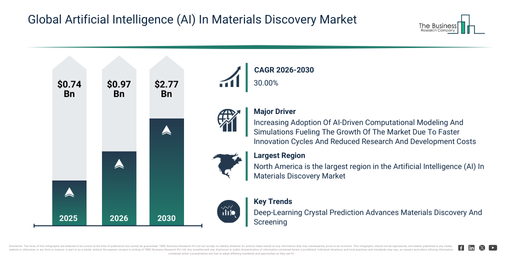
The scale of the artificial intelligence (AI) in materials discovery market has seen rapid expansion over recent years. This market is projected to expand from $0.74 billion in 2025 to reach $0.97 billion by 2026, demonstrating a compound annual growth rate (CAGR) of 30.3%. Historically, this growth can be linked to factors such as the greater acceptance of computational modeling, the expanding volume of digital materials datasets, increased financial commitment to artificial intelligence-driven research, the broader application of machine learning within laboratories, and enhanced partnerships between industry and academia.
The artificial intelligence (AI) in materials discovery market is projected to experience rapid expansion over the coming years. This market is set to achieve $2.77 billion by 2030, propelled by a compound annual growth rate (CAGR) of 30.0%. The anticipated growth during this forecast period stems from an escalating requirement for expedited discovery of advanced materials, a rising demand for high-performance energy storage materials, increasing adoption of generative artificial intelligence models, expanding deployment of cloud-based simulation platforms, and mounting pressure to reduce research and development cycles. Prominent trends within this forecast span include advancements in multimodal artificial intelligence models, innovations in high-throughput computational screening, the evolution of autonomous laboratory systems, focused research and development in materials-focused foundation models, and progress in quantum-enhanced materials simulations.
Download A Free Sample Report For Comprehensive Market Insights:
Artificial Intelligence (AI) In Materials Discovery Market Industry Drivers: What Is Driving Revenue Growth?
The expanding integration of AI-powered computational modeling and simulations is anticipated to fuel the advancement of the artificial intelligence (AI) in materials discovery market moving forward. These AI-driven approaches utilize machine learning and computational algorithms to forecast material attributes, engineer novel compounds, and optimize structures, thereby lessening reliance on conventional trial-and-error experimentation. The uptake of AI-based modeling is escalating due to mounting pressure on research institutions and industries to accelerate innovation and reduce development costs. AI in materials discovery supports this progression by enabling high-throughput virtual screening, precise property prediction, and swift identification of new materials. For instance, in September 2023, the Ames National Laboratory, a US-based government research lab, stated that AI-based modeling achieved a speed-up of 100× compared to first-principles calculations, successfully identifying 16 new P-rich compounds. Consequently, the rising adoption of AI-driven computational modeling and simulations is propelling the growth of the artificial intelligence (AI) in materials discovery market.
Artificial Intelligence (AI) In Materials Discovery Market Segmentation Trends And Revenue Drivers
The artificial intelligence (AI) in materials discovery market covered in this report is segmented –
1) By Offering: Software, Hardware, Services
2) By Material Type: Polymers, Metals and Alloys, Ceramics, Composites, Nanomaterials, Semiconductors
3) By Technology: Machine Learning, Deep Learning, Generative Artificial Intelligence, Natural Language Processing
4) By Deployment Mode: On Premise, Cloud Based, Hybrid
5) By End-User: Chemical Companies, Pharmaceutical Companies, Research Institutions, Manufacturing Companies, Other End-Users
Subsegments:
1) By Software: Predictive Modeling Platforms, Materials Simulation Tools, Data Analytics Systems, Molecular Design Software, Materials Informatics Platforms
2) By Hardware: High Performance Computing Systems, Graphics Processing Units, Specialized Accelerators, Data Storage Servers, Workstations For Computational Modeling
3) By Services: Consulting And Integration, Custom Model Development, Data Management Services, Simulation And Testing Services, Training And Support
Artificial Intelligence (AI) In Materials Discovery Market Trends: What Is Shaping Future Industry Growth?
Major companies active in the artificial intelligence (AI) in materials discovery market are concentrating on advancing large-scale crystal structure prediction, specifically through deep-learning-driven exploration of new crystalline compounds. This focus aims to expand the discoverable chemical space, accelerate the identification of materials, and refine computational screening methodologies. Large-scale crystal structure prediction refers to the application of graph-based neural networks and algorithmic exploration systems that generate, evaluate, and rank millions of hypothetical crystal structures against predefined stability and performance standards. As an illustration, in November 2023, Google DeepMind, an artificial intelligence company based in the UK, launched GNoME, an AI-powered system for materials discovery that predicted 2.2 million novel crystal structures and identified approximately 380,000 as potentially stable. The system employs graph neural networks to simulate atomic interactions, integrates active learning for ongoing refinement of predictions, and applies high-accuracy density functional theory (DFT) checks to validate structural stability. This introduction signifies a major stride in computational materials discovery by increasing the inventory of known stable crystals, expediting early-stage screening, and enabling researchers to uncover promising functional property candidates across diverse material classes.
#Artificial Intelligence (AI) In Materials Discovery Market Industry Leaders: Which Organizations Are Driving Competition?
Major companies operating in the artificial intelligence (AI) in materials discovery market are Google LLC, Microsoft Corporation, BASF SE, International Business Machine Corp, Dassault Systèmes, Nautilus Materials Inc., Schrödinger Inc., Enthought Inc., Citrine Informatics Inc., Iktos SA, Quantum Motion, Aionics Inc., Exabyte.io, Materials Zone Ltd., Aionics Inc., Polymerize AG, Atinary Technologies GmbH, Phaseshift Technologies, Polaron Analytics, Kebotix Inc.
Access The Complete Artificial Intelligence (AI) In Materials Discovery Market Report:
Artificial Intelligence (AI) In Materials Discovery Market Geographic Analysis: Where Is Demand Growing The Fastest?
North America was the largest region in the artificial intelligence (AI) in materials discovery market in 2025. Asia-Pacific is expected to be the fastest-growing region in the forecast period. The regions covered in the artificial intelligence (AI) in materials discovery market report are Asia-Pacific, South East Asia, Western Europe, Eastern Europe, North America, South America, Middle East, Africa.
Get in touch with us:
The Business Research Company: https://www.thebusinessresearchcompany.com/
Americas: +1 310-496-7795
Asia: +44 7882 955267 & +91 8897263534
Europe: +44 7882 955267
Email us at: marketing@tbrc.info
Follow us on:
LinkedIn: https://in.linkedin.com/company/the-business-research-company
YouTube: https://www.youtube.com/channel/UC24_fI0rV8cR5DxlCpgmyFQ
Global Market Model: https://www.thebusinessresearchcompany.com/global-market-model

Wasay has over a decade of experience in market research, data modelling, and analytics, with prior experience at GlobalData and Decision Tree Consulting Services. At The Business Research Company , he leads research operations across syndicated studies, customized consulting engagements, and the Global Market Model platform. His professional experience includes supporting organizations such as Boston Consulting Group, KPMG, and Ernst & Young. Wasay holds a degree in Electronics and Communications Engineering, postgraduate management qualifications from International Management Institute Belgium and Indian School of Business and Entrepreneurship, and completed the Integrated Program in Business Analytics from Indian Institute of Management Indore.