Featuring market attractiveness scoring, total addressable market sizing, company benchmarking matrices, interactive Excel dashboards, deeper supply chain intelligence, emerging startup tracking, and granular product-level insights, The Business Research Company’s 2026 market reports are built to deliver research that is both more actionable and more strategically valuable.
Robotic Laser Welding Cells Market Growth Potential: How Will Market Size Shift Through 2030?
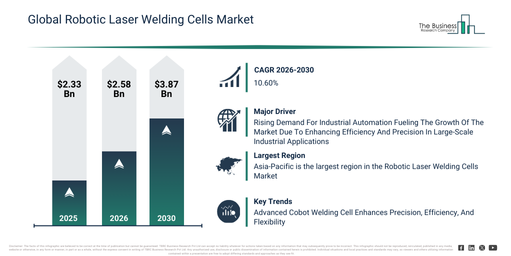
The robotic laser welding cells market has seen rapid expansion in recent years. It is anticipated to grow from $2.33 billion in 2025 to $2.58 billion in 2026, exhibiting a compound annual growth rate (CAGR) of 10.9%. The historical period’s growth can be linked to factors such as increased automation adoption in automotive manufacturing, a heightened demand for precision welding in electronics, a growing shift from manual to robotic welding, broader industrial laser integration, and an intensified focus on production efficiency.
The market for robotic laser welding cells is projected to experience substantial expansion over the upcoming years, with expectations to reach $3.87 billion by 2030, exhibiting a compound annual growth rate (CAGR) of 10.6%. This anticipated growth during the forecast period is driven by several factors, including increasing capital allocation towards factory automation, an escalating need for high-precision laser welding in the e-mobility sector, wider integration of automated welding processes in metal fabrication, the broader deployment of robotics within small and medium-sized manufacturing facilities, and a growing emphasis on achieving zero-defect production. Key developments expected during this timeframe encompass improvements in laser power and beam delivery systems, novel compact robotic welding cell designs, progress in AI-driven weld monitoring systems, ongoing research and development in adaptive laser welding techniques, and the incorporation of digital twin technology into welding cell operations.
Get A Free Sample Report With In-Depth Market Insights:
Robotic Laser Welding Cells Market Growth Factors Behind Sustained Expansion
Continued growth in the robotic laser welding cells market is anticipated due to the increasing need for industrial automation. Industrial automation encompasses the application of control systems, machinery, software, and robotics for operating and overseeing industrial processes with limited human involvement. The escalating requirement for industrial automation stems from the pursuit of enhanced operational efficiency, as businesses strive to curtail expenses, decrease errors, and amplify productivity. Increased infrastructure development benefits robotic laser welding cells, facilitating accurate and rapid welding for extensive construction and industrial ventures, thus making them suitable for contemporary infrastructure uses. These cells enhance construction effectiveness through the provision of uniform, precise welds, thereby cutting down on manual labor and shortening project schedules. As an illustration, data from September 2025, provided by the International Federation of Robotics, a non-profit organization located in Germany, indicated that 4,664,000 robotic units were operational in factories worldwide in 2024, representing a 9% rise from 4,281,585 units recorded in 2023. Consequently, the increasing need for industrial automation is fueling the expansion of the robotic laser welding cells market.
Robotic Laser Welding Cells Market Segments: Where Is Growth Concentrated?
The robotic laser welding cells market covered in this report is segmented –
1) By Component: Robot Arm, Laser Source, Controller, Safety Enclosure, Other Components
2) By Cell Type: Standalone Cells, Integrated Cells, Modular Cells
3) By Laser Type: Fiber Laser, Carbon Dioxide (CO₂) Laser, Diode Laser, Other Laser Types
4) By Payload Capacity: Low, Medium, High
5) By End-User: Automotive, Aerospace, Electronics, Metal Fabrication, Heavy Machinery, Other End-Users
Subsegments:
1) By Robot Arm: Articulated Robot Arm, Cartesian Robot Arm, Delta Robot Arm, Gantry Robot Arm, Parallel Robot Arm, Collaborative Robot Arm
2) By Laser Source: Fiber Laser Source, Carbon Dioxide Laser Source, Diode Laser Source, Solid State Crystal Laser Source, Disk Laser Source, Ultrafast Pulsed Laser Source
3) By Controller: Programmable Logic Controller, Robot Motion Controller, Laser Process Controller, Human–Machine Interface, Distributed Control System, Safety Interlock Controller
4) By Safety Enclosure: Fixed Safety Enclosure, Interlocked Safety Door, Protective Shielding Enclosure, Fume Extraction Enclosure, Access Control System, Light Curtain Protection
5) By Other Components: Fixturing And Workholding, Vision Inspection System, Tool Changer Unit, Cooling And Chiller System, Fume Extraction Unit, Material Handling Conveyor, Sensors And Monitoring Devices, Electrical Cabling And Connectors
Robotic Laser Welding Cells Market Industry Trends Fueling Future Revenue Growth
Leading companies in the robotic laser welding cells market are prioritizing the development of advanced systems, such as cobot laser welding systems, to enhance efficiency, increase flexibility, and lessen manual labor and production costs. Cobot laser welding systems are collaborative robotic cells that integrate high-speed laser processing with intuitive, safe human-robot interaction for accurate joining and surface cleaning applications. As an illustration, in May 2024, IPG Photonics Corporation, a US-based manufacturer of high-performance fiber lasers and laser systems, unveiled the LightWELD Cobot Laser Welding and Cleaning System. This fully integrated, portable system features a collaborative robot arm paired with IPG’s proprietary LightWELD laser welder. The system incorporates a patented vision-based alignment tool that simplifies programming and ensures precise weld placement, substantially reducing setup time and the likelihood of rework. Furthermore, it includes automated parameter selection and a safety-rated, contactless scanning system, facilitating rapid switching between welding and cleaning functions without needing operator intervention.
Robotic Laser Welding Cells Market Leading Companies And Competitive Benchmarking
Major companies operating in the robotic laser welding cells market are Panasonic Corporation, Mitsubishi Electric Corporation, ABB Ltd., Kawasaki Heavy Industries Ltd., Trumpf Group, FANUC Corporation, Lincoln Electric Holdings Inc., Yaskawa Electric Corporation, Amada Holdings Co. Ltd., Han’s Laser Technology Industry Group Co. Ltd., Nachi-Fujikoshi Corp., Daihen Corporation, IPG Photonics Corporation, Miller Electric Mfg. LLC, Prima Power, Fronius International GmbH, Mazak Optonics Corporation, IGM Robotersysteme AG, Wuhan Golden Laser Co. Ltd., Jenoptik AG, ERLAS Erlanger Lasertechnik GmbH, SENFENG Laser, Alpha Laser GmbH, HSG Laser Co. Ltd., INNO Robotics Co. Ltd.
View The Full Robotic Laser Welding Cells Market Report:
Robotic Laser Welding Cells Market Largest Region By Revenue And Market Share
Asia-Pacific was the largest region in the robotic laser welding cells market in 2025. North America is expected to be the fastest-growing region in the forecast period. The regions covered in the robotic laser welding cells market report are Asia-Pacific, South East Asia, Western Europe, Eastern Europe, North America, South America, Middle East, Africa.
Reach Out To Our Team:
The Business Research Company: https://www.thebusinessresearchcompany.com/
Americas: +1 310-496-7795
Asia: +44 7882 955267 & +91 8897263534
Europe: +44 7882 955267
Email us at: marketing@tbrc.info
Follow us on:
LinkedIn: https://in.linkedin.com/company/the-business-research-company
YouTube: https://www.youtube.com/channel/UC24_fI0rV8cR5DxlCpgmyFQ
Global Market Model: https://www.thebusinessresearchcompany.com/global-market-model

Wasay has over a decade of experience in market research, data modelling, and analytics, with prior experience at GlobalData and Decision Tree Consulting Services. At The Business Research Company , he leads research operations across syndicated studies, customized consulting engagements, and the Global Market Model platform. His professional experience includes supporting organizations such as Boston Consulting Group, KPMG, and Ernst & Young. Wasay holds a degree in Electronics and Communications Engineering, postgraduate management qualifications from International Management Institute Belgium and Indian School of Business and Entrepreneurship, and completed the Integrated Program in Business Analytics from Indian Institute of Management Indore.