Backed by market attractiveness analysis, total addressable market sizing, company benchmarking matrices, interactive Excel dashboards, wider supply chain intelligence, emerging startup coverage, and detailed product-level insights, The Business Research Company’s 2026 market reports are designed to offer research that is more actionable and strategically valuable than ever.
Robotic Spot Welding Cell Market Expansion Outlook: What Revenue Opportunities Are Ahead?
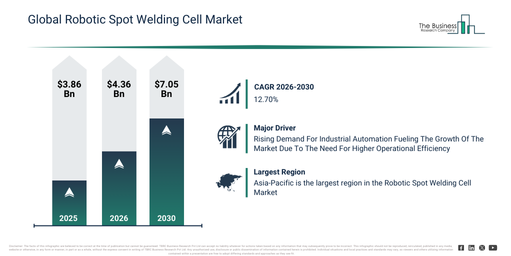
The robotic spot welding cell market has experienced rapid expansion in recent years. Its value is set to rise from $3.86 billion in 2025 to $4.36 billion in 2026, at a compound annual growth rate (CAGR) of 13.0%. The growth observed in the past can be attributed to increased automation adoption within automotive welding, the growing necessity for consistent weld quality, an uptick in demand for high-volume metal fabrication, the expanding utilization of industrial robots in manufacturing lines, and a noticeable transition from manual to robotic spot welding operations.
The robotic spot welding cell market is anticipated to experience substantial growth in the upcoming years, with its size projected to reach $7.05 billion by 2030, exhibiting a compound annual growth rate (CAGR) of 12.7%. This expansion during the forecast period is propelled by the increasing integration of AI-enabled welding controls, a greater focus on enhancing production efficiency, rising investments in automated assembly systems, the expanding deployment of modular robotic welding cells, and the rapid adoption of Industry 4.0 automation. Significant developments expected in this period include technological advancements in multi-robot welding coordination, innovations in adaptive welding control software, progress in real-time weld monitoring analytics, research and development efforts in energy-efficient welding systems, and technological improvements in cobot-based spot welding cells.
Get A Free Sample Report With In-Depth Market Insights:
Robotic Spot Welding Cell Market Growth Drivers: What’s Behind The Acceleration?
The increasing need for industrial automation is projected to drive the expansion of the robotic spot welding cells market in the coming years. Industrial automation involves utilizing control systems, machines, software, and robotics to manage and oversee industrial operations with minimal human involvement. This demand is growing because businesses seek greater operational efficiency, aiming to lower costs, decrease errors, and enhance productivity. Robotic spot welding cells bolster industrial automation by providing precise, consistent welds, thereby boosting production efficiency and uniformity across manufacturing lines. They also reduce manual work by automating repetitive joining tasks, which increases output, lowers defect rates, and improves overall facility productivity. For example, the International Federation of Robotics, a non-profit organization based in Germany, reported in September 2025 that 4,664,000 robotic units were operational in factories worldwide in 2024, representing a 9% rise from 4,281,585 units in 2023. Consequently, the expanding demand for industrial automation is a key factor in the growth of the robotic spot welding cells market. The increasing need for lightweight vehicles is projected to boost the expansion of the robotic spot welding cells market. These vehicles, made from lighter materials like aluminum, high-strength steel, carbon fiber, and composites, aim to reduce overall weight. The rising demand for them stems from the need for better fuel efficiency and lower emissions. Robotic spot welding cells improve the manufacturing of lightweight vehicles by precisely and reliably joining advanced materials like high-strength steel and aluminum. They aid in creating lighter components by providing robust, consistent welds, which enhances vehicle durability and assists car manufacturers in achieving fuel efficiency and emission goals. For instance, the American Chemistry Council, a trade association located in the US, reported in December 2024 that an average automobile incorporates 429 pounds of plastics and polymer composites, making up 9.7% of the total vehicle weight, with polypropylene content per vehicle increasing from 97 pounds in 2022 to 100 pounds in 2023. As a result, the increasing demand for lightweight vehicles is a significant factor propelling the growth of the robotic spot welding cells market.
Robotic Spot Welding Cell Market Segment Landscape: Which Areas Lead Development?
The robotic spot welding cell market covered in this report is segmented –
1) By Component: Robots, Controllers, Welding Guns, Positioners, Safety Devices, Other Components
2) By Cell Type: Standard Cells, Customized Cells, Modular Cells
3) By Application: Automotive, Aerospace, Electronics, Metal Fabrication, Other Applications
4) By End-User: Automotive Automotive Original Equipment Manufacturer (OEMs), Automotive Tier 1 And 2 Suppliers, General Manufacturing, Other End-Users
Subsegments:
1) By Robots: Articulated Industrial Robot, Gantry Mounted Robot, Collaborative Welding Robot, Scara Welding Robot, Parallel Kinematic Robot
2) By Controllers: Integrated Motion Controller, Multi Axis Robot Controller, Safety Rated Robot Controller, Welding Process Controller, Remote Monitoring Controller
3) By Welding Guns: Servo Driven Spot Welding Gun, Pneumatic Spot Welding Gun, Suspended Spot Welding Gun, C Type Spot Welding Gun, X Type Spot Welding Gun
4) By Positioners: Single Axis Weld Positioner, Dual Axis Weld Positioner, Head And Tail Stock Positioner, Turntable Weld Positioner, Elevating Rotary Positioner
5) By Safety Devices: Safety Light Curtain System, Interlocked Safety Guard, Pressure Sensitive Safety Mat, Emergency Stop Station, Safety Rated Laser Scanner
6) By Other Components: Cable Management System, Cooling And Chiller Unit, Fume Extraction System, Tool Change System, Monitoring And Diagnostic Module
Robotic Spot Welding Cell Market Competitive Analysis Of Leading Industry Participants
Major companies operating in the robotic spot welding cell market are ABB Ltd., Kawasaki Heavy Industries Ltd., FANUC Corporation, KUKA AG, Yaskawa Electric Corporation, NACHI-FUJIKOSHI Corp., Comau S.p.A., Ningbo Xin Chang Machinery Co. Ltd., T. J. Snow Company Inc., Patil Automation Private Limited, Acieta LLC, Pro Spot International Inc., Jiangsu Buswille Welding Equipment Co. Ltd., Shanghai JS Robot Co. Ltd., Winimech Technologies Private Limited, HD Hyundai Robotics Co. Ltd., Arm Welders Private Limited, Weld Master India, JP Robotics & Automation LLP, Swissweld Technologies Pvt. Ltd.
View The Full Robotic Spot Welding Cell Market Report:
Robotic Spot Welding Cell Market Geographic Distribution And Regional Opportunities
Asia-Pacific was the largest region in the robotic spot welding cell market in 2025. North America is expected to be the fastest-growing region in the forecast period. The regions covered in the robotic spot welding cell market report are Asia-Pacific, South East Asia, Western Europe, Eastern Europe, North America, South America, Middle East, Africa.
Reach Out To Our Team:
The Business Research Company: https://www.thebusinessresearchcompany.com/
Americas: +1 310-496-7795
Asia: +44 7882 955267 & +91 8897263534
Europe: +44 7882 955267
Email us at: marketing@tbrc.info
Follow us on:
LinkedIn: https://in.linkedin.com/company/the-business-research-company
YouTube: https://www.youtube.com/channel/UC24_fI0rV8cR5DxlCpgmyFQ
Global Market Model: https://www.thebusinessresearchcompany.com/global-market-model

Wasay has over a decade of experience in market research, data modelling, and analytics, with prior experience at GlobalData and Decision Tree Consulting Services. At The Business Research Company , he leads research operations across syndicated studies, customized consulting engagements, and the Global Market Model platform. His professional experience includes supporting organizations such as Boston Consulting Group, KPMG, and Ernst & Young. Wasay holds a degree in Electronics and Communications Engineering, postgraduate management qualifications from International Management Institute Belgium and Indian School of Business and Entrepreneurship, and completed the Integrated Program in Business Analytics from Indian Institute of Management Indore.