
Through market attractiveness analysis, total addressable market evaluation, company benchmarking matrices, interactive Excel dashboards, expanded supply chain intelligence, emerging startup coverage, and detailed product insights, The Business Research Company’s 2026 market reports provide more actionable and strategically valuable research.
Satellite-Based Earth Observation Market Size Forecast: How Large Could The Market Become By 2030?
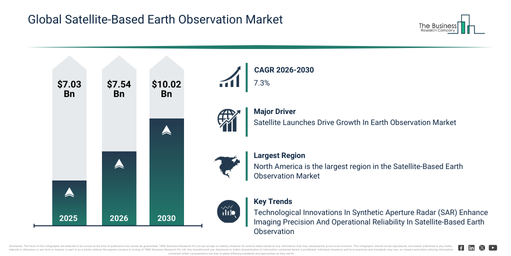
The satellite-based earth observation market has demonstrated significant expansion over the past few years. Projections indicate it will expand from $7.03 billion in 2025 to $7.54 billion in 2026, achieving a compound annual growth rate (CAGR) of 7.4%. This historical expansion is largely due to several factors: a heightened demand for weather forecasting services that encourages the deployment of earth observation satellites; an increasing use of environmental monitoring applications for climate and ecosystem analysis; growing requirements in urban planning that enhance the use of high-resolution satellite imagery; the broadening of disaster studies and emergency response operations, which benefit from real-time observational data; and continuous improvements in remote sensing technologies, which boost the accuracy and data quality of earth observation services.
The market for satellite-based earth observation is projected to experience robust expansion over the coming years. By 2030, this market is anticipated to reach a size of $10.02 billion, exhibiting a compound annual growth rate (CAGR) of 7.3%. Several factors will fuel this growth during the forecast period, including advancements in next-generation high-resolution and hyperspectral satellites that enhance analytical capabilities. Additionally, the increasing use of satellite analytics in agriculture, energy, and infrastructure sectors will broaden market applications. The integration of artificial intelligence (AI) and machine learning is improving the processing of earth observation data, while the proliferation of commercial smallsat constellations is boosting revisit rates and service availability. Furthermore, expanding international partnerships are promoting the deployment of shared earth observation platforms. Key trends anticipated for this period encompass a rising need for real-time environmental monitoring, an expansion in applications for disaster management and risk assessment, and a greater utilization in urban planning and smart city development. Other significant trends involve its adoption in precision agriculture and resource management, alongside the continuous development of multi-sensor and high-resolution imaging satellites.
Download A Free Sample Report For Comprehensive Market Insights:
Satellite-Based Earth Observation Market Growth Momentum: Which Factors Are Influencing Demand?
The expanding volume of satellite launches is projected to stimulate the growth of the satellite-based earth observation market going forward. A satellite is a device launched into orbit around Earth or another celestial body for various purposes, including gathering information, navigation, and scientific research. Satellites are equipped with sensors to observe and capture images of the Earth’s surface for multiple uses, such as weather forecasting, and environmental and climate change monitoring. For instance, in June 2025, according to the Orbital Today, a UK-based specialist in space industry news with a primary focus on the UK and European space sectors, reported that global satellite launches between January and April 2025 have dramatically increased to historical peaks, with a total surpassing 1,200 satellites. This signifies a roughly 50% year-on-year increase compared to approximately the 800 satellites launched during the same months in 2024. Therefore, the rising number of satellite launches is propelling the expansion of the satellite-based earth observation market.
Satellite-Based Earth Observation Market Segment Landscape: Which Areas Lead Market Development?
The satellite-based earth observation market covered in this report is segmented –
1) By Product Type: Earth Observation (EO) Data, Value Added Services
2) By Satellite Orbit: Low Earth Orbit, Medium Earth Orbit, Geostationary Orbit
3) By Technology: Optical, Synthetic Aperture Radar
4) By Payload Type: Electro-Optical Or Infra-Red (EO Or IR), Imaging, Navigation
5) By End-User: Defense And Intelligence, Infrastructure And Engineering, Agriculture, Energy And Power, Other End-Users
Subsegments:
1) By Earth Observation (EO) Data: Optical Satellite Data, Radar Satellite Data, Hyperspectral Satellite Data, Thermal Infrared Satellite Data, LiDAR Data
2) By Value Added Services: Data Processing and Analysis, Geographic Information Systems (GIS) Services, Data Visualization Services, Consulting Services, Custom Application Development
Satellite-Based Earth Observation Market Trends: What Is Shaping Future Industry Growth?
Major companies engaged in the satellite-based Earth observation market are concentrating on developing advanced solutions, such as high-resolution SAR imaging, to enhance data accuracy, expand mission versatility, and strengthen real-time monitoring capabilities. High-resolution SAR refers to a technology that captures detailed surface imagery irrespective of weather or lighting conditions, enabling continuous observation for defense, intelligence, and environmental applications. For instance, in September 2025, ICEYE, a satellite imaging company based in Finland, introduced its Generation 4 Synthetic Aperture Radar satellite, providing 25 cm resolution imaging for precise target detection. The system offers all-weather, day-and-night observation capability and improved support for strategic monitoring needs, having been designed to deliver superior imaging performance and operational resilience.
Satellite-Based Earth Observation Market Competitive Landscape: Who Are The Leading Companies?
Major companies operating in the satellite-based earth observation market are Raytheon Technologies Corporation, Lockheed Martin Corp., Airbus SE, BAE Systems Plc, Thales Group, L3Harris Technologies Inc., Israel Aerospace Industries Ltd., Viasat, Maxar Technologies Inc., MDA Corporation, Planet Labs Inc., Spire Global, BlackSky Global, Iceye, EOS Data Analytics, RS Metrics, D-Orbit, Descartes Labs, UrtheCast, Orbital Insight, GHGSat, Satellogic SA, GomSpace, SkyWatch Inc., Global Surface Intelligence Ltd., PlanetiQ Inc., GeoOptics Inc., ImageSat International N.V, Capella Space, HawkEye 360
Access The Complete Satellite-Based Earth Observation Market Report:
Satellite-Based Earth Observation Market Leading Geography: Which Region Generates The Most Revenue?
North America was the largest region in the satellite-based earth observation market in 2025. The regions covered in the satellite-based earth observation market report are Asia-Pacific, South East Asia, Western Europe, Eastern Europe, North America, South America, Middle East, Africa.
Access a Customized Satellite-Based Earth Observation Market Report for Deeper Competitive Insights
https://www.thebusinessresearchcompany.com/customise?id=12553&type=smp
The Business Research Company: https://www.thebusinessresearchcompany.com/
Americas: +1 310-496-7795
Asia: +44 7882 955267 & +91 8897263534
Europe: +44 7882 955267
Email us at: marketing@tbrc.info
Follow us on:
LinkedIn: https://in.linkedin.com/company/the-business-research-company
YouTube: https://www.youtube.com/channel/UC24_fI0rV8cR5DxlCpgmyFQ
Global Market Model: https://www.thebusinessresearchcompany.com/global-market-model

Wasay has over a decade of experience in market research, data modelling, and analytics, with prior experience at GlobalData and Decision Tree Consulting Services. At The Business Research Company , he leads research operations across syndicated studies, customized consulting engagements, and the Global Market Model platform. His professional experience includes supporting organizations such as Boston Consulting Group, KPMG, and Ernst & Young. Wasay holds a degree in Electronics and Communications Engineering, postgraduate management qualifications from International Management Institute Belgium and Indian School of Business and Entrepreneurship, and completed the Integrated Program in Business Analytics from Indian Institute of Management Indore.
