
Delivering more actionable and strategically valuable research, The Business Research Company’s 2026 market reports feature market attractiveness analysis, total addressable market evaluation, company benchmarking matrices, interactive Excel dashboards, expanded supply chain intelligence, emerging startup coverage, and detailed product insights.
Satellite-based Augmentation System Market Revenue Outlook: What CAGR Is Expected Through 2030?
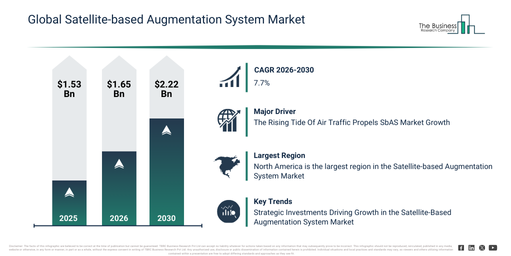
The market for satellite-based augmentation systems has experienced robust expansion over recent years. This market is projected to expand from $1.53 billion in 2025 to reach $1.65 billion in 2026, demonstrating a compound annual growth rate (CAGR) of 8.0%. This historical growth stems from several key factors, including a greater uptake of GNSS augmentation for enhancing navigation accuracy and ensuring integrity in aviation uses, the increasing utilization of ionospheric correction services, which improve the dependability of satellite navigation signals, an expansion in soil condition monitoring and geo-traceability applications that broaden SBAS’s usefulness beyond just aviation, the broadening of system monitoring and maintenance services that contribute to sustained operational performance over time, and progress in regional SBAS implementations leading to better service coverage and greater availability.
The satellite-based augmentation system market is anticipated to experience substantial growth in the coming years. It is projected to reach $2.22 billion by 2030, exhibiting a compound annual growth rate (CAGR) of 7.7%. This expansion during the forecast period stems from several factors, including the advancement of next-generation SBAS architectures, which enhance precision and compatibility across multiple constellations. Additionally, the increasing demand for highly accurate navigation in autonomous and unmanned systems is propelling SBAS adoption. The growing integration of SBAS capabilities in sectors like agriculture and infrastructure monitoring is further broadening its market presence. Global modernization initiatives that support the rollout of new and upgraded SBAS networks also contribute significantly, alongside progress in real-time correction algorithms that boost responsiveness and system resilience. Key trends expected over this period involve the expansion of aviation navigation services, a surge in maritime navigation and fleet management, greater integration into precision agriculture, the growing application in timing and synchronization for telecommunication networks, and the continued development of regional and future satellite augmentation systems.
Download A Free Sample Report For Comprehensive Market Insights:
Satellite-based Augmentation System Market Expansion Drivers: What Is Shaping Future Growth?
The expansion of air traffic is anticipated to fuel the growth of the satellite-based augmentation system market in the future. Air traffic encompasses the organized movement and supervision of aircraft within designated airspace, managed by air traffic control (ATC) to ensure secure and efficient operations. These aircraft movements and general air traffic supply crucial real-world validation, facilitate data collection, and offer user feedback, all of which enhance the precision, reliability, and overall functioning of satellite-based augmentation systems (SBAS), thereby bolstering aviation safety and operational efficiency. A case in point is the report from the International Air Transport Association, a Canada-based organization supporting the global airline industry, published in January 2025. It indicated that the total full-year traffic for 2024, measured in revenue passenger kilometers (RPKs), saw a significant increase of 10.4% compared to 2023. Consequently, the rising volume of air traffic serves as a key impetus for the expansion of the satellite-based augmentation system market.
Satellite-based Augmentation System Market Segments: Where Are The Largest Growth Opportunities?
The satellite-based augmentation system market covered in this report is segmented –
1) By Type: Wide Area Augmentation System (WAAS), European Geostationary Navigation Overlay Service (EGNOS), Multi-functional Satellite Augmentation System (MSAS), GPS Aided GEO Augmented Navigation (GAGAN), System For Differential Corrections And Monitoring (SDCM), Other Types
2) By Component: Satellites, Ground Stations, Receivers, Other Components
3) By Application: Aviation, Maritime, Road And Rail, Surveying, Timing And Synchronization, Agriculture, Other Applications
Subsegments:
1) By Wide Area Augmentation System (WAAS): Aviation WAAS, Non-Aviation WAAS Applications
2) By European Geostationary Navigation Overlay Service (EGNOS): EGNOS For Aviation, EGNOS For Land And Sea Applications
3) By Multi-Functional Satellite Augmentation System (MSAS): MSAS For Aviation, MSAS For Land Applications
4) By GPS Aided Geo Augmented Navigation (GAGAN): GAGAN For Aviation, GAGAN For Maritime Applications
5) By System For Differential Corrections And Monitoring (SDCM): SDCM For Land Navigation, SDCM For Maritime Navigation
6) By Other Types: Regional Augmentation Systems, Future Augmentation Systems
Satellite-based Augmentation System Market Industry Trends Shaping Future Revenue Growth
Leading companies active in the satellite-based augmentation system market are concentrating on strategic financial commitments to boost the manufacturing of novel satellite-based augmentation systems. These strategic investments in the satellite-based augmentation system market result in improved production efficiency, foster new product development, reduce running expenses, and expand market presence. Such initiatives empower businesses to address increasing demand and strengthen their market competitiveness. For example, in January 2024, Thales Alenia Space, an aerospace company located in France, unveiled the enhanced European Geostationary Navigation Overlay Service (EGNOS) V242B, an advanced iteration of Europe’s satellite-based augmentation system. This updated version delivers a significant performance boost through the integration of next-generation ground receiving stations, offering heightened safeguarding from ionospheric disturbances and geomagnetic storms, and providing a tenfold reduction in false alerts linked to GPS corrections. The upgrade substantially enhances positioning precision, user safety, and operational reliability for applications across the aviation, maritime, and precision agriculture sectors, thereby underscoring continuous innovation and capital expenditure within the satellite-based augmentation system market.
Satellite-based Augmentation System Market Company Landscape And Strategic Competition
Major companies operating in the satellite-based augmentation system market are RTX Corporation (Raytheon Technologies Corporation), Lockheed Martin Corporation, Airbus SE, Northrop Grumman Corporation, Honeywell International Inc., Broadcom Corporation, Safran Group, Federal Aviation Administration (FAA), Thales Group, L3Harris Technologies Inc., STMicroelectronics N.V., Elbit Systems Ltd., Rockwell Collins Inc., Garmin Ltd., Trimble Inc., Collins Aerospace, Topcon Corporation, Inmarsat Global Limited, u-Blox Holding AG, Spirent Communications Plc, GMV Innovating Solutions S.L., NovAtel Inc., Universal Avionics Systems Corporation, Accord Software & Systems Pvt. Ltd., Swift Navigation Inc., Hemisphere GNSS, Grintex India Limited, Septentrio NV, Locosys Technology Inc., NexNav Inc., NavatechGPS
Access The Complete Satellite-based Augmentation System Market Report:
Satellite-based Augmentation System Market Regional Outlook: Where Are The Largest Opportunities Located?
North America was the largest region in the satellite-based augmentation system market in 2025. Asia-Pacific is expected to be the significant growing region in the forecast period. The regions covered in the satellite-based augmentation system market report are Asia-Pacific, South East Asia, Western Europe, Eastern Europe, North America, South America, Middle East, Africa.
Access a Customized Satellite-based Augmentation System Market Report for Deeper Competitive Insights
https://www.thebusinessresearchcompany.com/customise?id=12433&type=smp
The Business Research Company: https://www.thebusinessresearchcompany.com/
Americas: +1 310-496-7795
Asia: +44 7882 955267 & +91 8897263534
Europe: +44 7882 955267
Email us at: marketing@tbrc.info
Follow us on:
LinkedIn: https://in.linkedin.com/company/the-business-research-company
YouTube: https://www.youtube.com/channel/UC24_fI0rV8cR5DxlCpgmyFQ
Global Market Model: https://www.thebusinessresearchcompany.com/global-market-model

Wasay has over a decade of experience in market research, data modelling, and analytics, with prior experience at GlobalData and Decision Tree Consulting Services. At The Business Research Company , he leads research operations across syndicated studies, customized consulting engagements, and the Global Market Model platform. His professional experience includes supporting organizations such as Boston Consulting Group, KPMG, and Ernst & Young. Wasay holds a degree in Electronics and Communications Engineering, postgraduate management qualifications from International Management Institute Belgium and Indian School of Business and Entrepreneurship, and completed the Integrated Program in Business Analytics from Indian Institute of Management Indore.
