Backed by market attractiveness analysis, total addressable market sizing, company benchmarking matrices, interactive Excel dashboards, wider supply chain intelligence, emerging startup coverage, and detailed product-level insights, The Business Research Company’s 2026 market reports are designed to offer research that is more actionable and strategically valuable than ever.
Long-Chain Polyamide Market Value Analysis: What Growth Lies Ahead Over The Forecast Period?
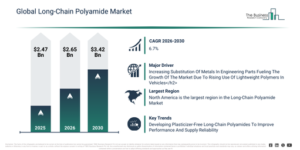
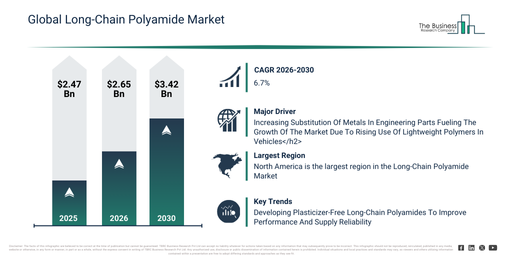
The long-chain polyamide market has experienced substantial growth in recent years. Its valuation is projected to increase from $2.47 billion in 2025 to $2.65 billion in 2026, achieving a compound annual growth rate (CAGR) of 7.0%. This historical expansion can be attributed to several factors, including the increasing demand for lightweight materials, the rising use of high-performance polymers, growing adoption in automotive applications, an increased focus on fuel efficiency, and the progressive development of durable plastic components.
The long-chain polyamide market is projected to experience robust expansion over the coming years. By 2030, this market is anticipated to reach $3.42 billion, exhibiting a compound annual growth rate (CAGR) of 6.7%. This projected growth during the forecast period stems from several factors, including an increased demand for sustainable high-performance polymers, an escalating emphasis on electric vehicle components, continuous advancements in chemical processing technologies, a heightened need for high-strength lightweight materials, and expanding investment in material innovation. Key trends expected during this period encompass progress in bio-based polyamide production, novel developments in long-chain polymer formulations, the incorporation of high-performance materials into contemporary manufacturing processes, improvements in recycling technologies for engineered plastics, and creative approaches to lightweight polymer design.
Get A Free Sample Report With In-Depth Market Insights:
Long-Chain Polyamide Market Demand Drivers: What’s Powering Industry Growth?
The long-chain polyamide market is anticipated to grow as a result of the increasing replacement of metals in engineering components. The substitution of metals in engineering parts signifies the adoption of high-performance polymers in place of traditional metallic elements to achieve reduced weight, enhanced resistance to corrosion, and greater manufacturing efficiency. The escalating substitution of metals in engineering parts stems from the demand for lightweight and cost-effective materials. Long-chain polyamide aids this growing substitution by providing high strength, durability, and lightweight characteristics, making it possible to use cost-effective and corrosion-resistant alternatives in mechanical and structural uses. For instance, in December 2024, the American Chemistry Council, a US-based trade association, reported that a typical automobile contains 429 pounds of plastics and polymer composites, making up 9.7% of the vehicle’s total weight, with polypropylene per vehicle increasing from 97 pounds in 2022 to 100 pounds in 2023. Thus, the growing substitution of metals in engineering parts is fostering the expansion of the long-chain polyamide market.
Long-Chain Polyamide Market Segment Outlook: Which Categories Are Growing Fastest?
The long-chain polyamide market covered in this report is segmented –
1) By Product Type: PA 12, PA 11, PA 610, PA 612, Other Product Types
2) By Form: Chips, Powder, Other Forms
3) By Application: Fuel Lines, Cooler Hoses, Corrugated Tubes, Oil And Gas Transportation, Sensors And Solenoids, Other Applications
4) By End-User: Automotive, Electrical And Electronics, Consumer Goods, Industrial, Other End-Users
Subsegments:
1) By PA 12: Extrusion-Grade PA 12, Injection-Molding-Grade PA 12, Blow-Molding-Grade PA 12, High-Viscosity PA 12, Flame-Retardant PA 12, Reinforced PA 12 (Glass Fiber, Carbon Fiber), Flexible PA 12 Compounds
2) By PA 11: Bio-Based PA 11 (100% Renewable Feedstock), Injection-Molding-Grade PA 11, Extrusion-Grade PA 11, High-Temperature PA 11, Impact-Modified PA 11, Reinforced PA 11 (Glass Fiber, Mineral Filled)
3) By PA 610: Extrusion-Grade PA 610, Injection-Molding-Grade PA 610, Heat-Stabilized PA 610, Oil-Resistant PA 610, Lightweight PA 610 Compounds, Reinforced PA 610 (Glass Fiber, Carbon Fiber)
4) By PA 612: Injection-Molding-Grade PA 612, Extrusion-Grade PA 612, Low-Moisture-Absorption PA 612, High-Fluidity PA 612, Reinforced PA 612 Compounds, Wear-Resistant PA 612 Grades
5) By Other Product Types: PA 1010, PA 1012, PA 46/PA 410 Blends, Bio-Based Long-Chain Polyamides (Non-PA11), Specialty Copolyamides, Customized Performance LCPA Compounds
Long-Chain Polyamide Market Innovation Trends: What Developments Are Reshaping The Industry?
Leading companies in the long-chain polyamide materials market are concentrating their efforts on creating sophisticated materials, such as plasticizer-free long-chain polyamides, with the aim of enhancing thermal capabilities, boosting sustainability, and decreasing dependence on imported specialized resins. These plasticizer-free long-chain polyamides represent advanced nylon innovations designed to provide exceptional flexibility, chemical resilience, and elevated operational temperatures without the need for plasticizing additives, simultaneously enabling greater bio-based content and more stable domestic supply networks. For example, in April 2024, Nylon Corporation of America Inc., a US-based manufacturer of engineered nylon resin, introduced NXTamid L. This proprietary plasticizer-free long-chain polyamide was developed to serve as an alternative to PA11 and PA12. The material offers a higher service temperature than PA12, comparable or superior mechanical performance, and adaptable formulations, all while eliminating plasticizers and incorporating bio content exceeding 50% in specific grades to meet sustainability objectives and mitigate supply chain disruptions.
Long-Chain Polyamide Market Leading Companies And Competitive Benchmarking
Major companies operating in the long-chain polyamide market are BASF SE, LG Chem Ltd., Mitsubishi Chemical Group Corporation, Toray Industries Inc., Evonik Industries AG, DuPont de Nemours Inc., Arkema S.A., Nan Ya Plastics Corporation, Ningbo Kingfa Advanced Materials Co. Ltd., Solvay S.A, Huntsman Corporation, Kolon Industries Inc, Ascend Performance Materials LLC, Toyobo Co. Ltd, Sanyo Chemical Industries Ltd., Ensinger GmbH, RadiciGroup S.p.A., Domo Chemicals GmbH, Nylon Corporation of America Inc., UBE Corporation, Shenzhen Esun Industrial Co. Ltd.
View The Full Long-Chain Polyamide Market Report:
Long-Chain Polyamide Market Largest Region By Revenue And Market Share
North America was the largest region in the long-chain polyamide market in 2025. Asia-Pacific is expected to be the fastest-growing region in the forecast period. The regions covered in the long-chain polyamide market report are Asia-Pacific, South East Asia, Western Europe, Eastern Europe, North America, South America, Middle East, Africa.
Reach Out To Our Team:
The Business Research Company: https://www.thebusinessresearchcompany.com/
Americas: +1 310-496-7795
Asia: +44 7882 955267 & +91 8897263534
Europe: +44 7882 955267
Email us at: marketing@tbrc.info
Follow us on:
LinkedIn: https://in.linkedin.com/company/the-business-research-company
YouTube: https://www.youtube.com/channel/UC24_fI0rV8cR5DxlCpgmyFQ
Global Market Model: https://www.thebusinessresearchcompany.com/global-market-model

Wasay has over a decade of experience in market research, data modelling, and analytics, with prior experience at GlobalData and Decision Tree Consulting Services. At The Business Research Company , he leads research operations across syndicated studies, customized consulting engagements, and the Global Market Model platform. His professional experience includes supporting organizations such as Boston Consulting Group, KPMG, and Ernst & Young. Wasay holds a degree in Electronics and Communications Engineering, postgraduate management qualifications from International Management Institute Belgium and Indian School of Business and Entrepreneurship, and completed the Integrated Program in Business Analytics from Indian Institute of Management Indore.