Built to provide research that’s more actionable and strategically valuable, The Business Research Company’s 2026 market reports include market attractiveness analysis, total addressable market sizing, company benchmarking matrices, interactive Excel dashboards, broader supply chain intelligence, emerging startup tracking, and in-depth product insights.
Lithium-Ion Battery Recycling Market Revenue Outlook: What CAGR Lies Ahead Through 2030?
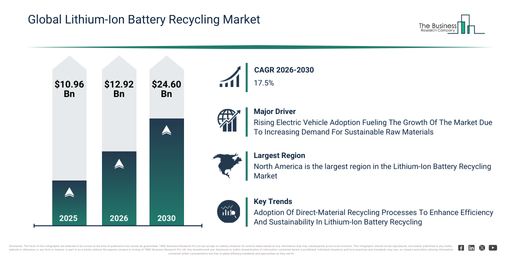
The lithium-ion battery recycling market has shown rapid expansion in recent years. Its value is projected to rise from $10.96 billion in 2025 to $12.92 billion in 2026, demonstrating a compound annual growth rate (CAGR) of 17.8%. Historically, this growth can be ascribed to several factors, including the increasing volume of EV battery waste, a growing need for recovered metals, heightened pressure for sustainable disposal methods, the expansion of circular-economy initiatives, and increasing regulatory compliance requirements.
The lithium-ion battery recycling market is anticipated to experience substantial expansion over the upcoming years, reaching $24.60 billion by 2030, exhibiting a compound annual growth rate (CAGR) of 17.5%. This projected increase is driven by factors such as the rising global adoption of electric vehicles (EVs), the escalating demand for recovering lithium and cobalt, a heightened emphasis on closed-loop production methods, the proliferation of large-scale recycling operations, and the implementation of more supportive government recycling initiatives. Key developments during this timeframe are expected to encompass technological progress in hydrometallurgy, innovations in automated sorting, improvements in high-efficiency material extraction, research into battery-material purification, and enhancements in advanced pyrometallurgical processes.
Get A Free Sample Report With In-Depth Market Insights:
Lithium-Ion Battery Recycling Market Growth Factors Behind Sustained Expansion
The future expansion of the lithium-ion battery recycling market is anticipated to be significantly influenced by the rising integration of electric vehicles (EVs). These vehicles are automobiles propelled by one or more electric motors, drawing power from rechargeable batteries rather than traditional internal combustion engines. The widespread embrace of electric vehicles is growing, primarily driven by a decrease in battery expenses. This reduction in the cost of lithium-ion batteries over time stems from advancements in technology, benefits from economies of scale, and enhanced manufacturing techniques, thereby making EVs more economical and available to consumers. The process of lithium-ion battery recycling is crucial for handling used EV batteries, enabling the reclamation of precious metals like lithium, cobalt, and nickel, which in turn diminishes environmental harm and safeguards natural resources. An illustration of this trend is observed in 2024 when, as per the International Energy Agency (IEA), a France-based intergovernmental organization, electric car sales in 2023 surpassed those in 2022 by 3.5 million units, indicating a 35% year-on-year increase. Consequently, the increasing prevalence of electric vehicles is a key factor fueling the expansion of the lithium-ion battery recycling market.
Lithium-Ion Battery Recycling Market Segments: Where Is Growth Concentrated?
The lithium-ion battery recycling market covered in this report is segmented –
1) By Battery Chemistry Type: Lithium-Nickel Manganese Cobalt, Lithium-Iron Phosphate, Lithium-Manganese Oxide, Lithium-Nickel Cobalt Aluminum Oxide, Other Battery Chemistry Types
2) By Source Of Batteries: Consumer Electronics, Electric Vehicles, Energy Storage Systems, Power Tools, Industrial Equipment
3) By Material Recovered: Base Metals And Others, Graphite, Lithium, Cobalt And Nickel
4) By Recycling Process Or Method: Hydrometallurgical Recycling, Pyrometallurgical Recycling, Direct Recycling
5) By End User: Automotive Original Equipment Manufacturer (OEMs), Battery Manufacturers, Recycling Companies, Metal And Chemical Producers, Energy Storage Providers, Other End Users
Subsegments:
1) By Lithium-Nickel Manganese Cobalt: High Nickel Cathode Cells, Medium Nickel Cathode Cells, Low Nickel Cathode Cells, Recycled Cathode Material Streams
2) By Lithium-Iron Phosphate: Power Grade Phosphate Cells, Energy Grade Phosphate Cells, Recycled Phosphate Cathode Materials, Refurbished Phosphate Battery Packs
3) By Lithium-Manganese Oxide: High Power Manganese Cells, Spinel Structure Manganese Cells, Recycled Manganese Cathode Materials, Blended Manganese Battery Packs
4) By Lithium-Nickel Cobalt Aluminum Oxide: High Energy Aluminum Cells, High Power Aluminum Cells, Recycled Aluminum Cathode Materials, Refurbished Aluminum Based Packs
5) By Other Battery Chemistry Types: Lithium-Titanate (LTO), Lithium-Cobalt Oxide (LCO), Lithium-Sulfur, Emerging And Hybrid Lithium Chemistries
Lithium-Ion Battery Recycling Market Industry Trends Fueling Future Revenue Growth
Prominent companies in the lithium-ion battery recycling sector are concentrating on developing sophisticated solutions, such as direct-material recycling processes, to enhance material recovery, decrease environmental harm, and boost cost-effectiveness. These direct-material recycling processes involve techniques that keep the active battery components intact during recycling, differing from conventional methods that disassemble batteries into their constituent metals, which leads to superior reuse efficiency and reduced energy for processing. For example, in March 2024, 24M Technologies, a battery technology firm based in Massachusetts, unveiled Liforever, an inventive direct-material recycling process tailored for semi-solid lithium-ion batteries. This technology is engineered to efficiently recover cathode and anode materials while preserving their structural soundness. Liforever accommodates various battery chemistries, including lithium iron phosphate (LFP) and nickel-rich types, facilitating the re-lithiation and subsequent reuse of active materials, thereby minimizing waste and enhancing sustainability.
Lithium-Ion Battery Recycling Market Key Participants And Competitive Landscape
Major companies operating in the lithium-ion battery recycling market are Glencore plc, BASF SE, Contemporary Amperex Technology Recycling Co. Ltd., Umicore SA, Sumitomo Metal Mining Co. Ltd., Zhejiang Huayou Cobalt Co. Ltd., EcoPro CNG Co. Ltd., Northvolt AB, Toho Zinc Co. Ltd., Redwood Materials Inc., Ascend Elements Inc., Lohum Cleantech Pvt. Ltd., Attero Recycling Pvt. Ltd., ACCUREC Recycling GmbH, Neometals Ltd., American Battery Technology Company, SungEel HiTech Co. Ltd., Redux Recycling GmbH, SNAM S.p.A., Brunp Recycling Technology Co. Ltd., JX Nippon Mining & Metals Corporation, Duesenfeld GmbH, GEM Co. Ltd., Primobius GmbH, TES Sustainable Battery Solutions
View The Full Lithium-Ion Battery Recycling Market Report:
Lithium-Ion Battery Recycling Market Geographic Analysis: Where Is Demand Accelerating Fastest?
North America was the largest region in the lithium-ion battery recycling market in 2025. Asia-Pacific is expected to be the fastest-growing region in the forecast period. The regions covered in the lithium-ion battery recycling market report are Asia-Pacific, South East Asia, Western Europe, Eastern Europe, North America, South America, Middle East, Africa.
Reach Out To Our Team:
The Business Research Company: https://www.thebusinessresearchcompany.com/
Americas: +1 310-496-7795
Asia: +44 7882 955267 & +91 8897263534
Europe: +44 7882 955267
Email us at: marketing@tbrc.info
Follow us on:
LinkedIn: https://in.linkedin.com/company/the-business-research-company
YouTube: https://www.youtube.com/channel/UC24_fI0rV8cR5DxlCpgmyFQ
Global Market Model: https://www.thebusinessresearchcompany.com/global-market-model

Wasay has over a decade of experience in market research, data modelling, and analytics, with prior experience at GlobalData and Decision Tree Consulting Services. At The Business Research Company , he leads research operations across syndicated studies, customized consulting engagements, and the Global Market Model platform. His professional experience includes supporting organizations such as Boston Consulting Group, KPMG, and Ernst & Young. Wasay holds a degree in Electronics and Communications Engineering, postgraduate management qualifications from International Management Institute Belgium and Indian School of Business and Entrepreneurship, and completed the Integrated Program in Business Analytics from Indian Institute of Management Indore.