Featuring market attractiveness scoring, total addressable market sizing, company benchmarking matrices, interactive Excel dashboards, deeper supply chain intelligence, emerging startup tracking, and granular product-level insights, The Business Research Company’s 2026 market reports are built to deliver research that is both more actionable and more strategically valuable.
Entertainment Augmented Reality (AR) And Virtual Reality (VR) System On A Chip (SoC) Market CAGR Outlook And Future Development
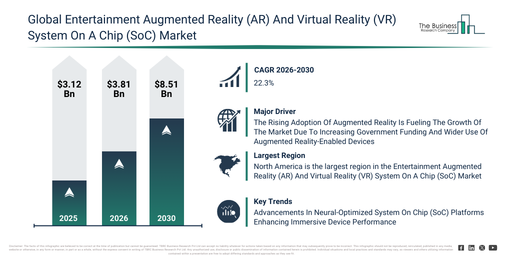
The entertainment augmented reality (AR) and virtual reality (VR) system-on-a-chip (SoC) market size has experienced significant expansion in recent years. This market is projected to grow from $3.12 billion in 2025 to $3.81 billion in 2026, indicating a compound annual growth rate (CAGR) of 22.1%. The historical growth in this sector can be attributed to factors such as increasing demand for immersive entertainment experiences, the advancement of gaming and media industries, breakthroughs in GPU and AI accelerator technologies, the widespread adoption of wearable and head-mounted displays, and the early implementation of standalone and tethered AR/VR systems.
The entertainment augmented reality (ar) and virtual reality (vr) system on a chip (soc) market is projected to expand significantly over the coming years. Its valuation is set to reach $8.51 billion by 2030, exhibiting a compound annual growth rate (CAGR) of 22.3%. This expansion during the projection period stems from factors such as a rising appetite for sophisticated immersive gaming, the broadening scope of mixed and extended reality applications, the incorporation of 5G and Wi-Fi 6/7 technologies into SoCs, an increase in consumer entertainment and media content creation, and the uptake of energy-efficient, high-performance SoC solutions. Key developments anticipated for this forecast timeframe encompass the optimization of SoC power efficiency, enhanced low-latency processing, support for advanced graphics rendering, the integration of sensor fusion and motion tracking, and the wider adoption of SoCs in wearable devices and Head-Mounted Displays (HMDs).
Get A Free Sample Report With In-Depth Market Insights:
Entertainment Augmented Reality (AR) And Virtual Reality (VR) System On A Chip (SoC) Market Growth Factors Behind Sustained Expansion
The increasing use of augmented reality (AR) is anticipated to boost the expansion of the entertainment augmented reality (AR) and virtual reality (VR) system on a chip (SoC) market in the future. Augmented reality (AR) is defined as a technology that superimposes digital data, visuals, or interactive elements onto the physical world instantaneously via devices like smartphones, smart glasses, or head-mounted displays. Demand for augmented reality (AR) is growing, driven by the expanding uptake of AR-enabled smartphones and wearables, which provide accessible immersive experiences for both individual users and businesses. AR facilitates real-time interactive overlays, improved visuals, and spatial effects by allowing high-performance graphics processing, sensor fusion, and low-latency computing directly on the chip. For example, in August 2024, the Government Accountability Office (GAO), a US-based nonpartisan agency, reported that funding in fiscal year 2022 was $8.6 million and in fiscal year 2023 was $11.5 million. Of this total funding spanning fiscal year 2022 to fiscal year 2023, about one-third, or 36%, was directed specifically to augmented reality and virtual reality technologies. Consequently, the increasing embrace of augmented reality (AR) is propelling the expansion of the entertainment augmented reality (AR) and virtual reality (VR) system on a chip (SoC) market.
Entertainment Augmented Reality (AR) And Virtual Reality (VR) System On A Chip (SoC) Market Segment Analysis: What Are The Core Market Categories?
The entertainment augmented reality (ar) and virtual reality (vr) system on a chip (soc) market covered in this report is segmented –
1) By Type: Augmented Reality (AR) Focused System on a Chip (SoC), Virtual Reality (VR) Focused System on a Chip (SoC), Standalone System on a Chip (SoC) Configurations, Tethered System on a Chip (SoC) Configurations, High-End System on a Chip (SoC), Mid-Range System on a Chip (SoC), Low-End System on a Chip (SoC)
2) By Technology Type: Virtual Reality (VR) Systems, Augmented Reality (AR) Systems, Mixed Reality (MR) Or Pass-Through Systems
3) By Connectivity And Integration Level: 5G-Enabled System on a Chip (SoC), Wi-Fi 6 Or Wi-Fi 7 Integrated System on a Chip (SoC), Edge Computing Integrated System on a Chip (SoC)
4) By Application: Game, Video, Other Applications
5) By End-User: Consumer Entertainment Users, Media And Entertainment Companies, Gaming Studios
Subsegments:
1) By Augmented Reality Focused System on a Chip (SoC): Standalone Configurations, Tethered Configurations, High-End Configurations, Mid-Range Configurations, Low-End Configurations
2) By Virtual Reality Focused System on a Chip (SoC): Standalone Configurations, Tethered Configurations, High-End Configurations, Mid-Range Configurations, Low-End Configurations
3) By Standalone System on a Chip (SoC) Configurations: High-End Configurations, Mid-Range Configurations, Low-End Configurations
4) By Tethered System on a Chip (SoC) Configurations: High-End Configurations, Mid-Range Configurations, Low-End Configurations
5) By High-End System on a Chip (SoC): Standalone Configurations, Tethered Configurations
6) By Mid-Range System on a Chip (SoC): Standalone Configurations, Tethered Configurations
7) By Low-End System on a Chip (SoC): Standalone Configurations, Tethered Configurations
Entertainment Augmented Reality (AR) And Virtual Reality (VR) System On A Chip (SoC) Market Industry Trends Fueling Future Revenue Growth
Major companies operating in the entertainment augmented reality (AR) and virtual reality (VR) system on a chip (SoC) market are concentrating on technological advancements, such as neural-optimized real-time rendering engines integrated into next-generation system on chip (SoC) platforms. These advanced chip frameworks combine high-performance graphics processing, artificial intelligence (AI) acceleration, and multiple sensor concurrency to deliver ultra-realistic interactive visuals with low latency for immersive headset experiences. For instance, in January 2024, Qualcomm Incorporated, a US-based semiconductor company, introduced the Snapdragon XR2+ Gen 2 Platform. The Snapdragon XR2 Plus Gen 2 platform provides superior visual fidelity by supporting ultra-high-resolution displays and advanced spatial tracking, enabling more realistic and immersive augmented reality and virtual reality experiences. It enhances performance and thermal efficiency to sustain intensive processing workloads required for premium standalone head-mounted devices in gaming and entertainment applications. The platform is designed to power next-generation mixed reality systems and expand the performance capabilities of immersive consumer devices across interactive and experiential use cases.
Entertainment Augmented Reality (AR) And Virtual Reality (VR) System On A Chip (SoC) Market Industry Leaders And Competitive Landscape
Major companies operating in the entertainment augmented reality (ar) and virtual reality (vr) system on a chip (soc) market are Apple Inc., Samsung Electronics Co. Ltd., Meta Platforms Inc, NVIDIA Corporation, Intel Corporation, QUALCOMM Incorporated, Advanced Micro Devices Inc., Texas Instruments Incorporated, MediaTek Inc., NXP Semiconductors N.V., Synopsys Inc., Marvell Technology Group Ltd., Realtek Semiconductor Corp., Himax Technologies, VeriSilicon Holdings Co. Ltd., Allwinner Technology Co. Ltd., Ambarella Inc., Rockchip Electronics Co. Ltd., SiFive Inc., and OMLogic Ltd.
View The Full Entertainment Augmented Reality (AR) And Virtual Reality (VR) System On A Chip (SoC) Market Report:
Entertainment Augmented Reality (AR) And Virtual Reality (VR) System On A Chip (SoC) Market Regional Analysis And Top Geography
North America was the largest region in the entertainment AR/VR system on a chip (SoC) market in 2025. Asia-Pacific is expected to be the fastest-growing region in the forecast period. The regions covered in the entertainment augmented reality (ar) and virtual reality (vr) system on a chip (soc) market report are Asia-Pacific, South East Asia, Western Europe, Eastern Europe, North America, South America, Middle East, Africa.
Reach Out To Our Team:
The Business Research Company: https://www.thebusinessresearchcompany.com/
Americas: +1 310-496-7795
Asia: +44 7882 955267 & +91 8897263534
Europe: +44 7882 955267
Email us at: marketing@tbrc.info
Follow us on:
LinkedIn: https://in.linkedin.com/company/the-business-research-company
YouTube: https://www.youtube.com/channel/UC24_fI0rV8cR5DxlCpgmyFQ
Global Market Model: https://www.thebusinessresearchcompany.com/global-market-model

Wasay has over a decade of experience in market research, data modelling, and analytics, with prior experience at GlobalData and Decision Tree Consulting Services. At The Business Research Company , he leads research operations across syndicated studies, customized consulting engagements, and the Global Market Model platform. His professional experience includes supporting organizations such as Boston Consulting Group, KPMG, and Ernst & Young. Wasay holds a degree in Electronics and Communications Engineering, postgraduate management qualifications from International Management Institute Belgium and Indian School of Business and Entrepreneurship, and completed the Integrated Program in Business Analytics from Indian Institute of Management Indore.